
Imagine walking into a local Rosedale shop only to have a hidden hazard send you to the emergency room with life-altering injuries. You are now facing a mountain of medical bills and lost wages, all while a massive insurance company tries to minimize your trauma. Simply getting hurt on someone else’s property doesn’t guarantee compensation. Successfully proving landowner negligence in NY requires a strategic approach to demonstrate that the owner failed in their duty of care. It’s a high-stakes battle where the burden of proof rests squarely on your shoulders.
We know the anxiety that comes with being vulnerable against powerful entities. This guide is your roadmap to understanding the exact legal requirements and evidence needed to hold a negligent New York property owner accountable. You will learn about the critical “Notice” requirement, the specific documentation you must preserve right now, and how a local advocate can act as your shield. We’ll move through the complexities of premises liability together, turning your confusion into a decisive plan for restoration and justice.
Key Takeaways
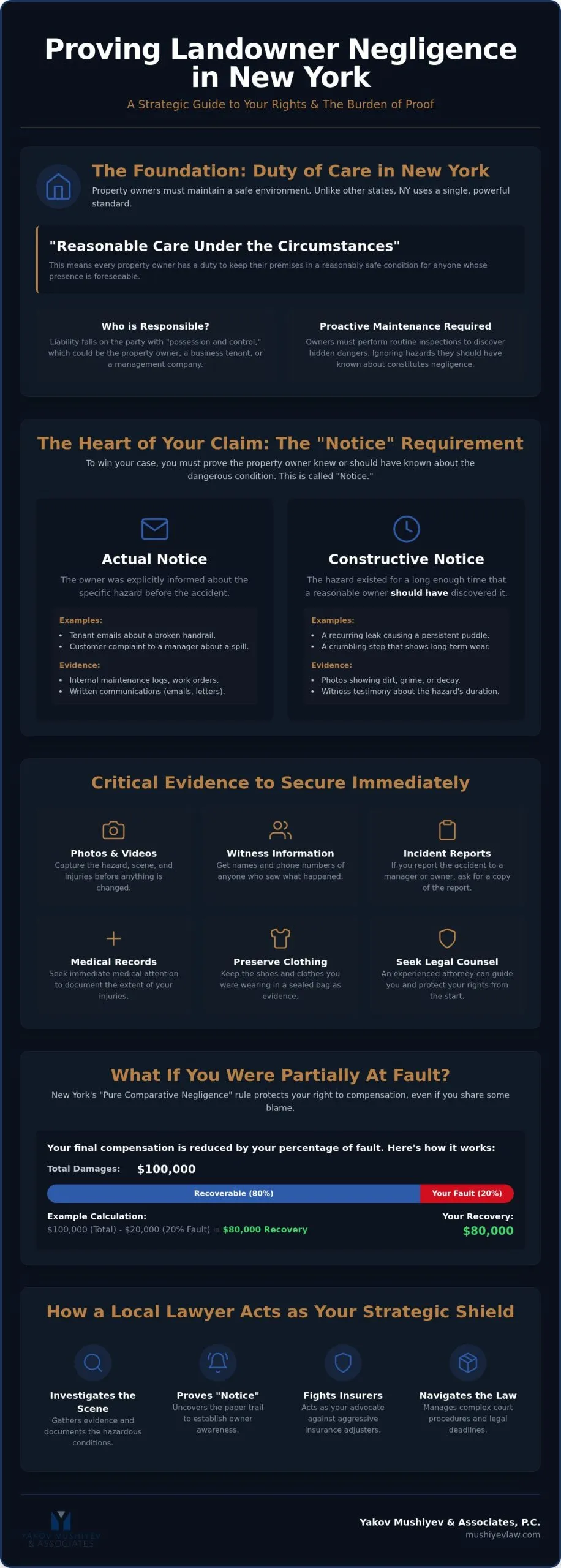
- Understand the legal duty of care that New York property owners owe to every visitor and how this foundation supports your claim.
- Master the critical “Notice” requirement, which serves as the most essential element for proving landowner negligence in NY.
- Identify the specific, time-sensitive evidence you must secure immediately before a negligent landlord has the chance to alter the accident scene.
- Discover how New York’s pure comparative negligence rules protect your right to compensation even if you were partially at fault for your injury.
- Learn why local Queens legal expertise provides a strategic shield when navigating complex court procedures and aggressive insurance adjusters.
The Foundation of Premises Liability: Duty of Care in New York
Your right to a safe environment is protected by New York law, but that protection isn’t automatic. To hold someone accountable, you must first understand the legal obligation they owed you. In many states, your legal status, whether you were a business guest or a social visitor, determines your rights. New York is different. Since 1976, our courts have applied a single standard of “reasonable care under the circumstances.” This means every property owner has a duty to keep their premises in a reasonably safe condition for anyone whose presence is foreseeable.
Successfully proving landowner negligence in NY requires more than just showing you were injured. It requires demonstrating that the owner failed to act as a prudent person would have in the same situation. Landowners aren’t “insurers” of your safety; they aren’t responsible for every freak accident. However, they are responsible when they ignore hazards that they knew, or should have known, existed. Whether you are at a private home in Rosedale or a major commercial hub in Queens, the owner’s duty remains the same: identify risks and fix them before someone gets hurt.
Who Is Responsible? Identifying the Negligent Party
Identifying the right defendant is the first hurdle in any premises liability claim. Liability often rests with the party who has “possession and control” of the area where you fell. In a commercial setting, a lease might shift the responsibility from the landlord to the business tenant for interior spills, while the landlord remains liable for structural issues like crumbling ceilings. Property management companies also play a role; they are often the entities tasked with daily maintenance and repairs. If you are injured on a public sidewalk in NYC, Administrative Code Section 7-210 typically shifts the liability from the City to the adjacent commercial or large residential property owner, adding another layer of complexity to your case.
The Scope of Reasonable Maintenance
Reasonable maintenance is a proactive requirement. Owners cannot simply wait for a complaint to act. They must perform routine inspections to discover hidden dangers like loose floorboards or dim stairwell lighting. Negligence often takes the form of inadequate security or poor visibility in high-traffic areas. When proving landowner negligence in NY, we meticulously examine maintenance logs to see if the owner ignored their own safety protocols. When weather strikes, the rules become even more specific. Under NYC Administrative Code 16-123, property owners generally have a four-hour window after precipitation stops to clear snow and ice. If they fail to meet these local standards, they may be found liable for your trauma. Our firm acts as a shield during this process, ensuring that the right parties are identified and held to the strict standards New York law demands.
Proving the Owner Knew: Actual vs. Constructive Notice
In New York, the mere existence of a hazard isn’t enough to win a case. You must prove the owner had “notice.” This is the legal threshold that determines whether a landlord is liable for your injuries or if the accident is considered an unpreventable event. If the owner didn’t know about the danger, they generally aren’t responsible. However, “knowing” has two distinct legal definitions that our firm uses as a sword against negligent parties who try to deflect blame.
Notice is the heartbeat of your claim. Without it, your case will likely be dismissed before it ever reaches a jury. When proving landowner negligence in NY, we focus on whether the owner had a “reasonable opportunity” to remedy the situation. Property owners often claim they were unaware of a problem, but New York law doesn’t allow them to remain willfully blind to the conditions of their buildings. We strip away that defense by establishing exactly when the danger began.
Actual Notice: The Paper Trail
Actual notice is the most straightforward form of proof. It means the property owner, manager, or an employee was explicitly informed of the hazard before your accident occurred. This might involve a tenant who sent multiple emails about a broken handrail or a customer who told a store clerk about a spill in a grocery aisle. According to the NYC Bar on premises liability, proving actual notice often requires uncovering a paper trail. We aggressively pursue internal maintenance logs, work orders, and direct communications to show the owner ignored a known threat. If someone warned them and they did nothing, their liability is clear.
Constructive Notice: The Element of Time
Most cases rely on constructive notice, which doesn’t require a written complaint. Instead, it requires proof that a hazard existed for a long enough duration that a reasonable owner should have discovered and fixed it. For proving landowner negligence in NY, the defect must be “visible and apparent.” A puddle of water that is covered in footprints and dirt has clearly been there longer than a fresh spill. We often secure surveillance footage to establish a precise timeline. If a hazard sat unattended for forty minutes in a high-traffic area, the owner had ample time to act. Sometimes, a “recurring condition,” like a ceiling that leaks every time it rains, is enough to establish that the owner should have known a floor would be slippery. If you suspect your injury was caused by a long-standing issue, getting a risk-free case assessment can help determine if constructive notice applies to your situation.
Critical Evidence Needed to Secure Your NY Negligence Claim
The moment an accident occurs, the property owner’s priority often shifts from maintenance to damage control. Evidence in a slip and fall case is incredibly fragile. A spill is mopped, a broken tile is replaced, or a burnt-out lightbulb is swapped within hours of an injury. Successfully proving landowner negligence in NY depends entirely on the quality of the evidence you gather before the property owner has a chance to cover their tracks. You aren’t just fighting a landlord; you’re fighting an insurance company that will use any gap in your documentation to deny your claim.
While New York General Obligations Law § 9-103 outlines the legal duty of owners to keep premises safe for certain uses, the burden of proving they failed that duty rests on you. We act as your shield by helping you assemble a forensic level of proof that leaves no room for doubt. Beyond the physical scene, your medical records serve as the ultimate link between the owner’s negligence and your personal trauma. Seeking immediate medical attention creates a timestamped, professional account of your injuries. This prevents the defense from claiming your pain was a pre-existing condition or an unrelated event.
Photography and Video: Visual Proof
Your smartphone is the most powerful tool you have at the scene. Take photos of the hazard from multiple angles. Close-up shots prove the existence of the danger, but wide-angle shots are necessary to show the lack of warning signs or safety barriers. Use a common object like a coin or a key to provide scale for cracks, holes, or uneven pavement. In Queens, surveillance is everywhere. We work quickly to secure CCTV footage from nearby Rosedale businesses before the data is overwritten. This video often provides the undeniable timeline needed to establish how long a hazard existed.
Incident Reports and Documentation
Never leave the premises without filing a formal incident report with the manager or owner. This creates an official record that the event occurred at a specific time and place. Be factual and brief. Describe exactly what happened, but don’t apologize or admit fault. Avoid phrases like “I should have been more careful,” as these will be used against you later. Once you’re home, start a pain journal. Document your daily pain levels, missed work days, and the specific ways your injury prevents you from caring for your family. This personal record transforms abstract legal “damages” into a concrete narrative of how proving landowner negligence in NY is the only path to your restoration.
Understanding New York’s Comparative Negligence Rule
Insurance companies often rely on a single, powerful tactic to avoid paying your claim: they blame you. They want you to believe that if you tripped over a visible hazard or weren’t looking exactly where you stepped, you’ve lost your right to compensation. This is a myth. New York operates under a “pure comparative negligence” system. This legal framework is designed to protect victims by ensuring that even if you played a minor role in your accident, the negligent property owner is still held accountable for their share of the damage.
Under this rule, your recovery is simply reduced by your percentage of fault. If a jury determines you were 20% responsible because you were momentarily distracted by your phone, you can still recover 80% of your total damages. While proving landowner negligence in NY is our primary objective, we also act as a shield against the aggressive tactics adjusters use to inflated your fault percentage. They will scrutinize your footwear, your walking speed, and your familiarity with the area to save their bottom line. Our job is to push back and keep that percentage as low as possible.
The “Open and Obvious” Defense
Landlords frequently argue that a hazard was “open and obvious,” suggesting that any reasonable person would have seen and avoided it. In many other states, this defense can end a case instantly. In New York, it’s different. An obvious danger does not automatically absolve a landowner of their duty to maintain a safe environment. It only goes toward the issue of comparative fault. For example, a massive, gaping hole in a Rosedale parking lot might be “obvious,” but the owner is still negligent for leaving it unrepaired. We counter the “you should have seen it” argument by proving the owner had ample time to fix the hazard regardless of its visibility.
Calculating Your Recovery
The math of comparative negligence has a massive impact on your final settlement. Consider a scenario where your medical bills, lost wages, and pain and suffering total $200,000. If the defense successfully argues you were 50% at fault, your check is cut in half to $100,000. If we successfully argue you were only 10% at fault, you walk away with $180,000. The difference is significant. Because every percentage point represents real money for your family, you need a tireless advocate who knows how to minimize your fault rating in the eyes of a Queens jury. If you’re being blamed for your own injuries, contact us for a risk-free assessment of your case today.
How a Rosedale Premises Liability Lawyer Builds Your Case
Queens is a major metropolitan legal environment with its own unique procedural rhythms. Navigating the courts in Jamaica or Long Island City requires a street-smart approach that only a local advocate can provide. Yakov Mushiyev & Associates, P.C. brings decades of experience to the table for victims in Rosedale and Rochdale. We understand that proving landowner negligence in NY is a technical challenge that requires immediate, aggressive action. We don’t wait for the insurance company to offer a pittance. We build your case for a maximum verdict from the very first day.
Our firm serves as your shield against powerful entities that want to bury your claim. While the legal theory behind premises liability is clear, the execution of a successful lawsuit is complex. We treat every case with clinical precision, combining our deep legal expertise with a genuine understanding of your personal trauma. We move with a sense of urgency because we know that time is of the essence when evidence is on the line.
Expert Analysis and Reconstruction
We don’t just tell the court what happened; we prove it with science. Our firm collaborates with forensic engineers and floor safety experts who measure the “coefficient of friction” on walking surfaces and analyze structural integrity. If a staircase or railing didn’t meet specific New York City building codes, we find the violation. This technical evidence creates an undeniable narrative of the owner’s failure. By the time we present your claim to an insurance adjuster, the evidence is often so overwhelming that they have no choice but to take your injuries seriously. Successfully proving landowner negligence in NY requires this level of forensic detail to overcome the “it was just an accident” defense.
Taking the Burden Off Your Shoulders
You should focus on your physical recovery, not on arguing with hostile insurance adjusters. These companies are formidable opponents that use delay tactics and confusing jargon to wear you down. We handle every phone call, every email, and every legal filing on your behalf. This includes ensuring you don’t miss the strict New York statutes of limitations. While you generally have three years for most negligence claims, actions against a municipality like the City of New York require a Notice of Claim to be filed within just 90 days. We manage these high-stakes deadlines so you never lose your right to justice due to a clerical error.
Our commitment to your restoration is backed by our no-win, no-fee contingency arrangement. You pay nothing out of pocket to start your case. We only receive a fee if we successfully secure a settlement or verdict for you. This client-first philosophy removes the financial barrier between you and the aggressive representation you need to win. Protect your rights—schedule a free assessment with a personal injury lawyer Rosedale NY today.
Take Decisive Action Toward Your Restoration
Navigating the aftermath of a serious injury is overwhelming, but you don’t have to face powerful insurance companies alone. Successfully proving landowner negligence in NY requires a strategic combination of immediate evidence preservation and a clinical understanding of notice requirements. Whether your trauma was caused by a hidden structural defect or a long-ignored hazard, the law provides a pathway for you to reclaim your life and secure the compensation you deserve for your medical bills and lost wages.
Yakov Mushiyev & Associates, P.C. stands as a fierce shield for victims across Queens. We bring deep experience in slip and fall legal representation to every case we handle. Our aggressive advocacy ensures that your rights are protected even when negligent parties try to shift the blame. We remove the financial barrier to justice with our risk-free, no-win, no-fee promise. This means you never pay legal fees unless we win your case.
Your journey toward justice starts with a single, decisive step. Don’t let a landlord’s negligence dictate your future. Contact Yakov Mushiyev & Associates, P.C. for a Free Case Evaluation today. We are ready to fight for the full restoration you deserve.
Frequently Asked Questions
What is the statute of limitations for a premises liability claim in NY?
In New York, you generally have three years from the date of your injury to file a premises liability lawsuit. However, if your claim is against a government entity like the City of New York, the timeline is much tighter. You must file a Notice of Claim within 90 days and initiate a lawsuit within one year and 90 days. Missing these deadlines is fatal to your case. We act as your shield by ensuring every filing meets these strict requirements.
Can I sue if I fell on a wet sidewalk in front of a Queens apartment building?
Yes, you can often hold the property owner liable. Under NYC Administrative Code Section 7-210, the responsibility for maintaining sidewalks shifts from the City to the owners of adjacent commercial or multi-family residential properties. If the owner failed to address a recurring leak or didn’t clear a hazard, they are negligent. Our firm investigates the property’s history in Queens to determine exactly who is responsible for your fall and the resulting trauma.
Do I still have a case if there were no witnesses to my fall?
A lack of witnesses does not end your case. While third-party testimony is helpful, we build strong claims using forensic evidence, such as surveillance footage from nearby Rosedale businesses and your immediate medical records. These documents serve as an objective account of the accident and your injuries. Successfully proving landowner negligence in NY often relies on this technical data rather than memory alone. We move quickly to secure this evidence before it is lost or destroyed.
What if I was trespassing when I got injured on the property?
You may still have a case. Unlike many other states, New York law requires property owners to maintain a reasonably safe environment for anyone whose presence is foreseeable, regardless of their legal status. While being a trespasser may affect the owner’s ability to foresee your presence, they cannot intentionally create traps or ignore known dangers. We analyze the specific circumstances of your entry to determine if the owner breached their duty of care under NY state law.
How much is my New York slip and fall case worth?
The value of your case depends on the severity of your injuries and the financial impact on your life. We calculate damages by totaling your current and future medical bills, lost wages, and the physical pain you’ve endured. Every case is unique, and no reputable firm can guarantee a specific settlement amount. Our goal is to maximize your recovery by minimizing your fault percentage and aggressively pursuing every dollar the negligent party owes you for your restoration.
Can I sue the city if I tripped on a pothole in Rosedale?
Suing the City of New York for a pothole injury is possible but requires proving “prior written notice.” This means the City must have received a written complaint about that specific pothole at least 15 days before your accident. We search the NYC Department of Transportation’s records to find this proof. Because of the 90-day Notice of Claim requirement, you must act with urgency to protect your right to hold the City accountable for its negligence.
How do I prove the landlord knew about a broken staircase?
We prove knowledge through actual or constructive notice. Actual notice involves finding previous complaints from other tenants or internal maintenance logs. Constructive notice is established by proving the defect was visible and existed long enough that a prudent landlord should have found it during a routine inspection. When proving landowner negligence in NY, we use expert testimony to show that a broken staircase didn’t happen overnight and was a result of long-term maintenance failure.
Will my case have to go to trial to get a settlement?
Most premises liability cases are resolved through settlements rather than trials. However, we prepare every case as if it is headed to a Queens courtroom. This aggressive posture shows insurance companies that we are ready to fight for your justice and won’t settle for a low-ball offer. By building an airtight case from the start, we often force the opposition to provide a fair settlement offer long before a jury is ever empaneled.