
What If the At-Fault Driver Was Working for a Company? | NY Liability Guide
What if the driver who shattered your sense of safety wasn’t just an individual, but an employee operating under the banner of a major corporation? You might feel overwhelmed by the thought of taking on a massive business, but what if the at-fault driver was working for a company at the exact moment of the crash? This scenario changes everything about your case. It shifts the burden from a single person’s limited policy to a corporation’s deep pockets and high-limit commercial insurance.
We know you’re likely facing a wall of aggressive corporate insurance adjusters while your medical bills pile up far beyond your personal policy limits. It feels like an unfair fight, but you don’t have to face it alone. This guide shows you how to hold a business accountable and maximize your compensation when an employee causes your accident. We’ll explain how to navigate “scope of employment” rules and the impact of New York’s new AVOID Act, effective April 18, 2026, which forces defendants to identify liable parties faster than ever. From holding employers responsible for negligent hiring to unlocking commercial policy limits, we provide the roadmap to secure your recovery.
Key Takeaways
- Learn how the legal doctrine of Respondeat Superior forces New York employers to take full financial responsibility for their employees’ negligence on the road.
- Discover the specific “scope of employment” tests used to determine if your settlement can be significantly increased by asking what if the at-fault driver was working for a company at the time of the crash.
- Identify the critical electronic evidence you need to secure immediately and why a “Spoliation Letter” is the only way to stop a corporation from deleting vital data.
- Understand why commercial insurance policies often provide coverage exceeding $1 million, offering a path to recovery that far surpasses the limits of a personal auto policy.
- See how relentless legal advocacy and expert accident reconstruction can dismantle corporate defenses to ensure you receive the maximum compensation for your injuries.
Understanding Vicarious Liability and Respondeat Superior in New York
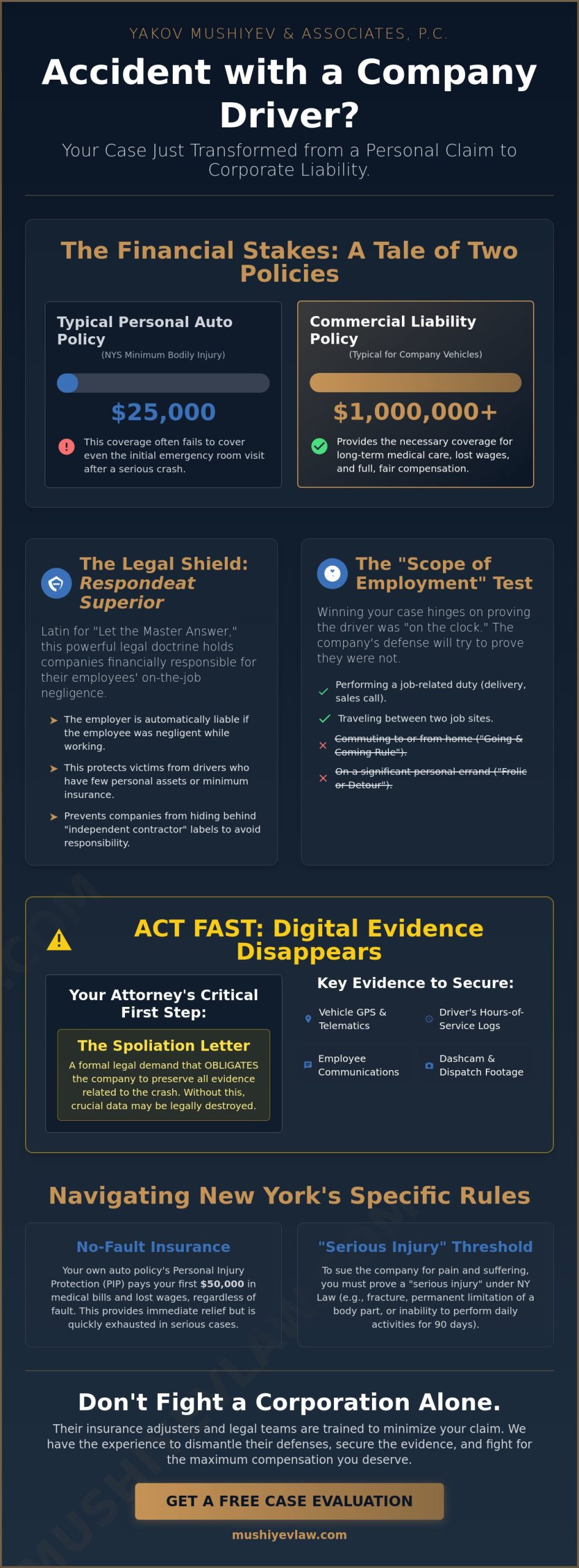
When a delivery truck or a corporate sedan strikes your vehicle, the legal landscape shifts instantly. You aren’t just dealing with a driver; you’re dealing with their employer and a massive corporate insurance policy. This is where the legal doctrine of Respondeat Superior comes into play. It literally means “let the master answer.” In New York, this principle ensures that businesses are held accountable for the negligent actions of their employees while they’re on the clock. It’s a powerful tool that transforms a standard accident into a high-stakes corporate liability claim.
To better understand how insurance coverage changes in these scenarios, watch this helpful video:
The Legal Doctrine of Vicarious Liability
You don’t have to prove the company itself was “bad” or had a history of negligent hiring to recover damages. If the employee was negligent and acting within their job duties, the company is vicariously liable. This doctrine exists because New York law recognizes that companies should bear the costs of the risks they create by putting drivers on the road. It protects victims from “judgment-proof” drivers who lack personal assets to cover catastrophic injuries. In the modern gig economy, New York courts are increasingly scrutinizing these relationships. We fight to ensure companies don’t hide behind “independent contractor” labels to avoid paying for the damage they cause.
Most individual NY drivers carry the minimum 25/50/10 coverage. That provides only $25,000 for bodily injury to one person. In a major crash, that doesn’t even cover the first night in the emergency room. What if the at-fault driver was working for a company? Commercial liability policies often start at $1 million or more. This massive difference in policy limits is often the only way for a victim to recover the full value of their claim for long-term care and lost wages.
No-Fault Interplay: Who Pays the Initial Bills?
Many victims get confused by New York’s No-Fault system. Regardless of who the driver works for, your own No-Fault insurance, also known as Personal Injury Protection, covers your initial medical bills and lost wages up to $50,000. This money is available quickly, but it’s rarely enough for serious injuries. Navigating the NY Claim Process requires a firm that knows how to bridge the gap between these initial benefits and a lawsuit against the employer.
To sue the company for pain and suffering, you must meet the “serious injury” threshold under NY Insurance Law § 5102(d). This includes fractures, permanent loss of use of a body organ, or a non-permanent injury that prevents you from performing your usual daily activities for 90 of the 180 days following the crash. Once we prove you’ve met this threshold, we shift the focus to the company’s commercial policy to secure the maximum compensation you deserve.
The “Scope of Employment” Test: Was the Driver Truly Working?
The moment a corporation realizes its employee caused an accident, its legal team begins looking for an exit strategy. Their most common tactic is claiming the driver was acting outside the “scope of employment.” This legal standard determines whether the employer is financially responsible for the crash. To win, we must prove the driver was performing a task that benefited the business or was performing a job-related duty. When you ask yourself, what if the at-fault driver was working for a company, the answer often hinges on the specific details of their route and their intent at the time of impact.
New York law generally follows the “Going and Coming” rule. This means an employer usually isn’t liable for accidents that happen during an employee’s normal commute to or from work. However, the situation changes if the company provided the vehicle or if the employee was required to use a cell phone for work during the drive. If the driver was “on-call” or responding to a professional email when they hit you, the company’s vicarious liability remains firmly in place. We dig into phone records and dispatch logs to prove the driver was tethered to their job.
Defining “Frolic” vs. “Detour” in NYC
Corporate insurers love to argue that a driver was on a “frolic.” In legal terms, a frolic is a major departure from work duties for personal reasons. If a delivery driver leaves their route in Queens to visit a relative in another borough, the company might escape liability. A “detour,” however, is a minor deviation. Stopping for gas, grabbing a quick coffee, or taking a slightly different street to avoid Midtown traffic are all considered detours. Under New York law, a detour does not sever the employer’s responsibility. We aggressively litigate these distinctions to ensure the company stays on the hook for your damages.
Negligent Hiring and Entrustment
Sometimes, the company’s liability goes deeper than just the driver’s mistake. We look for evidence of negligent hiring or entrustment. This involves suing the company for its own failures, such as:
- Hiring a driver with a history of DUIs or reckless driving.
- Failing to conduct mandatory background checks or drug screenings.
- Ignoring a driver’s repeated speeding tickets or internal safety violations.
- Failing to maintain the vehicle’s brakes, tires, or safety sensors.
These claims are powerful because they expose the company’s systemic disregard for public safety. In extreme cases, proving that a business knowingly put a dangerous driver on the road can lead to punitive damages. If you suspect a company’s negligence caused your pain, you should consult with an experienced advocate who knows how to uncover these corporate secrets. We don’t just look at the crash; we look at the culture of negligence that allowed it to happen.
Essential Evidence: Proving Corporate Responsibility in Queens
Evidence in a corporate accident case is perishable. While an individual driver might only leave behind a police report and some cell phone photos, a company vehicle is a goldmine of digital data. However, that data disappears quickly. Most corporations have internal policies for “data retention” that really serve as a convenient way to purge incriminating records. This is why our first step is always the Spoliation Letter. This legal notice forces the company and its insurer to preserve all evidence, from dashcam footage to GPS logs. If they delete it after receiving this letter, we can ask the court for “adverse inference” instructions, which essentially tells the jury to assume the deleted data proved the company was at fault.
What if the at-fault driver was working for a company and claims they were driving safely? We don’t take their word for it. We demand the telematics data. Modern commercial vehicles use sophisticated GPS tracking that records speed, braking force, and even whether the driver was wearing a seatbelt. This “black box” data provides an unbiased account of the seconds leading up to the crash. It turns a “he-said, she-said” argument into a factual demonstration of corporate negligence. We use this data to prove that the driver was rushing to meet a delivery quota or was distracted by a company-issued device.
Digital and Documentary Evidence
We look far beyond the crash site to build your case. Our investigation targets specific digital footprints that prove the driver was on the clock and under pressure. This includes:
- Electronic Logging Device (ELD) Data: For truck and delivery van drivers, these logs show exactly how long they had been behind the wheel, often exposing violations of federal hours-of-service regulations.
- Dispatch and App Timestamps: For delivery or rideshare drivers, these records prove the driver was actively engaged in a task that benefited the employer at the moment of impact.
- Employee Handbooks and Training Manuals: We compare the driver’s actions to the company’s own safety protocols. When a business fails to enforce its own rules, it establishes a clear pattern of negligence.
Witnesses and Physical Proof
Local knowledge is your greatest asset in a high-stakes litigation. We don’t just wait for the police report to arrive. Our team hits the pavement to find surveillance footage from businesses near the accident site, whether it happened on Jamaica Avenue or near the Queens Midtown Tunnel. We interview co-workers and supervisors to uncover if the driver was forced into an exhausting schedule that made an accident inevitable. You need Queens Injury Advocates Who Fight for You to ensure no stone is left unturned. We treat every piece of evidence as a weapon to secure the maximum compensation you deserve.
Why Company Vehicle Claims Offer Higher Compensation (and More Resistance)
When you realize a business is involved in your crash, the legal stakes skyrocket. You aren’t just filing a claim; you’re entering a high-stakes battle against a billion-dollar insurance entity. What if the at-fault driver was working for a company? It means the potential recovery for your injuries is significantly higher, but so is the level of hostility you’ll face from the defense. Corporate insurers don’t pay out because it’s the right thing to do. They protect their bottom line with aggressive legal teams and nearly endless resources. They view your trauma as a line item to be minimized.
The “Deep Pocket” myth often leads victims to believe a settlement will be easy. The opposite is true. Big companies have the money to fight you for years. They use New York’s pure comparative negligence rules to shift blame onto you, hoping to chip away at your final award. If they can prove you were even slightly responsible, they save hundreds of thousands of dollars. We don’t let them play these games. We position Mushiyev Law as your shield, neutralizing their tactics and forcing them to face the reality of their employee’s negligence.
The Reality of Commercial Insurance Policy Limits
In New York, the minimum liability coverage required for a personal vehicle is just $25,000 for bodily injury. That is peanuts. A single surgery or a week in a Queens hospital can wipe that out instantly. Commercial policies, however, typically start at $1,000,000. Many corporations also carry “excess” or “umbrella” layers of coverage that provide millions more in protection. This is vital when injuries result in permanent disability or require a lifetime of medical care. These high-value policies change the entire litigation strategy, requiring a firm that isn’t intimidated by large numbers or complex corporate structures.
Corporate Defense Tactics to Watch For
Expect the company to try every trick in the book to avoid liability. They often use the “Independent Contractor” defense, claiming the driver wasn’t actually an employee to sever the legal connection. They might hire private investigators to follow you, hoping to catch you performing a physical task that contradicts your injury claims. They also use intense pressure to get you to settle early. They know you’re vulnerable and facing high medical costs. They’ll offer a fraction of the claim’s true value, hoping you’ll take the quick cash and go away. Don’t sign anything without a fighter in your corner. If you want to stop the harassment and secure your future, contact our relentless legal team to protect your rights.
How Yakov Mushiyev & Associates, P.C. Fights Corporate Negligence
Taking on a corporation requires a level of aggression and technical precision that most firms simply cannot provide. We don’t just file claims; we build impenetrable cases. When you ask what if the at-fault driver was working for a company, the answer is simple: we go after the business with everything we have. At Yakov Mushiyev & Associates, P.C., we act as a necessary shield between you and the powerful insurance companies that want to silence you. We don’t back down from big corporations. We intimidate them into doing what is right.
Our firm employs a calculated strategy to dismantle corporate defenses. We hire top-tier accident reconstructionists to analyze the physics of your crash. These experts prove exactly how the company’s employee failed, leaving no room for the insurer to shift blame. This clinical precision is balanced by our deep, empathetic understanding of your trauma. We know you are in crisis. Our job is to transition you from a state of fear into a state of decisive action. We fight to win, and we don’t settle for anything less than what is fair.
Our Strategy for High-Stakes Litigation
Corporate litigation in New York is a minefield of complex paperwork and strict filing deadlines. With the recent implementation of the AVOID Act on April 18, 2026, the timeline for identifying liable parties has become even more condensed. We handle every nuance of this process so you can focus on healing. We have a proven history of Relentless Advocacy for Queens Victims, specifically serving the residents of Rosedale and Rochdale. We know the local traffic patterns of the Belt Parkway and the specific tendencies of the Queens courts. This local expertise is the edge you need to secure maximum compensation.
Start Your Recovery Today with a Free Consultation
Time is your greatest enemy in a personal injury claim. In New York, you generally have three years to file a lawsuit for a car accident. However, if the at-fault driver worked for a municipality or government agency, you must file a Notice of Claim within just 90 days of the accident. Evidence like dashcam footage and GPS logs can be deleted in an instant. You need to act now. We offer a No Win, No Fee contingency promise, meaning you pay us nothing unless we recover money for you. This is our commitment to your restoration. You will have direct access to our legal team that is tireless in its pursuit of justice. Contact Yakov Mushiyev & Associates, P.C. for a Free Case Evaluation today and let us start the fight for your future.
Take Decisive Action Against Corporate Negligence
You now understand that a crash involving a business vehicle is not a standard accident; it is a high-stakes legal battle. We have explored how vicarious liability holds employers responsible and how the “scope of employment” test determines the path to your recovery. Asking what if the at-fault driver was working for a company is the critical first step toward unlocking commercial insurance limits that far exceed the minimums of a personal policy. You don’t have to face aggressive corporate adjusters alone while you struggle with rising medical costs and physical trauma.
Yakov Mushiyev & Associates, P.C. serves as your necessary shield against powerful entities. With decades of experience in Queens personal injury litigation and deep expertise in NY labor and vehicle laws, we know how to dismantle corporate defenses. We handle the complex evidence preservation and litigation strategy so you can focus on your health. Our firm operates on a No Win, No Fee Guarantee, ensuring that you never pay a cent unless we recover the maximum compensation for your case. Your recovery starts with a single decision to fight back.
Get a Free Consultation with Yakov Mushiyev & Associates, P.C. and secure the restoration you deserve today.
Frequently Asked Questions
Can I sue an employer if their driver hit me in New York?
Yes, you can hold an employer legally responsible for your injuries under the doctrine of Respondeat Superior. If the employee was acting within the scope of their employment at the time of the crash, the company is liable for the damages they caused. This allows you to pursue compensation from the business’s commercial insurance policy rather than just the driver’s personal assets. We fight to prove this connection and ensure you aren’t left paying for a corporation’s negligence.
What happens if the driver was using their personal car for work?
The employer is still liable if the driver was performing a task for the benefit of the company. It doesn’t matter who owns the vehicle; the legal focus is on the purpose of the trip. If the driver was delivering goods, visiting a client, or running a business errand, the company’s commercial insurance should cover the loss. We investigate cell phone records and dispatch logs to prove the business was in control of the driver at the moment of impact.
Is the company liable if the driver was an independent contractor?
Companies often use the “independent contractor” label to escape liability, but New York courts look at the actual level of control the company exercised. If the business controlled the driver’s schedule, route, and methods of work, we can argue they were an employee in practice. Don’t let a company’s HR labels prevent you from seeking justice. We aggressively challenge these classifications to unlock the commercial policy limits you deserve.
What if the driver was on a lunch break when the accident happened?
Liability depends on whether the break was a minor “detour” or a major “frolic.” If the driver was briefly stopping for food while on an active delivery route, the company may still be responsible for the accident. However, a major personal departure from work duties usually severs the employer’s liability. We analyze the specific facts of the driver’s movements and time logs to determine if you can still hold the business accountable for your injuries.
How much more is a company car accident settlement worth?
Settlements involving company vehicles are often significantly higher because commercial policies typically carry limits of $1 million or more. What if the at-fault driver was working for a company and caused a catastrophic injury? You aren’t limited by the $25,000 New York personal liability minimum. This higher coverage allows us to recover the full cost of long-term medical care, lost future earnings, and extensive pain and suffering that a personal policy could never cover.
Will the company try to blame me for the accident?
Corporate insurers will aggressively use New York’s pure comparative negligence rule to shift blame onto you. They know that every percentage of fault they pin on you reduces the final payout they have to make. They hire private investigators and accident reconstruction experts to find any reason to minimize your claim. We act as your shield, using hard evidence and digital telematics data to shut down these bad-faith defense tactics and protect your recovery.
How long do I have to file a lawsuit against a company in NY?
You generally have three years from the date of the accident to file a personal injury lawsuit in New York. However, if the driver worked for a government entity or municipality, you must file a “Notice of Claim” within just 90 days. Additionally, the new AVOID Act effective April 18, 2026, accelerates litigation timelines for identifying liable parties. You must act immediately to ensure all responsible corporations are served within these strict legal windows.
Can I sue the company for negligent hiring if the driver had a bad record?
Yes, you can sue a company for negligent hiring or entrustment if they knew or should have known the driver was dangerous. This includes situations where a business hired someone with a history of DUIs, multiple speeding tickets, or a suspended license. What if the at-fault driver was working for a company that ignored these red flags? We dig into personnel files and driving records to prove the business prioritized profit over public safety, which can sometimes lead to punitive damages.

