
Statute of Limitations for Suing a City in New York: The 2026 Guide for Injury Victims

You might think you have years to seek justice after an injury, but when the defendant is a municipality, the clock doesn’t just tick; it screams. In New York, the invisible wall that destroys more valid cases than any other factor isn’t the final trial; it’s the 90-day Notice of Claim requirement. The statute of limitations for suing a city in New York is notoriously short and unforgiving, leaving no room for hesitation or administrative errors. If you miss a single filing window, your right to recovery can vanish forever, regardless of how clearly the city was at fault.
It’s natural to feel overwhelmed by the bureaucracy of City Hall while you’re still managing the trauma of a serious accident. You shouldn’t have to be a legal expert just to protect your future. We’ve created this 2026 guide to help you master these complex filing requirements before your time runs out. You’ll learn exactly how to navigate the mandatory 90-day and one-year deadlines, identify which specific agency is responsible for your harm, and understand why you need a relentless advocate who knows how to fight powerful government entities. Let’s ensure your path to justice remains open and your right to compensation stays protected.
Key Takeaways
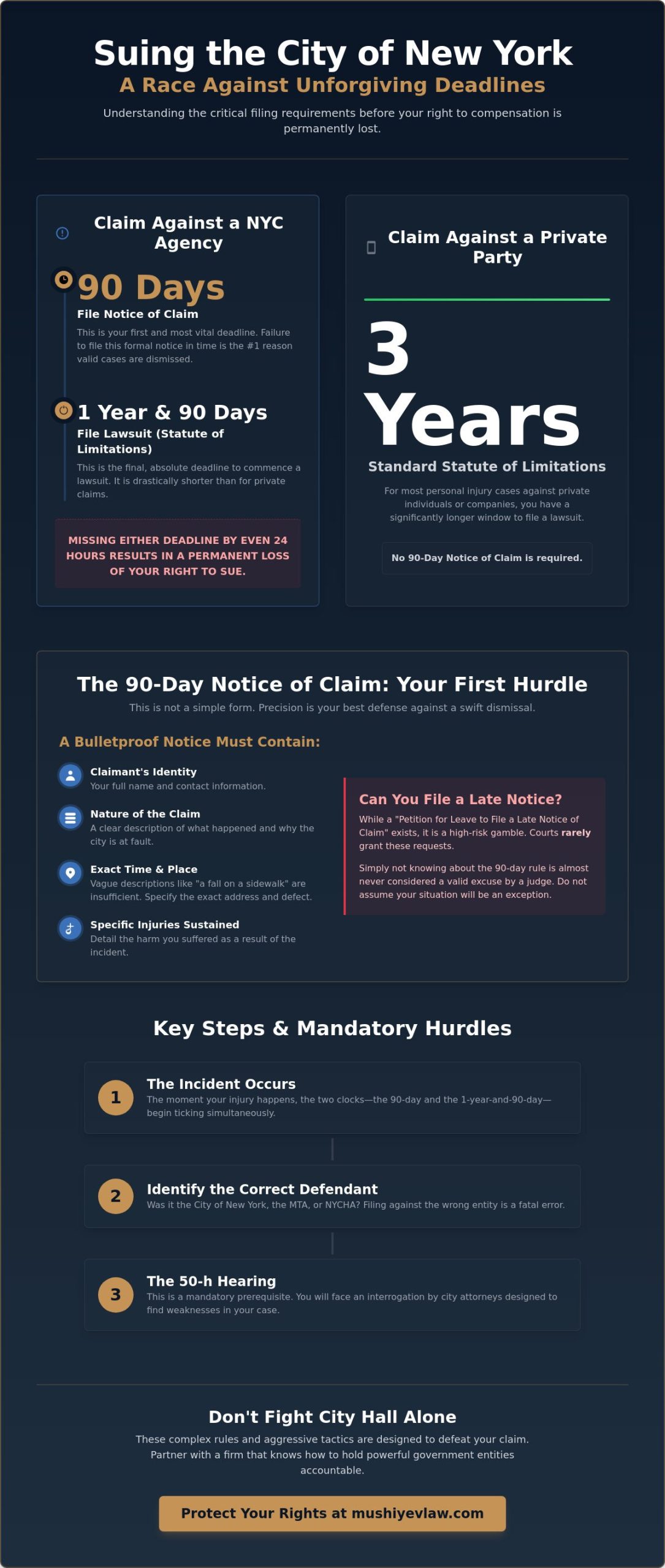
- You must file a formal Notice of Claim within 90 days of your accident or risk losing your right to compensation forever.
- The statute of limitations for suing a city in New York is strictly set at one year and 90 days, which is far shorter than standard personal injury deadlines.
- Learn how to identify the correct municipal defendant, whether it is the City of New York, the MTA, or NYCHA, to avoid fatal filing errors.
- Discover why the 50-h Hearing is a mandatory prerequisite and how to navigate this interrogation by city attorneys.
- Position yourself for success by partnering with a firm that understands the aggressive tactics used by City Hall’s legal teams.
Understanding the Statute of Limitations for Suing a City in New York
When you suffer an injury due to a city agency’s negligence, you aren’t just fighting a person or a company; you’re challenging a government entity protected by centuries of legal tradition. A Statute of Limitations acts as a rigid expiration date on your right to seek compensation. In most New York personal injury cases, you have three years to act. However, the statute of limitations for suing a city in New York is drastically shorter, requiring a lawsuit to be commenced within just one year and 90 days. This accelerated timeline exists to give the government a strategic advantage, allowing them to investigate claims while evidence is fresh and protect taxpayer budgets from long-term uncertainty.
The concept of sovereign immunity originally meant the government couldn’t be sued at all. While the law now allows for exceptions, it does so on its own terms. By setting these tight windows, the city ensures that victims who aren’t proactive are effectively silenced. You need an advocate who understands that in these high-stakes scenarios, speed is just as vital as evidence. We treat the statute of limitations for suing a city in New York as a hard line in the sand that cannot be crossed.
Municipal vs. Private Lawsuits: A Critical Difference
The disparity between private and public litigation timelines is a common trap for the unwary. If you’re hit by a private vehicle, you usually have three years to resolve your claim. If that same vehicle belongs to the New York City Department of Sanitation, your window shrinks by more than half. The impact of this difference is absolute. Consider these factors:
- Standard Injury Claims: Generally three years from the date of the incident for private defendants.
- City Claims: A strict one year and 90-day deadline for the lawsuit itself.
- The Penalty: Missing this deadline by even 24 hours results in a permanent loss of your right to sue.
General Municipal Law § 50-i: The Governing Statute
This rigid timeframe isn’t a suggestion; it’s a mandate codified in General Municipal Law § 50-i. This statute dictates that the clock starts ticking the very second the injury occurs. While some exceptions exist for minors or those with severe mental incapacitation, the courts apply these “tolls” with extreme scrutiny. Don’t assume your situation qualifies for an extension. These exceptions are rare and heavily litigated. The city’s legal department is one of the most aggressive in the state, and they will move to dismiss your case the moment a deadline passes. We step in to ensure every filing is precise and every deadline is met with clinical accuracy.
The 90-Day Notice of Claim: Your First and Most Vital Deadline
Before you even reach the final statute of limitations for suing a city in New York, you must clear a much smaller, more dangerous hurdle. The 90-day Notice of Claim isn’t a suggestion; it’s a mandatory prerequisite. If you fail to serve this notice within exactly 90 days of your accident, the city will move to dismiss your case before it ever sees a courtroom. This deadline is the primary weapon the city uses to silence injury victims. It’s designed to give the government an immediate chance to investigate, but in practice, it often serves as a trap that ends valid claims before they begin.
Waiting until the final year of the statute of limitations for suing a city in New York to start this process is a recipe for disaster. Some believe they can simply ask a judge for permission to file late. While a “Petition for Leave to File a Late Notice of Claim” exists, it’s a gamble you shouldn’t take. Judges rarely grant these petitions unless you have an extraordinary excuse and can prove the city suffered no prejudice from the delay. In the eyes of the law, simply not knowing about the 90-day rule is almost never a valid excuse for missing it.
Drafting a Bulletproof Notice of Claim
Precision is your best defense against a quick dismissal. A Notice of Claim must include the claimant’s identity, the nature of the claim, the exact time and place of the incident, and the specific injuries sustained. Vague descriptions like “a fall on the sidewalk” are invitations for a denial. You must identify the specific defect, such as a two-inch vertical sidewalk displacement or a specific oil spill on a subway platform. Even if your medical treatment is ongoing, you must quantify your damages to the best of your ability. If you aren’t sure how to describe the negligence properly, consulting with a Queens personal injury attorney can prevent a fatal technical error.
Step-by-Step: Filing Your Claim Against NYC
The process of Filing a Notice of Claim with the NYC Comptroller requires clinical attention to detail. Follow these steps to ensure your claim is legally recognized:
- Identify the correct agency: Suing the wrong department, like the Parks Department instead of the Department of Transportation, can result in an immediate dismissal.
- Complete the official forms: Use the Comptroller’s specific forms or ensure your drafted notice meets every requirement of General Municipal Law § 50-e.
- Execute proper service: Serve the papers via personal delivery or certified mail, return receipt requested.
- Preserve proof: Keep your stamped copies and mailing receipts in a secure location. These documents are your only proof that you met the deadline.
Navigating Municipal Entities: Who Are You Actually Suing?
Many victims assume “The City” is a single, monolithic target. This mistake is exactly what municipal lawyers hope you’ll make. In reality, New York City is a collection of distinct authorities, each with its own specific legal requirements and service addresses. If you serve the wrong agency, the court will not care that you were only a few blocks away from the correct office. By the time you realize your error, the 90-day window has often closed, and the statute of limitations for suing a city in New York has effectively barred your path to justice.
The NYC Comptroller’s Office Personal Injury Claim FAQs provide a baseline for general city claims, but they don’t cover every entity. One of the most dangerous outliers is the Port Authority of New York and New Jersey. While most city agencies follow the 90-day notice rule, the Port Authority operates under a different set of unconsolidated laws. You must serve a notice of claim at least 60 days before you can even commence a lawsuit, and the entire action must be brought within one year. This is even more restrictive than the standard statute of limitations for suing a city in New York, leaving zero room for administrative delays.
The MTA and NYC Transit Authority
Injuries occurring on subways, buses, or within transit stations fall under the jurisdiction of the MTA or the New York City Transit Authority. These entities are notoriously aggressive in defending against claims. If a city bus is involved in your accident, the rules of “No-Fault” insurance become significantly more complex because these agencies are often self-insured. Whether you are seeking a Car Accident Lawyer Jamaica Avenue or help with a platform slip and fall, you must identify the exact subsidiary responsible to protect your claim.
NYCHA and NYC Health + Hospitals (H+H)
Public housing residents facing injuries from broken stairs, elevator failures, or lead paint exposure must file their claims against the New York City Housing Authority (NYCHA). Similarly, medical negligence at facilities like Elmhurst or Queens Hospital requires a claim against NYC Health + Hospitals. These are not private entities; they are municipal corporations. If you need Medical Malpractice Legal Representation for an injury sustained at a city-run hospital, you cannot wait the standard two and a half years allowed for private doctors. You have 90 days to notify them of your intent to sue, or your case is over before it begins.
Beyond the Filing: The 50-h Hearing and City Investigations
Clearing the 90-day Notice of Claim hurdle is only the first step in a complex legal battle. Under New York General Municipal Law § 50-h, the city has the statutory right to demand a physical and oral examination of any person filing a claim. This is not a casual meeting; it is a sworn interrogation conducted by a city attorney. It serves as a mandatory prerequisite to filing your lawsuit. If you fail to appear for this hearing or neglect to schedule it within the required timeframe, your case will be dismissed. This remains true even if you have months left on the statute of limitations for suing a city in New York. The law is designed to protect the municipality’s interests, and they will use every technicality to bar your recovery.
The city’s legal department uses these hearings as a tactical weapon to find inconsistencies in your story. They will probe into every detail of the accident, your medical history, and your daily life to find reasons to deny your claim. Their goal is to build a defense that minimizes their liability before you even step into a courtroom. You shouldn’t walk into this high-stakes environment without a relentless advocate by your side. We act as your shield, preparing you for aggressive questioning and ensuring your testimony remains focused on the facts of your injury. If you have been served with a 50-h demand, contact a Queens accident lawyer immediately to protect your right to compensation.
What to Expect During Your 50-h Hearing
A 50-h hearing usually takes place in a city office or a lawyer’s conference room with a court reporter present to record every word. You will be asked specific questions about the accident location, the sequence of events, and the extent of your pain. City attorneys often scrutinize your past medical records to see if they can blame your current suffering on a pre-existing condition. Precision is your best defense. A single contradictory statement can be used to impeach your credibility later at trial, making honest and prepared testimony vital for your success.
Physical Examinations by City Doctors
The city also maintains the right to have you examined by their own medical experts. While these are often called “independent” medical examinations, the doctors are hired and paid by the city. Their reports frequently downplay the severity of your injuries to save the government money. We provide strategic tips for navigating these exams, such as:
- Be honest about your pain levels without exaggerating.
- Provide a clear history of how the injury has impacted your mobility.
- Understand that the doctor is not your friend and is looking for signs of recovery.
- Ensure your own medical team has documented your injuries thoroughly to counter the city’s findings.
Don’t Fight City Hall Alone: How Mushiyev Law Protects Queens Victims
The New York City Law Department is one of the largest and most aggressive legal teams in the country. They employ a massive fleet of attorneys whose primary objective is to protect city funds by dismissing your claim on a technicality. When you challenge a municipal entity, you aren’t just filing paperwork; you are entering an arena where the opponent has unlimited resources and a distinct home-field advantage. You need a shield. Mushiyev Law provides that protection. We understand the clinical precision required to navigate the statute of limitations for suing a city in New York, and we have the street-smart tenacity to stand our ground when the city tries to intimidate you.
Waiting until the last minute is the most common mistake injury victims make. While you technically have time under the statute of limitations for suing a city in New York, every day you wait is a day evidence disappears. Surveillance footage from city buses is overwritten. Witnesses forget details. Potholes are filled. Calling us on Day 1 rather than Day 89 allows us to secure the proof needed to win. Our “No Win, No Fee” promise ensures that you never have to worry about upfront costs. We take on the financial risk because we believe in your right to justice and restoration.
Relentless Advocacy for Rosedale and Rochdale Residents
Our firm is deeply rooted in the local community. We know the specific dangers of Queens streets, the neglect often found in NYCHA buildings, and the hazards of local transit hubs. We don’t just see a case number; we see a neighbor who has been wronged by a powerful system. As a Personal Injury Lawyer Rosedale NY, Yakov Mushiyev acts as a fierce advocate for those who feel vulnerable. We position ourselves as a barrier between you and the negligent parties who hope you’ll simply give up. We are here to ensure the city is held accountable for its failures.
Take the First Step Toward Justice Today
Your recovery shouldn’t be stalled by bureaucracy or fear of the system. Scheduling a complimentary, confidential assessment with Yakov Mushiyev is the first step in reclaiming your future. When we meet, bring any accident reports, photos of the scene, and medical records you have gathered. This information allows us to move with the urgency these cases demand. We handle the paperwork and the pressure so you can focus on healing. Don’t let a short deadline silence your voice. Contact Yakov Mushiyev & Associates now to protect your claim. We are ready to fight for the settlement or verdict you deserve.
Protect Your Right to Justice Against City Hall
Navigating a claim against a municipal entity is a high-stakes race against an unforgiving clock. You now understand that the 90-day Notice of Claim is the first and most critical barrier to your recovery. Identifying the correct agency and preparing for the mandatory 50-h hearing are essential steps for a successful case. The statute of limitations for suing a city in New York leaves no room for administrative errors or hesitation. When you’re facing the city’s massive legal department, you need a fighter who knows their tactics and won’t back down.
Yakov Mushiyev & Associates brings decades of experience fighting NYC municipal agencies to every case we handle. We proudly serve residents in Rosedale, Rochdale, and all of Queens with a relentless commitment to justice. Our contingency-based fee structure means you pay nothing unless we win your case. You don’t have to carry the burden of this bureaucracy alone. We are ready to act as your shield and your advocate. Secure Your Rights: Schedule Your Free Consultation with Yakov Mushiyev Today. Your path to restoration starts with a single decisive action.
Frequently Asked Questions
Can I sue New York City if I missed the 90-day Notice of Claim deadline?
Missing the 90-day Notice of Claim deadline usually results in an immediate dismissal of your case. You can petition the court for “leave to file a late notice of claim,” but judges rarely grant these requests unless you have a compelling excuse like medical incapacitation. The burden of proof is on you to show the city wasn’t prejudiced by the delay. It’s a difficult legal battle that requires immediate intervention from an experienced advocate.
Is the statute of limitations different for a wrongful death claim against the city?
For a wrongful death claim against a city entity, the 90-day Notice of Claim period begins from the date a personal representative is appointed for the decedent’s estate. This differs from standard personal injury cases where the clock starts on the date of the incident. While the general New York wrongful death statute is two years, the statute of limitations for suing a city in New York for wrongful death still requires strict adherence to municipal filing rules.
What happens if I was injured on a sidewalk in front of a private Queens home?
Liability for sidewalk injuries in Queens depends on the type of property adjacent to the defect. Under NYC Administrative Code § 7-210, the city shifted liability to most commercial and large residential property owners. However, if you fell in front of a one, two, or three-family owner-occupied residential home, the city might still be the responsible party. We investigate property records immediately to identify the correct defendant before your 90-day window expires.
How much does it cost to hire an attorney to sue the City of New York?
Hiring our firm to sue the City of New York involves zero upfront costs or hourly fees. We operate on a contingency-fee basis, which means our payment is a percentage of the final settlement or verdict we secure for you. If we don’t win your case, you don’t owe us a legal fee. This arrangement allows you to challenge the city’s massive legal department without any financial risk to your family.
Can I sue the MTA if I was hurt on a subway platform in Queens?
You can sue the MTA or the New York City Transit Authority if their negligence caused your subway platform injury. These entities are common targets for slip and fall claims involving station leaks, platform gaps, or broken stairs. Because the MTA is a public benefit corporation, you must still file a Notice of Claim within 90 days. We ensure your claim targets the correct subsidiary to prevent a technical dismissal.
What is the difference between the 90-day deadline and the 1 year and 90 days deadline?
The 90-day deadline is for filing your Notice of Claim, which is a mandatory warning to the city that you intend to sue. The 1 year and 90 days deadline is the final statute of limitations for suing a city in New York to actually file your lawsuit in court. You cannot skip the first step and proceed to the second. Both deadlines must be met with absolute precision to keep your case alive.
Do I have to file a Notice of Claim if I was hit by a city-owned vehicle?
Yes, you must file a Notice of Claim if you are hit by a city-owned vehicle, such as an NYPD cruiser, an FDNY truck, or a sanitation vehicle. These accidents fall under General Municipal Law requirements. Even though it’s a motor vehicle accident, the standard three-year personal injury deadline does not apply. You have 90 days to notify the city and one year and 90 days to commence a lawsuit for your injuries.
What if my injury was caused by a police officer or firefighter?
If a police officer or firefighter causes you injury through negligence or excessive force, you can pursue a claim against the city. These cases often involve complex issues of qualified immunity and municipal liability. You must still adhere to the strict 90-day notice requirement and the municipal statute of limitations. We act as a shield against these powerful agencies, ensuring your rights are protected regardless of the defendant’s badge.

