
It happens fast. A sliver of metal leaves a grinder wheel. An airbag fires at your face. A box slides off a high shelf and a corner catches you just below the brow. Then comes the stinging, the blur, the tears you cannot stop. If someone else’s carelessness put you there, this guide walks you through what an eye injury lawyer looks at, one cause at a time, for people hurt in Queens, the five boroughs or Nassau, and what you should be saving while your memory and your records are still fresh.
First, a Short Glossary of Eye Injury Terms
Your discharge papers may use words you have never seen. Here is what the most common ones mean in plain language. This is not medical advice. Your doctors decide what your eye needs; this list only helps you follow the paperwork.
- Corneal abrasion. A scratch on the clear front surface of the eye. It often comes from dust, grit, a fingernail or a flying particle.
- Orbital fracture. A break in the bones that form the eye socket. A blow from a steering wheel, a fist or a hard object can cause one. The “blowout” type involves the thin floor of the socket.
- Retinal detachment. The retina, the light-sensing layer at the back of the eye, pulls away from where it belongs. Trauma is one known cause. People often describe a curtain or shadow over part of their sight.
- Traumatic cataract. Clouding of the eye’s natural lens after an injury. It may show up right away or develop over months.
- Chemical burn. Damage from a splash of a cleaner, solvent or other substance. Alkaline products are a frequent culprit.
Why this matters for a claim: the diagnosis shapes which legal rules apply. A fractured orbit, for example, is treated very differently from a scratch that healed in a week, especially in a car crash case. Keep every record that names your condition.
Eye Injuries on a Construction Site or in Industrial Work
Job sites produce a steady stream of eye injuries. Welding arcs, cutting torches, chipping hammers, concrete dust, nail-gun fragments and grinding sparks all aim at the same small target. Here the legal picture has two layers.
The workers’ compensation layer
If you were hurt working for your own employer, workers’ compensation generally covers medical care and part of your lost wages. Under Workers’ Compensation Law § 11, that coverage is generally the only remedy you have against your own employer. The statute does allow another party to seek contribution from the employer in cases of “grave injury,” but that category is narrowly defined. Do not assume your eye injury fits it without a careful review.
The third-party layer
On construction projects, the owner and the general contractor are often separate from your employer, and they can carry their own duties. Labor Law § 241(6) places safety obligations on owners and contractors, and claims under it are generally tied to a specific rule in the state Industrial Code. For eye injuries, the rule that tends to come up is the eye-protection provision, which generally requires approved eye protection for workers doing work that may endanger the eyes, such as welding, burning, cutting, chipping or grinding. Whether that rule fits your facts depends on what you were doing and what equipment was on hand.
OSHA summarizes federal standards for goggles, face shields and welding helmets on its eye and face protection page. Those standards can help show what a reasonable site should have provided. If a defective tool, guard or pair of goggles failed, a manufacturer may also be responsible; our article on defective products on a construction site explains that route. For the broader picture of site claims, see our page on construction accident cases.
What to save after a job-site eye injury
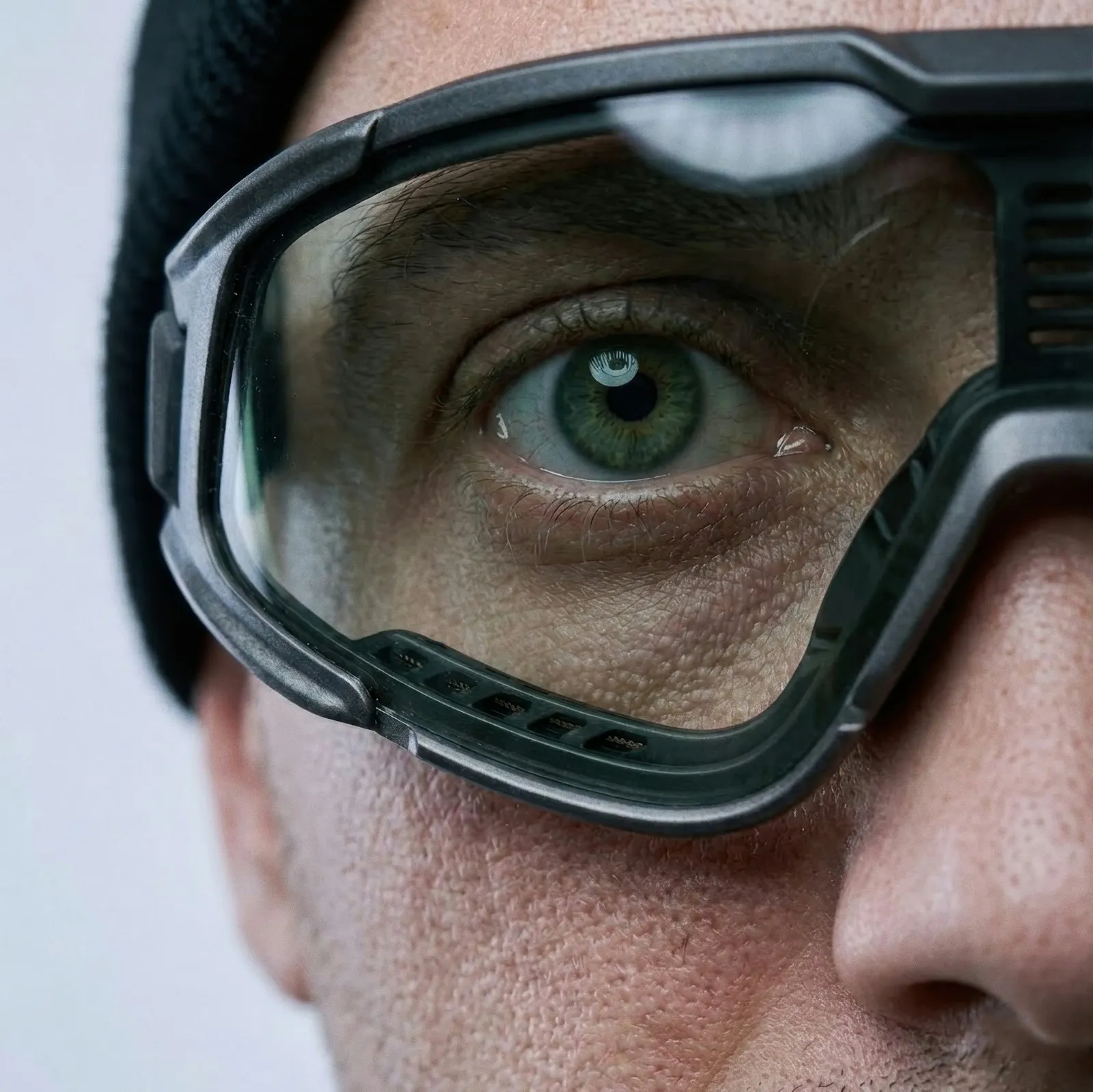
- The safety glasses, goggles or face shield you were wearing, even if cracked. If you had none, write down that none were given to you.
- The name of your employer, the general contractor and the property owner, if you know them.
- The task you were doing and the tool in use, including make and model if visible.
- Names and phone numbers of coworkers who saw it.
- A copy of any incident or accident report, or the date you reported it and to whom.
- Photos of the work area, the tool and any posted safety signs, taken as soon as you safely can.
Eye Injuries From a Car Crash
In a collision, the eye is exposed to several forces at once. An airbag deploys toward the face at high speed. Side and rear windows can shatter inward. Your head may strike the steering wheel, the door pillar or the window. Any of these can cause an abrasion, a hyphema, a detached retina or a fracture of the socket.
Start with no-fault. That coverage generally handles your treatment costs and a portion of missed pay no matter which driver was to blame. File the application quickly; the window is generally just 30 days. For the paperwork itself, see this walkthrough of New York no-fault.
Recovering for pain and suffering against the other motorist is a separate step. It generally hinges on clearing the “serious injury” bar set by Insurance Law § 5102(d). Three categories in that list often matter in eye cases:
- Fracture. An orbital fracture is a fracture, so it generally qualifies on that basis alone.
- Permanent loss of use. Lasting loss of sight in one eye may be argued under the permanent-loss category or the related limitation categories, depending on the medical proof.
- Significant disfigurement. Visible scarring around the eye or a change in its appearance may apply.
The insurer will look hard at your records to test each category. Our page on car accident claims explains the rest of the process.
What to save after a crash
- The police report number and the other driver’s insurance information.
- Photos of the deployed airbag, the broken glass and the interior of the car.
- Your eyeglasses or sunglasses if they broke on impact.
- Ambulance and emergency room records.
- Your no-fault application and any letters from the insurer.
Injuries in a Store, Office or Apartment Building
Property hazards cause more eye injuries than people expect. Merchandise falls from overloaded shelves. A display hook or shelf bracket sticks out at face height. A mop bucket gets kicked over and a cleaning chemical splashes upward. A broken light fixture drops glass.
In these cases you generally must show that the owner or occupant created the hazard, or knew or should have known about it. “Should have known” usually means the danger was easy to see, and it sat there so long that a reasonable employee would have spotted and corrected it. A problem the owner knew kept coming back can also matter. Unlike a car case, there is no serious-injury threshold here.
For more on falling items, read our piece on falling merchandise injuries in stores, and see our premises liability practice for how these claims are built.
What to save after a property injury
- Photos of the shelf, hook, fixture or spill, before anyone cleans it up.
- The product label or name of the chemical, if a splash was involved.
- The manager’s name and a copy of the store or building incident report.
- Names of anyone who saw the event.
- A note of any cameras in the area, so the footage can be requested before it is erased.
Assaults and Defective Products
Some eye injuries come from a punch, a thrown object or another deliberate act. The person who attacked you can be sued directly, but be careful with timing: CPLR § 215 generally gives you only one year to sue over assault, battery and other intentional wrongs. That is much shorter than the usual window.
The attacker may have no money to pay a judgment. In that case, look at the place where it happened. If a building, bar or parking area had poor lighting, broken door locks or a history of similar incidents, the owner may face a negligence claim for inadequate security. Our article on negligent security claims covers that theory.
Products can fail, too. A bungee cord snaps back. A pressurized container bursts. A pair of protective glasses shatters when it should hold. When a product’s design, manufacture or warnings were faulty, the maker and seller may be responsible.
What to save after an assault or product failure
- The police report or complaint number.
- The product itself, its packaging and receipt.
- Photos of your face and eye over the following days.
Evidence That Carries an Eye Injury Claim
Across every cause, the strongest files share the same building blocks. An eye injury lawyer will usually ask for these first:
- Emergency room records. They fix the date, the mechanism and the first findings.
- Ophthalmologist follow-up. A specialist’s exam records your visual acuity, field of vision and any structural damage. Gaps in follow-up care are often used by insurers to argue you recovered.
- Photographs. Of the scene, the object, and your eye as it heals.
- Protective equipment. The safety glasses or goggles you wore, or proof that none were provided.
- Incident reports and witness names. These are often the first thing to disappear.
- A symptom record. Headaches, light sensitivity, double vision, trouble reading. This symptom diary method keeps it simple.
What Vision Loss Can Mean for Damages
The losses from an eye injury reach further than the hospital bill. Think about each of these as you talk with your doctors and your lawyer:
- Reduced or lost vision. Partial or total loss in one eye changes daily life.
- Depth perception. Losing sight in one eye can make stairs, driving, sports and pouring a glass of water harder.
- Lost earnings and earning capacity. Electricians, drivers, machine operators and people who read screens all day may not be able to return to the same work. The medical and vocational proof this takes is laid out in our article on showing an injury keeps you off the job.
- Future treatment. Some injuries call for later surgery, such as cataract removal or retinal repair, plus ongoing visits. See how future medical costs are calculated.
- Disfigurement and emotional harm. Scarring, a drooping lid or a visibly changed eye affects how people feel in public.
If a pre-existing condition, like an earlier cataract or weak eyesight, was made worse, the aggravation is generally compensable. The responsible party takes you as it finds you. Facial injuries often come in pairs, too; if your teeth were also damaged, our article on broken teeth after an accident addresses that side of the claim.
Deadlines You Need to Know
Time limits vary with who caused the harm. Here are the general ones:
- Most negligence claims: CPLR § 214 generally allows three years, counted from the day you were hurt. This covers most crashes, store injuries and third-party construction claims.
- Intentional harm: generally one year, as noted above.
- A city, town, county or other public body: the formal notice of claim is generally owed within 90 days, and the suit itself within one year and 90 days of the injury. Each step is spelled out in our piece on deadlines for claims against a city.
- No-fault applications: generally 30 days.
How Our Firm Approaches Eye and Vision Cases
Eye injuries put a quiet kind of pressure on people. At Yakov Mushiyev & Associates, we start by listening to how it happened and lining up the records that answer the insurer’s first questions. We work out of Suite 325 at 1 Cross Island Plaza in Rosedale and take cases from Queens, every other borough and Nassau County. Across its practice, the firm has collected more than $80 million on behalf of people hurt in this state.
If reading or travel is hard right now, we can meet by video or come to your home or a hospital room. Conversations can be held in English, Russian or Spanish. Consultations are free; we are paid only if your case succeeds. To set one up, send us a message or dial 718.775.3110.
Eye Injury Questions We Hear Often
Do I need an eye injury lawyer if my vision is coming back?
Not always. But some injuries, like traumatic cataracts or retinal problems, can surface weeks or months later. A short consultation can help you decide whether to preserve evidence and keep the claim open while your doctors watch your recovery.
My employer never gave me safety glasses. Can I sue my employer?
Generally, no. Workers’ compensation is usually your only remedy against your own employer. However, the owner or general contractor on a construction project may face a separate claim, and the lack of required eye protection can be central to it.
Does an orbital fracture meet the serious-injury rule in a car case?
A fracture is one of the listed categories under Insurance Law § 5102(d), so a documented orbital fracture generally satisfies that requirement. Imaging and specialist records are what prove it.
What if I was partly at fault, like not wearing my glasses?
New York follows pure comparative fault. Any blame assigned to you generally trims the award by that percentage; it does not wipe the claim out. An eye injury lawyer can help you understand how the other side may try to assign fault, and how to answer it.
Visit Yakov Mushiyev & Associates
Our office is at 1 Cross Island Plaza, Suite 325, Rosedale, NY 11422, just off the Cross Island Parkway on the Queens–Nassau border. If you can’t come to us, we’ll come to you: at home, in the hospital or by video.

Talk to a New York eye injury lawyer today
Yakov Mushiyev & Associates has recovered over $80 million for injured New Yorkers across the five boroughs and Nassau County. Consultations are free, available in English, Russian and Spanish, and there is no fee unless we win.
Call 718.775.3110 or contact us online for a free case review.
This article is general information, not legal advice. Every case is different. Attorney Advertising.