Will Medicaid Take My Personal Injury Settlement Money in NY? (2026 Guide)

Your settlement check isn’t a gift from the state, yet New York’s Medicaid Casualty Recovery program often treats it like an open tab. You spent months fighting for justice after a serious accident, only to face the gut-wrenching question: will medicaid take my personal injury settlement money in NY? It’s a valid fear. With individual asset limits set at $33,038 for 2026, a single deposit could suddenly strip away your health coverage and your financial security.
We understand the anxiety of watching a hard-won recovery disappear into the state’s coffers. You deserve a shield against these formidable recovery units. This guide explains how Medicaid liens actually work and the aggressive legal strategies used to protect your funds. We’ll show you how the Ahlborn pro-rata reduction and Special Needs Trusts can minimize the state’s claim. You’ll learn how to navigate the 2026 legal landscape to keep your settlement money while ensuring your future benefits remain fully intact. The state has its advocates; it’s time you had yours. We invite you to reach out for a complimentary initial assessment to start securing your recovery today.
Key Takeaways
- Identify the legal basis of NY Medicaid liens and why the Office of the Medicaid Inspector General (OMIG) targets your personal injury recovery.
- Leverage the Ahlborn ruling and procurement cost deductions to force a pro-rata reduction of the state’s claim against your settlement funds.
- Prepare for the itemized Statement of Claim that follows a lawsuit filing, ensuring the state only recovers for medical care directly related to your accident.
- Protect your long-term eligibility by using First-Party Special Needs Trusts to ensure the question of will medicaid take my personal injury settlement money in NY doesn’t result in a loss of benefits.
- Secure a relentless advocate to negotiate with state agencies and prevent administrative overreach from draining your financial future.
Understanding the NY Medicaid Lien: Why the State Claims Your Money
When you are injured in a New York accident, the state often steps in to cover your immediate medical costs through its Medicaid program. This support isn’t free. Under NY Social Services Law Section 104-b, the state possesses a statutory right to be reimbursed from any recovery you receive from a negligent party. This legal claim is known as a Medicaid lien. It attaches to your settlement or verdict automatically. While this is part of the broader Medicaid estate recovery program framework, in personal injury cases, it specifically targets the funds you win for the injuries you suffered. We position ourselves as a necessary shield between you and the state’s recovery units to ensure they don’t take a dollar more than they are legally owed.
To better understand how these claims impact your recovery, watch this helpful breakdown:
It’s vital to distinguish between a lien and a subrogation claim. In New York, Medicaid holds a lien, which provides them a direct claim against your settlement proceeds. Unlike private insurance subrogation, where an insurer might have to sue a third party in your place, a Medicaid lien is an absolute right granted by statute. If you settle a claim for a truck accident or a construction injury, the state expects its reimbursement before you receive the medical portion of your award. This is not a request; it is a legal mandate that requires aggressive management to resolve in your favor.
What is the Office of the Medicaid Inspector General (OMIG)?
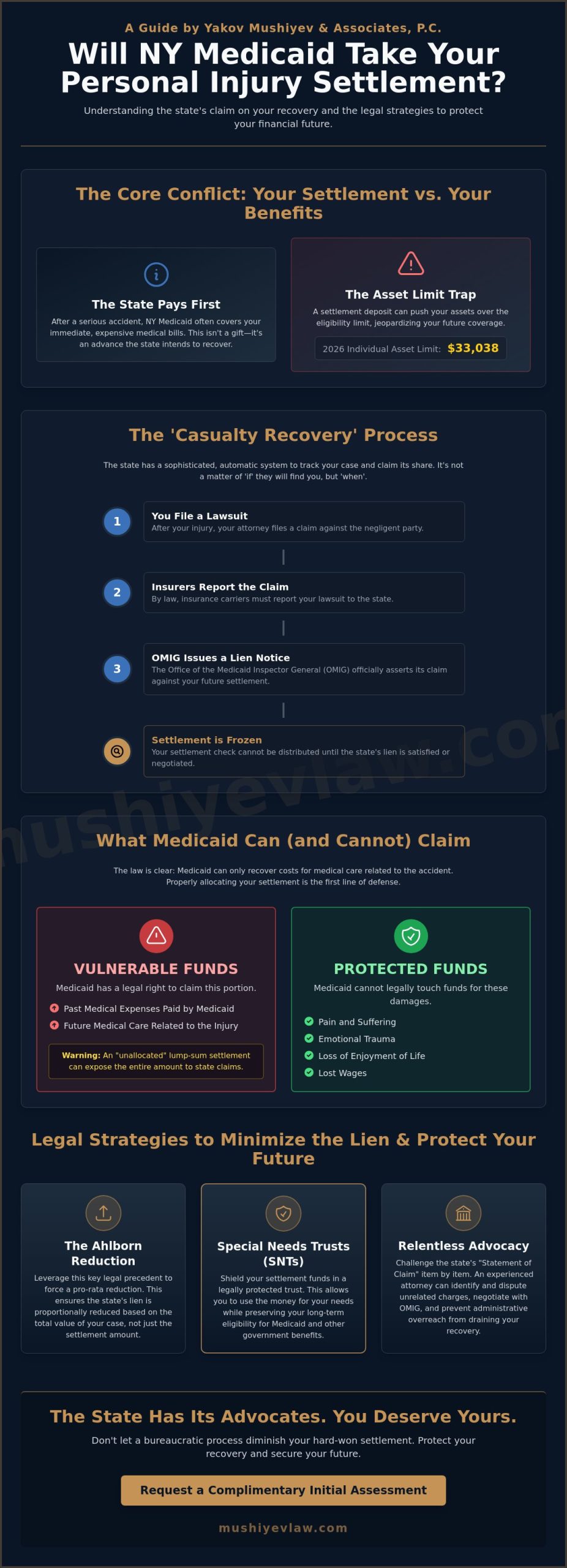
The Office of the Medicaid Inspector General (OMIG) acts as the state’s enforcement arm. They are tasked with tracking personal injury lawsuits across the five boroughs to identify potential recoveries. When you file a lawsuit in Queens Supreme Court, insurance companies are required to report the claim. OMIG monitors these reports with clinical precision. Once they identify your case, they issue a “Notice of Lien.” This document officially alerts all parties that the state is an interested party in your recovery. It can halt the distribution of your settlement check until the lien is satisfied or negotiated down.
Medical Bills vs. Pain and Suffering
A primary concern for many victims is: will medicaid take my personal injury settlement money in NY if that money is meant for my pain and suffering? The law is clear: Medicaid can only recover from the portion of your settlement specifically allocated to past and future medical expenses. They cannot legally touch funds intended to compensate you for physical pain, emotional trauma, or loss of enjoyment of life. This makes the language in your settlement release exceptionally critical. If you accept an “unallocated” lump sum, the state may attempt to claim the entire amount. We work tirelessly to ensure settlement documents clearly separate these categories, protecting your non-medical recovery from state seizure.
The NY ‘Casualty Recovery’ Process: How the State Tracks Your Case
The state’s mechanism for clawing back funds is through the NY Medicaid Casualty Recovery program. It’s a sophisticated tracking system. When you file a summons and complaint in Queens Supreme Court after a truck accident or a slip and fall, the state is immediately notified. They don’t wait for you to call them. Insurance carriers have a statutory duty to report these claims. This reporting acts as a tripwire. Once triggered, the state begins building its “Statement of Claim.” This document is an itemized ledger of every penny Medicaid spent on your care since the date of the accident. This brings us back to the central concern: will medicaid take my personal injury settlement money in NY without oversight? Without an advocate to challenge this ledger, they certainly will.
Administrative delays are common. Resolving a lien can take months, often holding up your final check even after the insurance company has agreed to pay. You might think the state’s accounting is infallible, but it’s frequently riddled with errors. They often include charges for routine check-ups, pre-existing conditions, or medications completely unrelated to your injuries. We treat this statement like a hostile audit. If the state claims $50,000 but $15,000 of that was for a flu shot or a chronic condition you had years before the crash, we fight to strike those items. If you are worried about the state overreaching, having a Queens personal injury lawyer review your claim is a necessary step to protect your recovery.
Audit Your Medicaid Statement of Claim
Every line item on the state’s ledger is a potential point of contention. We demand a full itemized breakdown from the Department of Social Services. We look for duplicate billing, which happens more often than the state admits. We also look for services that weren’t “accident-related.” If you were treated for a broken leg from a car accident, the state cannot recover for your unrelated eye exam. We challenge these specific charges to lower the total lien before any money changes hands.
Managed Care vs. Fee-for-Service Medicaid
Recovery looks different if you use a Medicaid Managed Care plan like HealthFirst or Fidelis. These are private insurance companies that manage Medicaid benefits for the state. They are often more aggressive than state-run agencies. They hire third-party recovery firms that use high-pressure tactics to maximize their take. Negotiating with these private administrators requires an additional layer of legal maneuvering. These plans often claim they have “federal preemption” rights, but we know the limits of their authority. We ensure these private entities follow the same pro-rata rules as the state.
Calculating the Cut: The Ahlborn Formula and Reducing Your Lien
The state’s initial demand is never the final word. While the question of will medicaid take my personal injury settlement money in NY often triggers immediate anxiety, the law provides a powerful mathematical defense. The U.S. Supreme Court ruling in Arkansas Department of Health & Human Services v. Ahlborn serves as your primary shield. This landmark decision mandates that Medicaid can only recover from the portion of a settlement specifically allocated to medical expenses. If your total damages far exceed the available insurance coverage, the state is legally required to accept a “pro-rata” reduction. We use clinical precision to calculate these ratios, ensuring the state doesn’t siphon off funds meant for your pain and suffering.
The math of a reduction can be dramatic. Suppose Medicaid paid $10,000 for your emergency care after a motorcycle accident, but we prove your total case value is $300,000 while the negligent driver only had a $100,000 policy. In this scenario, you are only recovering one-third of your case’s true value. Under the Ahlborn formula, the state’s $10,000 claim should be reduced by that same ratio, potentially dropping their recovery to roughly $3,333. We don’t stop there. We also negotiate “Hardship Waivers” through the Department of Social Services or OMIG when a settlement is exceptionally small compared to the severity of the injuries. This aggressive maneuvering ensures you keep the lion’s share of your recovery.
The ‘Pro-Rata’ Share Calculation
The formula is straightforward but requires expert application: (Total Settlement ÷ Total Value of Case) x Medical Bills Paid. The Ahlborn reduction stands as the primary shield for NY victims against state overreach. By demonstrating a “full value” that is significantly higher than the actual settlement, we force the state to shrink its lien. We meticulously document your long-term disability, future lost wages, and permanent trauma to inflate the “Total Value” figure, which mathematically crushes the percentage Medicaid can legally claim from your check.
Deducting Legal Fees and Expenses
New York law requires Medicaid to “pay its share” of the costs required to recover the money. These are known as procurement costs. They include attorney fees and the literal expenses of the litigation, such as expert witness fees and filing costs. In New York, this typically results in an automatic 1/3 reduction of the Medicaid lien. This deduction happens before the state ever sees a dime. If the state’s adjusted lien is $3,000, the procurement cost deduction could slash that final payment even further. We ensure every penny of these costs is accounted for to minimize the state’s take and maximize your net recovery.
How to Protect Your Settlement: Special Needs Trusts and Eligibility
Winning your case is only half the battle. If you receive a large check while on benefits, you hit the “Resource Limit” trap. For 2026, New York’s asset limit for an individual is $33,038. A single deposit from a car accident settlement can instantly disqualify you from Medicaid and SSI. This is why the question of will medicaid take my personal injury settlement money in NY is so urgent. It’s not just about the lien; it’s about your continued survival. We don’t just win your case. We act as a shield to ensure your recovery doesn’t cost you your healthcare. Our team as a personal injury lawyer Rosedale NY coordinates directly with trust specialists to implement protective structures before the first dollar is paid.
One immediate option is the “spend-down” strategy. You can use your settlement funds to purchase exempt assets that do not count toward the $33,038 limit. This includes paying off a primary residence, buying a reliable vehicle, or prepaying funeral expenses. This is a legitimate way to keep your money while staying eligible. However, this must be done within a specific timeframe to avoid penalties. If you need a relentless advocate to help you manage this transition, contact us for a complimentary assessment to secure your financial future.
The First-Party Special Needs Trust (SNT)
An SNT is a powerful tool for those under age 65. It allows you to hold settlement funds in a protected account managed by a trustee. These funds can pay for “quality of life” items Medicaid won’t cover, such as specialized therapy, travel, or home modifications. The catch is the “Payback Provision.” When the recipient passes away, any remaining money in the trust must first reimburse the state for medical care provided. It’s a calculated trade-off. It allows you to maintain current health coverage while enjoying a higher quality of life now. We ensure the trust is established correctly to meet strict NY Department of Health guidelines.
Impact on Other Benefits: SNAP and Section 8
A settlement doesn’t just threaten your health insurance. In Queens, programs like SNAP (food stamps) and Section 8 housing vouchers have their own strict income and asset requirements. Reporting your settlement incorrectly can lead to an eviction notice or a loss of nutrition assistance. We guide you through Navigating the NY Claim Process to ensure all state agencies are notified correctly. This prevents administrative errors from triggering a total loss of support. We treat your benefits with the same urgency as your legal claim.
Why You Need a Relentless Queens Advocate to Fight the Medicaid Lien
The state is a formidable opponent. They don’t just ask for reimbursement; they demand it with the full weight of the law behind them. If you’re asking will medicaid take my personal injury settlement money in NY, you must understand that the Office of the Medicaid Inspector General (OMIG) operates with clinical efficiency. They aren’t looking out for your future. They use administrative pressure to maximize their recovery at your expense. Without a relentless advocate, you’re just a file number in an automated system designed to claw back every possible dollar. We act as a necessary shield, standing between you and the government’s aggressive recovery units.
Aggressive negotiation must happen before your settlement is finalized. Once you sign a release, your leverage vanishes. We intervene early in the process to audit the state’s Statement of Claim and resolve disputes before the check is even cut. Our approach is rooted in a sense of duty to our clients. We refuse to settle for anything less than what is fair. This proactive strategy is part of our risk-free financial arrangement. You don’t pay us a penny unless we secure a recovery for you. This “No Win, No Fee” guarantee ensures that we are as invested in your financial victory as you are.
Fierce Advocacy Against Powerful Entities
Dealing with NYC lien adjusters requires more than just legal knowledge. It requires street-smart negotiation. These adjusters handle thousands of cases and often expect victims to accept their initial demands without question. We don’t. Whether we are providing Slip and Fall Legal Representation in Queens or fighting for a victim of a truck accident, we treat the government like any other adversary. We challenge every unrelated medical charge and apply the Ahlborn formula with absolute certainty. We ensure the state pays its fair share of procurement costs, keeping more money in your pocket.
Free Case Assessment for Rosedale & Rochdale Residents
For our neighbors in Rosedale and Rochdale, the stakes of a personal injury case are personal. A settlement represents your path to restoration after a trauma. We handle the complex paperwork and the tireless back-and-forth with the OMIG so you can focus on healing. Our firm is committed to maximizing the “net” recovery—the actual amount you take home after all liens and fees are settled. We invite you to Contact Yakov Mushiyev today for a complimentary initial assessment. Let us review your specific Medicaid situation and build the strategic defense you need to protect your settlement from being drained by the state.
Secure Your Financial Recovery Today
You’ve survived the trauma of a serious accident; now you must secure the compensation meant for your healing. New York’s Medicaid recovery system is aggressive, but it’s bound by strict legal limits. By leveraging the Ahlborn pro-rata formula and utilizing Special Needs Trusts, you can successfully navigate the question of will medicaid take my personal injury settlement money in NY. We provide the clinical precision necessary to audit state claims and protect your non-medical recovery from seizure. Our team ensures that every procurement cost is deducted and every itemized charge is verified for accuracy.
Yakov Mushiyev & Associates, P.C. stands as a tireless shield for Queens victims. Our deep expertise in NY Social Services Law 104-b ensures that every line item is challenged and every possible reduction is maximized. We operate on a risk-free, “No Win, No Fee” basis, meaning our fierce advocacy is accessible to everyone in our community. You deserve a fighter who is intimidating to opponents but remains a calm, steady guide for you. Protect Your Settlement—Get a Free Consultation with Yakov Mushiyev & Associates today. Your future is worth the fight, and we are ready to lead it. You can move forward with absolute confidence in your financial security.
Frequently Asked Questions
Can Medicaid take my entire personal injury settlement in New York?
No, the state cannot seize your entire recovery. Federal and state laws limit Medicaid’s reach to the portion of the settlement specifically allocated for past and future medical expenses. They cannot legally touch funds awarded for your physical pain, emotional suffering, or lost wages. We ensure your settlement release is drafted with clinical precision to shield your non-medical funds from state recovery units.
How long does it take for Medicaid to issue a final lien amount?
The timeline for a final lien payoff letter varies but typically spans several months. After your case settles, the Department of Social Services or OMIG must review your itemized medical history to finalize the numbers. We push these agencies aggressively to prevent administrative delays from holding up your check. Time is of the essence, and we treat these delays as obstacles to your justice.
Will I lose my Medicaid health insurance if I get a settlement check?
You risk losing coverage if your assets exceed the 2026 individual limit of $33,038. Receiving a lump sum can trigger an immediate disqualification from needs-based benefits. This is a primary reason people ask: will medicaid take my personal injury settlement money in NY? We resolve this by implementing Special Needs Trusts or spend-down strategies to preserve your eligibility while you enjoy your recovery funds.
What happens if Medicaid paid for my surgery but the settlement is very small?
If your settlement is small relative to your injuries, the state must accept a pro-rata reduction. Under the Ahlborn formula, Medicaid’s recovery is limited to a fair percentage of the total recovery. If they paid $50,000 for surgery but you only recover 10 percent of your case’s true value, they cannot demand the full $50,000. We also fight for hardship waivers in extreme cases to protect your net recovery.
Does the Medicaid lien come out of the lawyer’s fee or my portion?
The lien is paid from the settlement proceeds, but the state must share in the cost of the recovery. This means the Medicaid lien is reduced by its proportionate share of your attorney’s fees and litigation expenses. In New York, this usually results in an automatic one-third reduction of the lien. The state doesn’t get a free ride on the work we do to secure your funds.
Can I settle my case without telling Medicaid?
Attempting to settle without notifying Medicaid is a violation of New York law and can lead to charges of fraud. Insurance companies are required by statute to report these settlements to the state. If you fail to resolve the lien, the state can sue you or your attorney directly to recover the funds. Transparency is the only way to legally and safely protect your recovery.
What is a 104-b lien in New York personal injury law?
A 104-b lien refers to the section of the New York Social Services Law that grants the state a statutory right to reimbursement. It allows the local Department of Social Services to place a lien on a personal injury claim to recover medical expenditures. This law is the primary tool the state uses to claim a portion of your settlement. We understand the nuances of this statute and use it to your advantage during negotiations.
Can my lawyer negotiate a reduction with the OMIG?
Yes, your lawyer can and should negotiate a reduction with the Office of the Medicaid Inspector General (OMIG). These liens are not set in stone. We use technical arguments regarding the Ahlborn ruling and procurement costs to force the state to lower its demand. Negotiation is a standard part of our process to ensure the question of will medicaid take my personal injury settlement money in NY ends with you keeping as much as possible.

