
How Are Personal Injury Settlement Checks Distributed in NY? The 2026 Legal Guide

Winning your case is only half the battle; the real fight begins when you’re waiting for the funds you were promised to actually hit your bank account. You’ve endured the trauma of a serious accident, and now, with bills mounting, the silence from an insurance carrier feels like a second victimization. You need to know exactly how are personal injury settlement checks distributed in NY to ensure you aren’t being sidelined by bureaucratic delays or hidden deductions.
We understand the financial pressure you’re facing. This 2026 legal guide provides the clinical precision you need to understand the mandatory disbursement sequence. We’ll cover the strict 21-day payment deadline for private defendants and the 90-day window for public entities. You’ll learn how the escrow process works, which medical liens are legally valid, and how New York law protects your right to a prompt payout. We’ll outline the exact path your money takes from the insurance company’s hands to your own, ensuring you have the confidence to demand every cent you’re owed.
Key Takeaways
- Signing the General Release is the definitive legal trigger that secures your settlement but permanently waives your right to further litigation.
- Understand the clinical precision of the IOLA escrow system and exactly how are personal injury settlement checks distributed in NY to protect your funds.
- Leverage New York CPLR 5003-a to hold insurance companies accountable to a strict 21-day payment deadline.
- Navigate the “Deduction Gauntlet” to see how attorney fees and medical liens are calculated against your gross recovery.
- Review the importance of the Closing Statement as a final, line-by-line accounting that ensures you receive your maximum net recovery.
The Trigger: Signing the General Release and Settlement Agreement
The moment you agree to a settlement for your car accident or construction injury, the legal machinery shifts gears. The General Release is the engine of this transition. It is a binding contract where you surrender your right to pursue further litigation against the negligent party in exchange for a specific sum. In the foundational context of personal injury law, this document is the absolute prerequisite for payment. Insurance companies will not move a single dollar until they have a signed, notarized original in their hands. They demand perfection; any typo or missing signature gives them a reason to stall.
You cannot change your mind once the ink is dry. This is a final resolution. Along with the Release, your attorney prepares a Stipulation of Discontinuance. This document tells the court the matter is resolved, effectively ending the judge’s involvement. If you’re wondering how are personal injury settlement checks distributed in NY, remember that the timeline is dictated by how quickly these documents are executed and delivered. We act as your shield during this phase, ensuring the defense doesn’t use paperwork errors as a weapon to delay your recovery.
To better understand this concept, watch this helpful video:
Court Approval for Minors, Estates, and Incapacitated Persons
In Queens County and across the metropolitan area, cases involving minors or incapacitated persons require a “Compromise Order.” A judge must review the settlement details to ensure it serves the best interests of the child or the vulnerable individual. If the case involves a fatality, the Surrogate’s Court must also approve the distribution of funds to the estate. These extra layers of judicial oversight are necessary for protection, but they frequently add weeks or even months to the timeline. You aren’t just waiting on a check. You’re waiting on a court calendar. We navigate these bureaucratic hurdles with clinical precision to keep the process moving forward.
The Danger of the ‘Broad Release’ Language
Aggressive insurance adjusters often try to slip in “Broad Release” language. This tactic attempts to release the defendant from “any and all claims,” which could potentially include future incidents or unrelated medical issues. A standard release should be limited to the specific accident date and location. Your attorney must carefully vet every sentence to protect your future rights. There’s a massive difference between a standard release and a limited release; choosing the wrong one can be a catastrophic mistake. We refuse to let our clients sign away rights they didn’t intend to, standing firm against formidable opponents who prioritize their bottom line over your justice.
The Escrow Phase: Why the Check Goes to Your Attorney First
When the insurance company finally issues a payment, the check doesn’t arrive in your personal mailbox. Instead, it’s typically made payable to both you and your law firm. This joint-payee structure is a standard security measure in New York litigation. It ensures that all legal obligations, including medical liens and litigation costs, are satisfied before the final funds reach your hands. This is a critical stage in understanding how are personal injury settlement checks distributed in NY, as it marks the transition from a legal claim to actual liquid assets.
Upon receipt, your attorney must deposit the check into a specialized trust account known as an Interest on Lawyer Account (IOLA). In New York State, these accounts are strictly regulated to keep client funds entirely separate from the law firm’s daily operating expenses. You should expect a “clearing period” once the deposit is made. For large insurance checks, banks often require 5 to 10 business days to verify the funds. This isn’t a delay created by your lawyer; it’s a mandatory banking protocol to ensure the check is valid and the funds are fully available for disbursement.
The Attorney’s Fiduciary Duty
Your lawyer has a non-negotiable fiduciary duty to protect your settlement money. This means they’re legally and ethically bound to act in your best interest throughout the escrow phase. According to a relevant NYSBA Ethics Opinion, attorneys must maintain clinical precision when managing these accounts. Any mishandling of funds can lead to severe disciplinary action or disbarment. We provide a transparent accounting of every cent, ensuring you have absolute confidence that your recovery is being shielded from any outside interference or administrative error. If you’re feeling overwhelmed by the process, speaking with an experienced advocate at mushiyevlaw.com can provide the clarity you deserve.
What Happens if the Insurance Company Delays the Check?
Insurance carriers sometimes attempt to drag their feet even after a settlement is reached. We don’t tolerate these tactics. Our firm aggressively tracks the “date of receipt” to ensure the carrier is complying with statutory timelines. If the check doesn’t arrive within the legally mandated window, we’re prepared to enforce “Prompt Payment” rules that can penalize the insurer for their negligence. We verify the clearing of funds with the bank immediately, moving with a sense of urgency to transition your case from the escrow phase to final distribution. Time is of the essence, and our strategic approach is designed to eliminate unnecessary waiting periods.
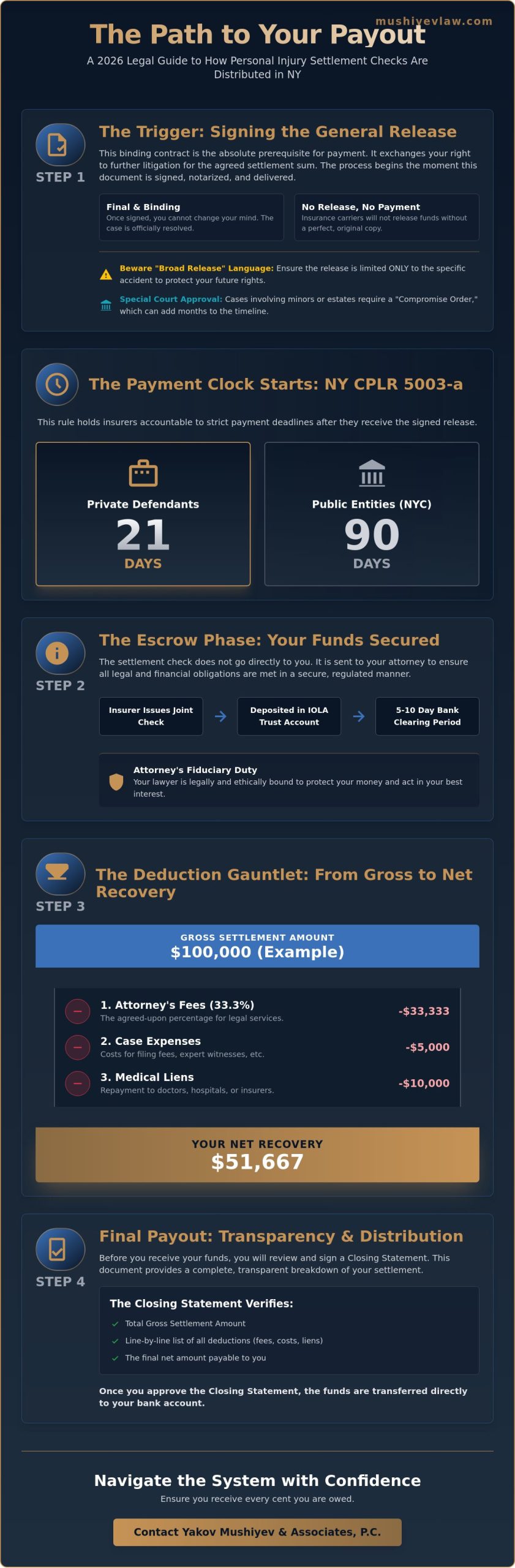
The Deduction Gauntlet: Calculating Your Net Recovery
The gross settlement figure on your agreement represents the total victory, but your net recovery is the money that actually lands in your bank account. Understanding how are personal injury settlement checks distributed in NY requires a clinical look at the mandatory disbursement sequence. We don’t just wait for a check to arrive; we aggressively manage the “Deduction Gauntlet” to ensure the maximum amount of that total figure stays with you. This phase is where legal expertise transitions into financial advocacy.
First, the standard contingency fee is deducted from the gross amount. In New York personal injury cases, this fee is typically 33.3 percent. This risk-free arrangement ensures you never pay out of pocket for our services. Next, we must reimburse the litigation expenses. These are the costs our firm advanced to build your case, including court filing fees, the cost of securing comprehensive medical records, and fees for expert witnesses who provided the technical evidence needed to win. Every expense is documented with absolute precision.
We don’t simply accept these deductions as static numbers. Our role is to scrutinize every bill and every demand. We fight to lower these costs, knowing that every dollar saved is a dollar that goes back to you for your recovery and future stability.
Medical Liens: Medicare, Medicaid, and ERISA
If health insurance paid for your accident-related treatment, they often have a legal right to be reimbursed from your settlement. If Medicaid provided coverage, New York Social Services Law Section 104-b grants the state a statutory lien. However, the state is generally required to share in the legal costs, which often results in a one-third reduction of the Medicaid lien amount. We manage the “Final Demand” process with government agencies like Medicare, which can be notoriously slow. We also navigate the complexities of self-funded ERISA plans, which are governed by federal law and require sophisticated negotiation to resolve.
Other Potential Deductions: Workers’ Comp and Child Support
When an injury occurs on a construction site or during the course of employment, a Workers’ Compensation lien often applies to your car accident or third-party settlement. This lien must be satisfied before you receive your funds. New York law also mandates a comprehensive lien search for every plaintiff. This search identifies outstanding judgments, such as unpaid child support or certain tax obligations, which must be paid by law from the settlement proceeds. If you switched attorneys during your case, we also resolve any fee-sharing agreements with your prior counsel. Every deduction is detailed line-by-line in your final closing statement, providing you with total transparency before the final check is cut.
New York CPLR 5003-a: The 21-Day ‘Prompt Payment’ Rule
New York law doesn’t leave the timing of your recovery to the whims of an insurance adjuster. Civil Practice Law and Rules (CPLR) § 5003-a is the primary statute governing how are personal injury settlement checks distributed in NY once a settlement is reached. This law serves as a powerful shield against insurance companies that attempt to sit on your funds to earn interest for themselves. It’s a non-negotiable mandate. A private settling defendant must pay all sums due within 21 days of receiving the necessary settlement documents. We refuse to let them dictate the terms of your recovery.
If an insurer fails to meet this deadline, the consequences are severe. You have the right to enter a judgment for the settlement amount plus interest, costs, and disbursements. Under CPLR 5004, the statutory interest rate on judgments is 9% per annum. This high rate creates a massive financial incentive for defendants to move quickly. We don’t just wait for the check; we actively monitor the calendar. If the 21-day mark passes without payment, we’re prepared to take immediate legal action to secure your funds along with the penalties the law allows.
When Does the 21-Day Clock Actually Start?
The clock starts upon “tendering.” This means the physical or electronic delivery of the signed and notarized Release and the Stipulation of Discontinuance to the defense. Mailing documents can add days to the process, so we prioritize electronic delivery with read receipts to establish an indisputable start date. Insurance adjusters often claim they didn’t receive the paperwork or that it was sent to the wrong department. We document every transmission with clinical precision to ensure they can’t evade the 21-day requirement. If they claim a document was “incomplete” to stall for time, we’re ready to challenge that excuse immediately.
Exceptions: Municipalities and the State of New York
Settlements involving public entities follow a different timeline. Municipalities like the City of New York, or public corporations like the MTA and NYPD, have 90 days to process payment under CPLR 5003-a. The State of New York also operates within a 90-day window, which begins only after the comptroller determines that all necessary papers have been received. These cases require a different strategic approach and patient persistence. While the wait is longer, the same principles of accountability apply. If your case involves a complex municipal entity, you need a fighter who knows how to navigate these extended timelines at mushiyevlaw.com.
The Final Distribution: Your Closing Statement with Yakov Mushiyev & Associates, P.C.
The journey toward justice reaches its definitive conclusion at the distribution desk. For many of our clients, the most pressing question remains: how are personal injury settlement checks distributed in NY during this final stage? The answer lies in the Closing Statement. This document is a clinical, line-by-line accounting of every dollar involved in your case. It serves as the final blueprint of your recovery, detailing the gross settlement amount and every authorized deduction. We don’t just hand you a check; Yakov Mushiyev & Associates, P.C. provides a transparent roadmap of how your victory was calculated.
You’ve an absolute right to review and approve every single deduction before the final check is cut. Our firm prioritizes speed, but we never sacrifice accuracy. We understand you’ve been waiting for this moment through months of physical pain and financial stress. The fighter mentality of Yakov Mushiyev & Associates, P.C. means we don’t stop our advocacy once the settlement is reached. We continue to push until the funds are in your hand and every administrative hurdle is cleared. We’re your shield against any last-minute complications that could delay your payout.
Reviewing the Math: Transparency in Costs
The “Disbursements” section of your Closing Statement often requires the most scrutiny. This area lists the costs our firm advanced to win your case. It includes everything from court filing fees and medical record charges to the fees for private investigators or expert witnesses. We provide this level of detail so you know exactly where the money went. Our team also verifies that all medical providers with valid liens have been paid in full. This prevents a scenario where a hospital or doctor bills you months after your case is closed. Understanding these details is a vital part of Navigating the NY Claim Process with total confidence.
Receiving Your Funds: Wire Transfer vs. Physical Check
Once the funds in the IOLA account have cleared and you’ve signed the Closing Statement, the final distribution occurs. You’ve options for how you receive your money. Many clients prefer the speed of a wire transfer, which provides immediate access to funds once the bank processes the transaction. Others prefer a traditional physical check. Regardless of the method, we ensure the process is handled with the same urgency that defined your entire case. We also finalize your file, ensuring your future rights are protected and you’ve the resources needed for ongoing care. This commitment to the end result is Why Hire Yakov Mushiyev & Associates, P.C. is the right choice for victims who refuse to settle for less than justice.
Secure Your Recovery and Reclaim Your Future
The legal process doesn’t end when the settlement is reached; it ends when the funds are safely in your possession. You now understand the clinical sequence of how are personal injury settlement checks distributed in NY, from the strict 21-day prompt payment deadline to the rigorous negotiation of medical liens. We’ve shown you why the IOLA escrow system exists and how a detailed closing statement provides the transparency you deserve. This knowledge is your first step toward financial restoration.
Waiting for your recovery is a state of vulnerability we don’t take lightly. With over 20 years of aggressive NY litigation experience, Yakov Mushiyev & Associates, P.C. acts as your shield against insurance companies that try to stall your payment. We proudly serve Rosedale, Rochdale, and all of Queens with a zero-fee guarantee. You don’t pay us a cent unless we win your case. Don’t let powerful entities dictate the timeline of your restoration. Take the decisive step toward financial stability. Schedule Your Free Settlement Consultation with Yakov Mushiyev & Associates, P.C. Today. You’ve fought hard for this justice; we’ll ensure you receive every dollar you’re owed.
Frequently Asked Questions
How long does it take to get a settlement check after signing the release in NY?
You should receive your settlement check within 21 days if the defendant is a private individual or a standard insurance company. This timeline is mandated by CPLR 5003-a. However, if you are settling with a municipality like the City of New York or a public entity like the MTA, the legal deadline extends to 90 days. We monitor these dates with clinical precision to ensure no insurance carrier oversteps their bounds.
Can I get an advance on my settlement check while I wait?
Our firm does not provide direct cash advances, but we can guide you through the process of third-party litigation funding if your financial situation is dire. You must exercise extreme caution here. These companies often charge high interest rates that can significantly eat into your final recovery. We review these agreements to protect you from predatory terms while you wait for the final distribution of your funds.
Why is my lawyer’s name on the settlement check?
Your lawyer’s name appears on the check to ensure all legal and financial obligations are met before the funds are released to you. This is a standard requirement for the IOLA escrow system. It allows us to pay off medical liens, litigation expenses, and statutory fees directly from the trust account. This structure is a vital part of how are personal injury settlement checks distributed in NY to protect all parties involved.
What happens if the insurance company refuses to pay within 21 days?
We take immediate aggressive action if an insurance company misses the 21-day deadline. Under New York law, we can enter a formal judgment against the defendant for the full settlement amount. This judgment includes an additional 9% annual interest plus costs and disbursements. We don’t tolerate delays. If they refuse to pay on time, we use the power of the court to increase what they owe you.
Will I have to pay taxes on my personal injury settlement in New York?
Most personal injury settlements in New York are not considered taxable income at the federal or state level. Under IRC Section 104, compensation for physical injuries and related pain and suffering is exempt. However, certain portions of a recovery might be taxable, such as punitive damages or interest earned on a judgment. We recommend consulting a tax professional to review the specific breakdown of your closing statement.
What is a medical lien and how does it affect my check?
A medical lien is a legal claim filed by a healthcare provider or insurance company to get reimbursed for the treatment they provided. These liens are deducted directly from your gross settlement before you receive your check. Understanding how are personal injury settlement checks distributed in NY requires recognizing these debts as mandatory. We fight to negotiate these liens down so that a larger portion of the recovery stays in your pocket.
Do I have to pay back my health insurance from my settlement?
You are generally required to pay back government plans like Medicare and Medicaid or self-funded ERISA plans. However, New York General Obligations Law Section 5-335 protects many residents from having to reimburse private health insurance companies. The rules are complex and depend entirely on the specific language of your insurance policy. We analyze your plan to ensure you don’t pay back a cent more than the law requires.
What if I have outstanding child support; will it be taken from my settlement?
Yes, outstanding child support is a priority lien that must be satisfied from your settlement proceeds. New York law requires attorneys to perform a lien search before distributing funds to a plaintiff. If the search reveals unpaid child support or certain other government judgments, those amounts are legally required to be deducted. We provide a full accounting of these payments in your final closing statement to ensure total transparency.

