
What Happens After My Deposition in a Queens Injury Case? (2026 Guide)

The grueling hours of questioning are finally over, but the silence that follows often feels more taxing than the interrogation itself. You might be replaying every answer in your head, fearing a single slip-up cost you your recovery. It’s a common concern, but the reality is that your testimony just forced the insurance company to stop hiding behind paperwork and look you in the eye. Understanding exactly what happens after my deposition in a Queens injury case is the only way to regain control of your narrative. This isn’t just a procedural pause. It’s the moment your case transitions from a stack of medical records into a high-stakes demand for justice.
We understand the exhaustion you’re feeling as you wait for news from the Queens Supreme Court. You’ve done your part, and now it’s our turn to go on the offensive. This guide reveals the critical 60-day transcript review window mandated by CPLR 3116, the shift toward electronic IME filings, and how we leverage your credibility to corner negligent parties into settlement negotiations. You’ll get a clear timeline of the next steps and the confidence that your legal team is aggressively pushing for every dollar you deserve. The wait is over; the strategy for your maximum recovery starts now.
Key Takeaways
- Secure the accuracy of your legal record by utilizing the transcript review period to correct critical errors before the testimony is finalized.
- Discover exactly what happens after my deposition in a Queens injury case as your testimony shifts the insurance company’s settlement posture and risk assessment.
- Anticipate the Defense Medical Examination (DME), a tactical physical exam often scheduled immediately after your testimony to challenge the severity of your injuries.
- Advance your claim toward a resolution by filing the Note of Issue, signaling to the Queens Supreme Court that discovery is complete and the case is trial-ready.
- Neutralize the defense’s delay tactics by maintaining an aggressive trial-ready stance that forces powerful opponents to meet your settlement demands.
Immediate Post-Deposition Actions: Transcripts and the Review Period
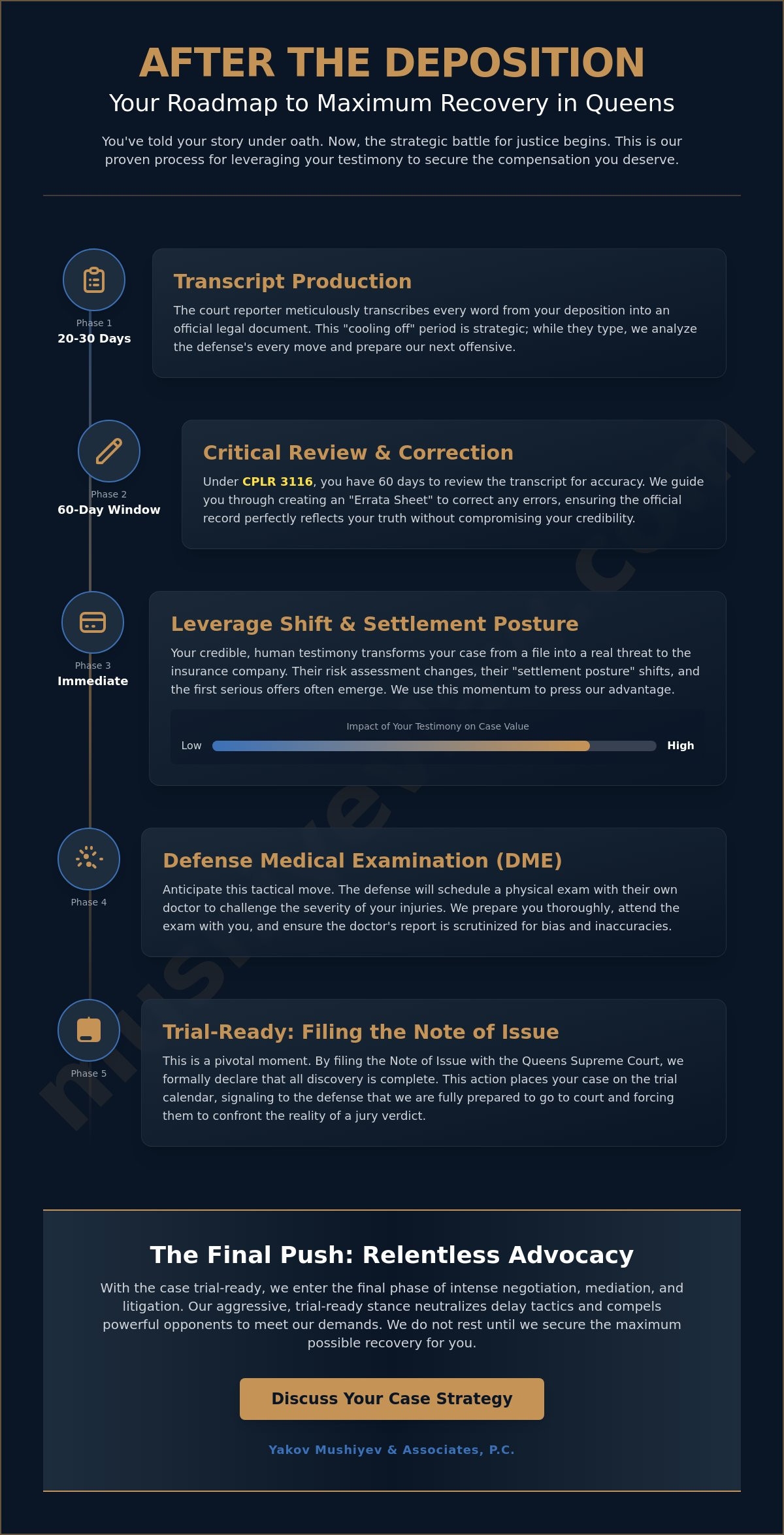
You’ve just stepped out of a high-pressure environment where every word was scrutinized by attorneys looking for a reason to deny your claim. The deposition is finished, but the legal record is just beginning to take shape. A court reporter was present to document every statement, and they’ll now spend the next 20 to 30 days producing a verbatim transcript. This waiting period is a necessary “cooling off” phase for you. It allows the adrenaline to fade so you can approach the next steps with clinical precision. We use this time to prepare for the technical review that will define the rest of your litigation journey. It’s a time for your personal recovery, but for us, it’s a time for rigorous analysis.
Many people ask what happens after my deposition in a Queens injury case because the sudden lack of activity feels unsettling after months of preparation. Don’t mistake this silence for stagnation. It’s a strategic pause. While the reporter types, we’re already calculating how your testimony impacted the defense’s willingness to pay. We’re looking for the cracks in their defense that your words just created.
To better understand this concept, watch this helpful video:
The Errata Sheet: Correcting the Record
New York law provides a specific safety net for your testimony. Under CPLR 3116, you have exactly 60 days to review your transcript and submit corrections via an errata sheet once it’s delivered. This process isn’t just a formality; it’s your shield. It allows us to fix transcription errors or clarify points where the record doesn’t match your intended meaning. You must be careful. Substantive changes to your story can be lethal to your case. If you change a fundamental fact, the defense will use the original transcript to paint you as untrustworthy in front of a jury. We analyze every potential correction to ensure your credibility remains unshakeable.
Debriefing with Yakov Mushiyev & Associates
Our advocacy doesn’t pause while the transcript is being printed. We conduct an immediate, deep-dive debriefing to analyze the defense attorney’s behavior during the session. Every lawyer has “tells” during questioning. We identify which evidence made them uncomfortable and which parts of your account resonated most with the opposition. This insight is invaluable. We use the “discovery” gained during your testimony to refine our tactical plan. If the defense showed concern regarding the specifics of your car accident or construction injury, we press that advantage. We don’t just react to the process; we lead it toward a maximum recovery.
Shifting the Settlement Posture: How Your Testimony Impacts Case Value
The deposition is the first time the defense sees the face behind the medical codes and police reports. It represents a massive shift in the leverage of your claim. Before this moment, the insurance company treated your injuries as a data point on a spreadsheet. Now, they must account for the human element. Understanding what happens after my deposition in a Queens injury case is essential for managing your expectations during the settlement phase. Your testimony has likely changed the defense’s “settlement posture,” which is the clinical term for how much risk they believe they face at trial. If you were credible and consistent, that risk—and your case value—just went up.
A successful session often triggers the first real settlement offer. The defense attorney isn’t just looking for facts; they are measuring your impact on a potential jury. Once the uncertainty of your performance is removed, the insurance carrier can no longer ignore the possibility of a high verdict. This is also the stage where we transition into the physical verification of your claims. Under the legal framework of Rule 35. Physical and Mental Examinations, the defense will likely schedule their own medical review to counter your testimony. We anticipate this move and prepare you to handle their doctors with the same precision you used during your questioning.
The Insurance Adjuster’s New Assessment
Immediately following the session, the defense attorney drafts a detailed report for the insurance adjuster. They analyze your likability, your ability to stay calm under pressure, and how well you describe your trauma. A credible plaintiff is an expensive plaintiff for an insurance company. Even if you feel you had a “bad” day or forgot a specific date, your case isn’t over. We look for the “new” evidence your testimony uncovered, such as specific ways your injury has crippled your daily routine, to force a higher valuation from the carrier. If you need help navigating these complex interactions, our personal injury legal representation is designed to protect you from being undervalued.
Leveraging Testimony for Higher Demands
We don’t wait for the defense to make the first move. We use specific, powerful quotes from your transcript to dismantle their previous arguments. If you testified vividly about the pain of a construction fall or the terror of a truck collision, those words become weapons in our updated demand package. We align your story with the clinical evidence to present an undeniable case for maximum compensation. When clients ask what happens after my deposition in a Queens injury case, we explain that the leverage has shifted into our hands. We refuse to settle for less than what your future requires, using your own words as the foundation for our next aggressive demand.
The Defense Medical Examination (DME): The Next Major Hurdle in Queens
Once your testimony is finalized on the record, the defense moves to the next phase of their tactical strategy. They’ve heard your story; now they want to minimize your physical reality. This is a pivotal part of what happens after my deposition in a Queens injury case. The Defense Medical Examination (DME) is typically scheduled shortly after your testimony because the insurance company wants their hand-picked doctor to challenge the specific limitations you described under oath. If you testified that a construction accident left you unable to lift your arm, the defense doctor will focus specifically on disproving that claim.
It is vital to understand that a DME is not a treatment session. It is a physical evaluation conducted by a physician hired and paid for by the insurance company. There is no doctor-patient relationship here. The sole purpose of this exam is to generate a medical report that minimizes your trauma and supports the defense’s narrative that you are either fully recovered or exaggerating. This is the psychological shift from talking about your injuries to proving them in a clinical setting.
What to Expect at a Queens DME
A Queens DME is notoriously brief. While your own doctors have spent months treating you, an insurance doctor might spend only ten minutes evaluating your condition. You must remain vigilant from the moment you arrive. Defense doctors often observe how you walk from the parking lot or how you sit in the waiting room. They are looking for any inconsistency between your natural movements and your deposition testimony. We advise our clients to be honest but exceptionally brief. Do not volunteer information; simply answer the doctor’s questions regarding your current symptoms without expanding on the accident itself.
Protecting Your Rights During the Exam
We do not leave you alone with the insurance company’s experts. Protecting your rights during this exam is a core part of our advocacy. In complex cases, we may utilize a legal observer or a nurse advocate to document exactly what occurs. We record the duration of the exam and note which tests the doctor performed or, more importantly, which ones they skipped. This data is critical. If the doctor’s report is biased or incomplete, we use our recorded findings to dismantle their credibility during trial. We treat these “expert witnesses” as what they are: paid extensions of the insurance company. By understanding what happens after my deposition in a Queens injury case, you can approach this exam with the confidence that your legal team is standing between you and the insurance company’s tactics.
Motion Practice and Mediation: Navigating the Queens Supreme Court Timeline
Navigating the procedural timeline of the Queens Supreme Court requires more than just legal knowledge. It requires a strategic understanding of the local landscape on Sutphin Boulevard. After the discovery phase concludes and the transcript is finalized, we file a document known as the Note of Issue. This acts as a formal declaration to the court that your case is ready for trial. It is a critical milestone in what happens after my deposition in a Queens injury case because it moves you onto the trial calendar. You must understand that the Queens court system currently faces a significant trial backlog. Insurance companies count on this delay. They hope the wait will exhaust your patience and force you to accept a lowball offer. We counter this by maintaining an aggressive stance that signals we are prepared for a jury, no matter how long the court takes.
During this period, the defense will likely engage in motion practice. This involves filing formal requests for the judge to rule on specific aspects of the case. In Queens County, filing a motion or cross-motion carries a $45.00 fee, a small price the defense is happy to pay if they think they can stall your progress. We anticipate these moves and prepare our rebuttals long before the defense ever hits the courthouse steps. If you are concerned about the pace of your claim, contact us for an evaluation of your Queens injury case to see how we can accelerate your recovery.
Summary Judgment: The Legal Fork in the Road
The defense will often file a motion for summary judgment to dismiss your case before it reaches a jury. In New York, they frequently use “threshold” motions, arguing that your injuries are not “serious” enough to warrant compensation under state law. We use your deposition testimony as a shield. By highlighting the specific “triable issues of fact” established during your questioning, we prevent the judge from dismissing your claim. Winning a motion for summary judgment on the issue of liability is a massive victory. It removes the question of who is at fault and leaves only the question of how much the insurance company must pay you.
Mediation in the Heart of Queens
Mediation often provides the final opportunity for a resolution before a trial date is set. Whether it is a court-ordered session at the courthouse or private mediation in a neutral office, the goal is to reach a settlement that reflects the full value of your trauma. A neutral mediator facilitates the dialogue, but they do not have the power to force a deal. Many Queens cases settle in the hallways of the courthouse or during these intense, hours-long sessions. Success depends on knowing your “bottom line” with the guidance of Yakov Mushiyev. If the defense refuses to meet our demands, we don’t blink. We move forward to trial.
Final Resolution: Why a Relentless Queens Advocate is Essential Now
The final stage of your litigation is often the most psychologically demanding phase of the entire process. After surviving the intensity of the questioning and the scrutiny of medical exams, many plaintiffs experience what we call “settlement fatigue.” The insurance company counts on this exhaustion. They rely on the slow pace of the court system to erode your resolve, hoping you will accept a fraction of your claim’s value just to end the uncertainty. This is a defining moment in what happens after my deposition in a Queens injury case. We prevent the defense from winning this war of attrition by maintaining an uncompromising, trial-ready stance. Our team continues to prepare your case for a jury even while negotiations are at their peak. This strategy ensures the defense sees us as a credible threat rather than a firm looking for an easy exit.
Choosing a Queens injury advocate who understands the specific tendencies of local juries makes the difference between a lowball offer and true justice. We know how insurance carriers operate in our borough. We know their tactics. We don’t blink when they try to stall. Your testimony has already set the stage, and we use that momentum to force a resolution that reflects the true cost of your trauma.
The Last Push for Maximum Compensation
As the trial date approaches, the insurance company often faces what is known as the “Trial Tax.” They realize their legal expenses are about to skyrocket and their risk of a major verdict is becoming a reality. This is typically when the most significant settlement offers appear. We analyze every “final” offer with clinical precision, comparing it against current Queens jury trends and the specific evidence we secured during discovery. If the offer fails to account for your long-term needs, we move forward. We never settle for anything less than what is perceived as fair and just for your restoration.
Life After Your Case: Restoring Your Future
Once a settlement is reached or a verdict is rendered, the final disbursement process begins. This involves more than just receiving a check. We must resolve medical liens and address insurance subrogation to ensure you keep the maximum amount of your recovery. Our team works tirelessly to:
- Negotiate with healthcare providers to reduce your outstanding medical bills.
- Verify that all legal and procedural requirements are met for a clean file closure.
- Ensure that after the “Release” is signed, your funds are delivered promptly, typically within 21 to 30 days.
Our “No Win, No Fee” promise ensures you are never at financial risk. You’ve already endured the trauma of an injury; you shouldn’t have to endure the stress of legal costs. We fight to restore your future so you can move forward with confidence.
Secure Your Maximum Recovery in Queens
The path from testimony to a final check requires unwavering focus. You’ve navigated the transcript review and faced the defense medical exam; now is the time to press your advantage. Understanding what happens after my deposition in a Queens injury case is about more than just tracking dates on a calendar. It’s about recognizing when the insurance company is vulnerable and having the clinical precision to strike. We provide the protective legal expertise needed in Rosedale and Rochdale to ensure victims aren’t silenced by powerful corporate entities or negligent parties.
Our firm provides the relentless advocacy you need to transition from a state of crisis to a state of justice. We operate under a risk-free financial arrangement where we don’t get paid unless we win for you. Don’t let settlement fatigue rob you of the compensation your future requires. Take the final step toward restoration today. Get a Free Evaluation of Your Queens Injury Case Now. You’ve done the hard work of testifying; let us finish the fight for you.
Frequently Asked Questions
How long after my deposition will I get a settlement offer in Queens?
A settlement offer typically follows once the defense attorney reports your credibility to the insurance carrier. This usually occurs within 30 to 60 days after the transcript is finalized. If your testimony was strong, the adjuster may initiate negotiations to avoid the risk of a trial. However, some carriers wait until after the Defense Medical Examination to verify your physical limitations before making a move.
Can my case be dismissed after the deposition is over?
The defense can file a motion for summary judgment to dismiss your claim after discovery. They often argue that your injuries fail to meet the “serious injury threshold” required by New York law. We counter these motions by using your deposition testimony to prove that genuine issues of fact exist for a jury to decide. Winning this motion is a critical step in what happens after my deposition in a Queens injury case.
What if I realized I made a mistake or forgot something during my deposition?
You have a 60-day window under CPLR 3116 to correct the record using an errata sheet. This period begins once the court reporter delivers the transcript. You can correct transcription errors or clarify confusing answers. You must be cautious; significant changes to your story can be used by the defense to attack your credibility during a trial. We review every correction to protect your case value.
Do I have to go to the Defense Medical Exam (DME) if I already had a deposition?
You are generally required to attend the DME as part of the discovery process in New York. While the deposition covers your account of the accident, the DME allows the insurance company’s doctor to evaluate your physical condition. The defense waits until after your testimony to schedule this exam so their doctor can specifically target the injuries and limitations you described under oath.
Why is my Queens injury case taking so long to reach trial after the discovery phase?
The backlog at the Queens Supreme Court on Sutphin Boulevard is the primary reason for the delay. Once we file the Note of Issue, your case is placed on the trial calendar. Because of the high volume of litigation in our borough, it can take months or even years to reach a trial date. We use this time to keep pressure on the insurance company, showing them we are ready to fight.
Will I have to testify again in court after my deposition?
You will only testify again if your case proceeds to a full trial. Most injury claims in Queens reach a settlement before that happens. If a trial is necessary, you will tell your story to a judge and jury. Your previous deposition testimony will be used as a reference point. Consistency is vital because the defense will look for any contradictions between your past and present statements.
What is the difference between a deposition and mediation in a NY injury case?
A deposition is a formal discovery tool used to gather sworn evidence, while mediation is a voluntary or court-ordered settlement negotiation. During a deposition, you answer questions from the defense. In mediation, a neutral third party helps both sides reach a financial agreement. One is about building the record; the other is about ending the litigation with a fair payout.
How much of my settlement goes to my lawyer and medical bills?
Your final recovery is distributed according to a standard contingency fee agreement and the resolution of medical liens. We work on a “no win, no fee” basis, meaning our fee is a percentage of the final settlement or verdict. We also aggressively negotiate with your healthcare providers to reduce medical liens and subrogation claims. This ensures that the largest possible portion of the settlement stays in your pocket.

