
Proving a Property Owner Was Negligent in a Slip and Fall Case: The NY Legal Standard
In New York, the mere fact that you fell and suffered a life-altering injury does not mean the property owner is automatically responsible for your medical bills. You are likely facing a mountain of debt from ER visits and the stress of missing paychecks while insurance adjusters pressure you to admit fault. It feels like the system is rigged against you when you are at your most vulnerable. Successfully proving a property owner was negligent in a slip and fall case requires more than just showing a hazard existed; it demands clear evidence that the owner had actual or constructive notice of the danger before you ever lost your footing.
We understand the trauma you are experiencing and the weight of the fight ahead. This guide will help you master the legal requirements and evidence needed to hold a New York property owner accountable for your injuries. We will break down the critical role of notice, explain how New York’s comparative negligence rules affect your recovery, and provide a clear roadmap for securing the justice you deserve.
Key Takeaways
- Understand the specific legal standards and “Duty of Care” that New York property owners must meet to keep visitors and tenants safe.
- Discover why “Notice” is the central battleground when proving a property owner was negligent in a slip and fall case.
- Learn which evidence disappears first and how to document the scene to prevent insurance adjusters from shifting the blame.
- See how New York’s pure comparative negligence rule allows you to recover damages even if the defense argues the hazard was open and obvious.
- Explore how a street-smart legal investigation in Queens can expose negligence and secure the maximum compensation for your trauma.
Proving Negligence in a New York Slip and Fall Case
A slip and fall incident is more than a moment of embarrassment; it’s a traumatic event that can derail your life in an instant. In New York, the legal definition of negligence centers on the failure of a property owner to exercise reasonable care under the circumstances. Simply hitting the ground does not trigger a payout. To succeed in your claim, you must demonstrate that the owner ignored a safety standard they were legally bound to uphold. Falling isn’t a crime, but ignoring a foreseeable hazard is a breach of the law.
Whether you are shopping at a supermarket in Queens or visiting a residential apartment complex, the owner owes you a “Duty of Care.” This is a non-negotiable legal obligation to maintain a premises that is reasonably safe for all lawful visitors. New York law previously focused heavily on your status as a guest or trespasser, but the modern standard is more direct. Owners must act reasonably to keep their property safe for anyone whose presence is foreseeable. If you were invited onto the property as a customer or tenant, the owner’s responsibility to inspect and repair hazards is at its highest level.
Proving a property owner was negligent in a slip and fall case requires pinpointing a specific breach of this duty. If a landlord ignores a leaky pipe for weeks and you slip on the resulting puddle, they have breached their duty. If a store manager sees a broken glass bottle and walks away without marking the area, they have chosen convenience over your safety. We don’t accept “accidents” as an excuse when a simple repair could have prevented your hospital visit.
The Four Pillars of a Premises Liability Claim
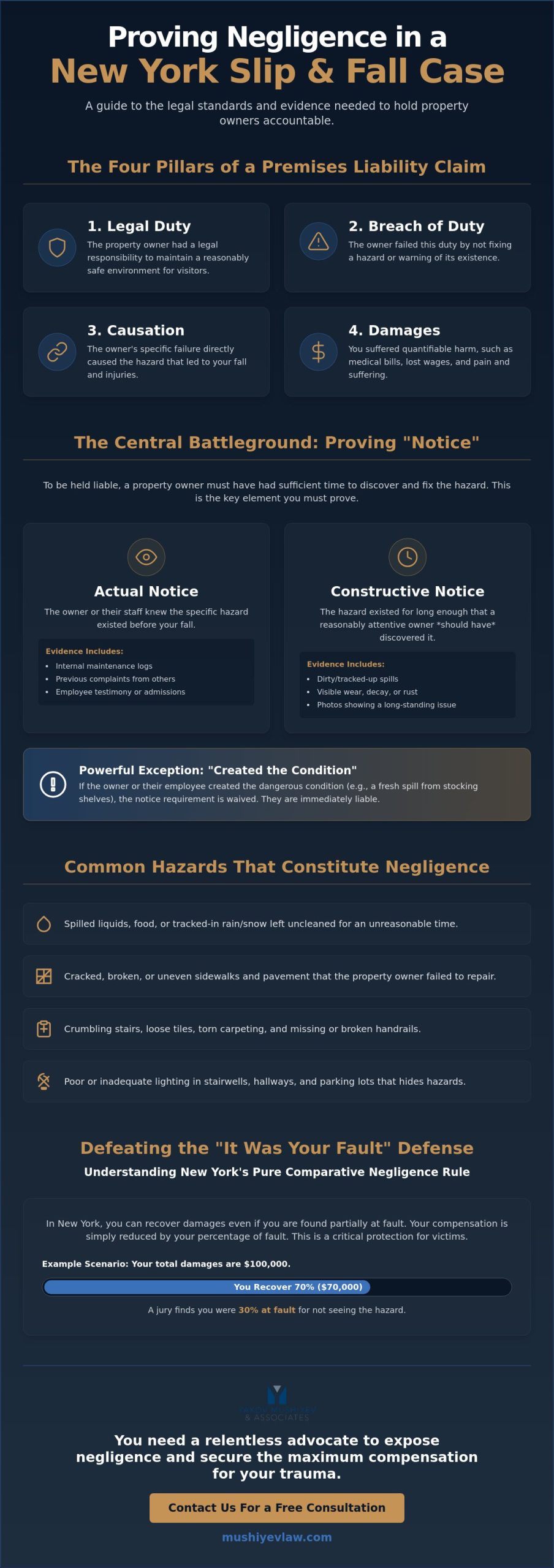
To hold a powerful property owner or insurance company accountable, your case must stand on four specific legal pillars:
- Legal Duty: Establishing that the defendant owned or controlled the property and had a responsibility to keep you safe.
- Breach of Duty: Proving the owner failed to fix a known hazard or failed to provide an adequate warning.
- Causation: Directly linking the owner’s failure to the specific hazard that caused you to fall and suffer injuries.
- Damages: Quantifying the real-world impact, including ER bills, lost wages, and the physical pain that has disrupted your life.
Common Hazards That Constitute Negligence
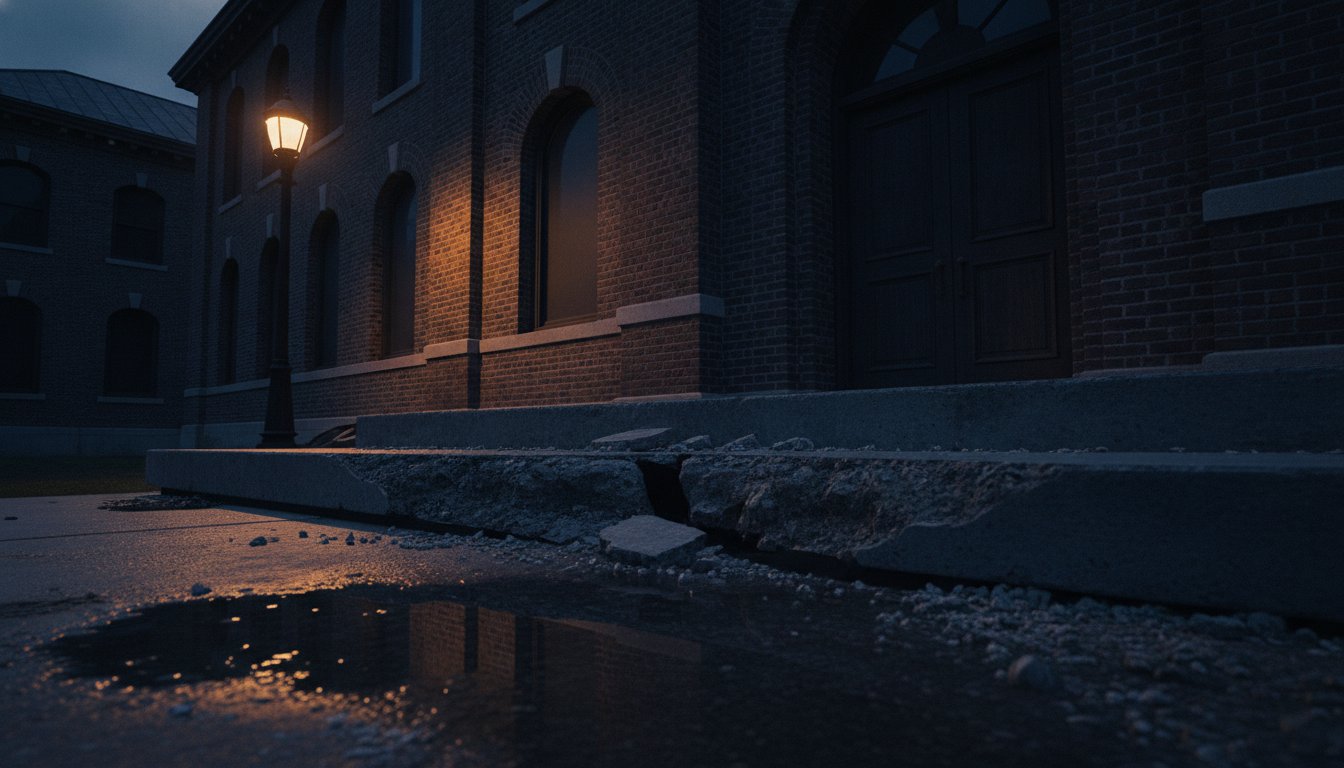
Negligence often hides in the details of poor maintenance. We frequently see cases involving transient substances like spilled liquids or tracked-in slush that sat on a floor for hours without being cleaned. Structural defects are also rampant across NYC. These include crumbling concrete stairs, missing handrails, and cracked sidewalks that the abutting property owner failed to repair. Even environmental factors like poor lighting in a stairwell can turn a routine walk into a catastrophic event. These aren’t just bad luck. They are actionable failures of management.
The ‘Notice’ Requirement: Actual vs. Constructive Knowledge
The legal battlefield of a New York premises liability claim often boils down to a single word: Notice. You cannot simply point to a puddle or a broken tile and expect a settlement. Under New York law, the owner is only liable if they had enough time to discover and fix the hazard. This requirement serves as a shield for property owners, but it becomes your primary target when proving a property owner was negligent in a slip and fall case. This is the plaintiff’s burden of proof that must be met with clinical precision to overcome aggressive defense tactics.
If the owner or their staff created the danger themselves, the notice requirement is waived. This “created the condition” exception is a powerful tool against negligent businesses. For example, if a grocery store employee stacks jars precariously and they fall, creating a spill, the store cannot claim they didn’t have time to find the mess. They are responsible from the moment the hazard was born of their own carelessness. In these scenarios, the owner’s direct involvement is the only proof needed to establish their liability.
Proving Actual Notice with Direct Evidence
Actual notice is the most straightforward path, yet it requires aggressive investigation. We look for paper trails that the defense hopes will stay buried. This includes reviewing formal complaints filed by previous tenants or internal maintenance logs that flagged a structural defect weeks before your accident. In many Queens retail settings, an employee might even make a spontaneous admission like, “I told them to fix that leak an hour ago.” These statements are powerful evidence that the owner chose to ignore a known threat to your safety. We move quickly to preserve these records before they are lost or overwritten.
Winning on Constructive Notice: The Timeline is Key
When direct evidence is missing, we pivot to constructive notice. The central question is: “How long was the hazard there?” New York courts look for “time-on-the-floor” evidence. If you slipped on a piece of fruit that was smashed and dirty, it suggests the hazard had been there long enough for the owner to find it. Surveillance footage is often the definitive resolution in these disputes, as it can pinpoint exactly when a spill occurred. If a landlord fails to perform regular safety sweeps, they cannot claim ignorance as a defense. If you believe your fall was caused by long-term neglect, consulting with a specialist in Slip and Fall Legal Representation can help you secure the timeline evidence needed to win.
Critical Evidence Needed to Build a Winning Claim in Queens
The sixty minutes following your accident are the “Golden Hour” of your legal claim. In a high-traffic borough like Queens, evidence does not wait for you to recover. Janitors mop up spills, snow is salted, and broken tiles are patched within hours of a fall. If you don’t secure the scene immediately, you lose the primary tools for proving a property owner was negligent in a slip and fall case. While your priority is your health, capturing the reality of the hazard before it is “sanitized” by the property manager is the definitive resolution to future disputes with insurance adjusters. We act as your shield by preserving the truth before it disappears.
Third-party witness statements carry immense weight because they are perceived as unbiased. While your own account is vital, a bystander who saw the puddle or heard you scream provides the external validation needed to crush the “it was your fault” defense. Filing an official store incident report is a calculated move. It creates a paper trail that the owner cannot later deny. However, you must be wary. Never sign a statement that includes an admission of fault or suggests you weren’t looking where you were going. According to the New York City Bar on Slip and Fall Cases, establishing the specific cause and the owner’s liability is the foundation of any successful recovery. We ensure these reports are used as a sword for your case, not a shield for the defense.
The Power of Visual Documentation
Your smartphone is your most potent weapon at the scene. Take wide-angle shots to document the entire area, specifically showing the absence of yellow warning cones or “wet floor” signs. Transition to close-up photos of the substance itself. Look for footprints, shopping cart tracks, or dirt that suggests the hazard was ignored for a long time. Finally, capture the “view from the ground.” This perspective proves what was actually visible to you at the moment of impact. It can defeat claims that the danger was so obvious you should have avoided it. If you can’t take these photos yourself, ask a friend or witness to do it for you.
Expert Testimony and Technical Reports
We don’t just rely on photos; we deploy experts to quantify the owner’s failure. Flooring specialists use digital tribometers to measure the “coefficient of friction.” If a floor is too slippery for standard footwear, it’s a trap, not a floor. In NYC, we leverage specific violations of the NYC Building Code or Administrative Code § 7-210 regarding sidewalk maintenance. When an owner violates a safety statute, it can constitute “negligence per se,” which significantly lowers the barrier to proving liability. We also utilize medical experts to testify how the specific mechanics of your fall directly align with the defect we’ve documented.
Defeating the ‘It Was Your Fault’ Defense: Comparative Negligence
Insurance companies are not your friends. After a serious injury, their primary objective is to protect their bottom line by shifting the blame onto you. They will weaponize your trauma, arguing that you were distracted by your phone, wearing inappropriate shoes, or that the hazard was so “open and obvious” that you should have avoided it. This is why proving a property owner was negligent in a slip and fall case requires a strategic counter-offensive against these victim-blaming tactics. We act as your shield, ensuring that a property owner’s failure to maintain a safe environment isn’t overshadowed by aggressive defense lawyers.
You must be extremely careful with your words immediately following a fall. Never admit fault to a store manager, and never give a recorded statement to an insurance adjuster without a lawyer present. They are trained to extract admissions that can be used to devalue your claim. If they can trick you into saying you “weren’t looking,” they will use that single sentence to slash your compensation. We stand between you and these formidable opponents, forcing them to address their own client’s negligence instead of scrutinizing your every move.
Understanding NY Pure Comparative Fault
New York follows a “pure comparative negligence” rule under N.Y. C.P.L.R. § 1411. Pure comparative negligence is the legal standard that prevents a victim’s minor oversight from barring their entire recovery. In many other states, being 51% at fault means you get nothing. In New York, you can still recover damages even if you are partially responsible for the accident. A Queens jury will assign a percentage of blame to each party, and your final award is reduced by that amount. If your damages are $200,000 and you are found 10% at fault for a minor distraction, you still recover $180,000. Our goal is always to prove the owner is 100% liable.
Common Defense Tactics and How to Counter Them
The “Open and Obvious” defense is a favorite for negligent property owners. They claim that because a hazard was visible, they had no duty to fix it. We defeat this by showing that while a danger might be visible, it doesn’t excuse the owner’s failure to provide a safe walkway. We also utilize the “distraction” exception; New York law recognizes that pedestrians aren’t expected to stare at their feet 24/7, especially in busy commercial environments. If you are facing these maneuvers, see our guide on Slip and Fall Legal Representation in Rosedale & Rochdale, Queens for more on local defense trends. If you’re ready to fight back, contact us for an expert Slip and Fall Legal Representation assessment today.
Why You Need a Relentless Queens Slip and Fall Advocate
The streets of Queens are a complex legal landscape. You aren’t just fighting a property owner; you’re fighting their massive insurance carrier. These entities have unlimited resources and one goal: to pay you nothing. Proving a property owner was negligent in a slip and fall case in a major metropolitan area requires more than just knowing the law. It requires a street-smart strategy that anticipates defense maneuvers before they happen. Yakov Mushiyev & Associates, P.C. serves as your necessary shield, providing the clinical precision of legal expertise combined with a tireless drive for justice. We understand that in NYC, property owners often think they are untouchable. We are here to prove them wrong.
We understand the crushing weight of medical debt and the anxiety of missing work. Our firm operates on a risk-free financial arrangement. This means we don’t charge a fee unless we win your case. By removing the financial barrier to justice, we allow you to focus on your recovery while we handle the high-stakes litigation. We refuse to settle for anything less than what is fair. Our commitment is rooted in a sense of duty to our community. We believe every victim deserves an advocate who is as relentless as the opponents they face. We move with a sense of momentum because we know that in these matters, time is of the essence.
Our Strategic Approach to Slip and Fall Litigation
Time is your enemy in premises liability. We immediately dispatch investigators to secure surveillance footage and identify witnesses before evidence is lost or destroyed. Our team uses aggressive deposition tactics to catch property owners in lies regarding their notice of the hazard. We know exactly where to look for the cracks in their defense. This proactive approach ensures that we are always one step ahead of the insurance adjusters who are pressuring you to settle for less. To understand our commitment to this level of detail, learn more about our firm’s Personal Injury Lawyer Rosedale NY philosophy.
Restoring Your Life After a Serious Injury
A serious injury affects more than your body; it threatens your future financial stability. We work to maximize compensation for long-term rehabilitation, future lost earnings, and the personal trauma you’ve endured. Our role is to be your steady, calm guide during this crisis. We take the fight to powerful insurance companies and negligent landlords so you don’t have to carry that burden alone. You deserve a fighter who is intimidating to opponents but remains approachable for you. We are ready to move forward with your claim with the urgency and efficiency your situation demands.
Don’t let a property owner’s carelessness dictate your future. Schedule your free consultation with Yakov Mushiyev & Associates, P.C. today.
Secure Your Financial Recovery Today
Your path to restoration depends on more than just medical treatment. It requires a decisive legal response to the trauma you’ve endured. Winning your claim hinges on documenting the scene immediately and countering the insurance company’s attempts to shift the blame onto you. Successfully proving a property owner was negligent in a slip and fall case is a high-stakes challenge that demands street-smart advocacy and a deep understanding of New York’s specific premises liability standards.
Yakov Mushiyev & Associates, P.C. brings decades of experience in Queens personal injury litigation to your corner. We act as a formidable shield against major NYC insurers who want to devalue your injuries. With our no-fee guarantee, you don’t pay us unless we win your case. This risk-free arrangement ensures that your current financial burden never stands in the way of holding a negligent landlord or business owner accountable.
Fight back against negligent property owners; contact Yakov Mushiyev & Associates, P.C. for a free case evaluation. You have the right to seek justice for your losses. We are ready to start building your winning claim today.
Frequently Asked Questions
How do I prove the property owner knew about the danger?
You prove knowledge through actual or constructive notice. Actual notice exists if an employee saw the hazard or a tenant reported it previously. Constructive notice is established by showing the hazard existed long enough that the owner should have discovered it. This is a critical step in proving a property owner was negligent in a slip and fall case, as it establishes they had a reasonable window to act but failed to protect you.
What if there were no ‘Wet Floor’ signs present?
The absence of “Wet Floor” signs is a significant breach of the owner’s duty to warn visitors. If a property manager knows a floor is slick but fails to mark the area, they’ve knowingly exposed you to a trap. We use this failure to demonstrate that the owner prioritized convenience over your safety. Photos of the scene showing no signs are vital to crushing any defense argument that they acted reasonably.
Can I still sue if I was partially at fault for my fall in New York?
Yes, you can recover damages even if you were partially at fault. New York follows a pure comparative negligence rule under N.Y. C.P.L.R. § 1411. This means your final award is reduced by your percentage of blame, but it isn’t eliminated. If a jury finds you 20% responsible for not seeing a spill, you still recover 80% of your total damages. We fight to keep your percentage of fault at zero.
What is the statute of limitations for a slip and fall in NYC?
For most accidents involving private property owners in NYC, you have three years from the date of the injury to file a lawsuit. However, if the fall occurred on government property, the timeline is much tighter. You must file a formal Notice of Claim within 90 days of the incident. Failing to meet these strict deadlines can permanently bar your right to recovery, making immediate legal intervention essential.
Should I give a statement to the property owner’s insurance company?
You should never provide a recorded statement to the owner’s insurance company without your attorney present. Adjusters are trained to lead you into making admissions that suggest you were at fault or that your injuries aren’t serious. They’ll use your own words to devalue your claim later. Let your legal advocate handle all communications to ensure your rights are protected from these predatory tactics.
How much is my slip and fall case worth in Queens?
Case value varies based on the severity of your injuries and the impact on your earnings. Typical New York settlements range from $15,000 for minor fractures to over $250,000 for injuries requiring surgery. The most significant factor is often whether you needed surgical intervention and the length of your recovery. We perform a clinical analysis of your medical records to ensure we pursue the maximum compensation available for your trauma.
What happens if I fell on a city-owned sidewalk in NYC?
Under NYC Administrative Code § 7-210, the responsibility for sidewalk maintenance usually falls on the abutting property owner, not the city. This law applies to most commercial and residential buildings, except for one, two, and three family owner occupied homes. Identifying the correct liable party is a complex task. We investigate property records to ensure the negligent owner is held accountable for your medical bills and lost wages.
Do I need a lawyer if the insurance company offered me a settlement?
You absolutely need a lawyer because initial settlement offers are almost always lowball figures designed to make you go away cheaply. Insurance companies know you’re facing medical debt and hope you’ll settle before you realize the true cost of your long term care. A relentless advocate will calculate your future lost wages and pain and suffering to ensure you don’t settle for a fraction of what you deserve.

