
New York Labor Law 240
New York Labor Law 240: What Injured Construction Workers Need to Know
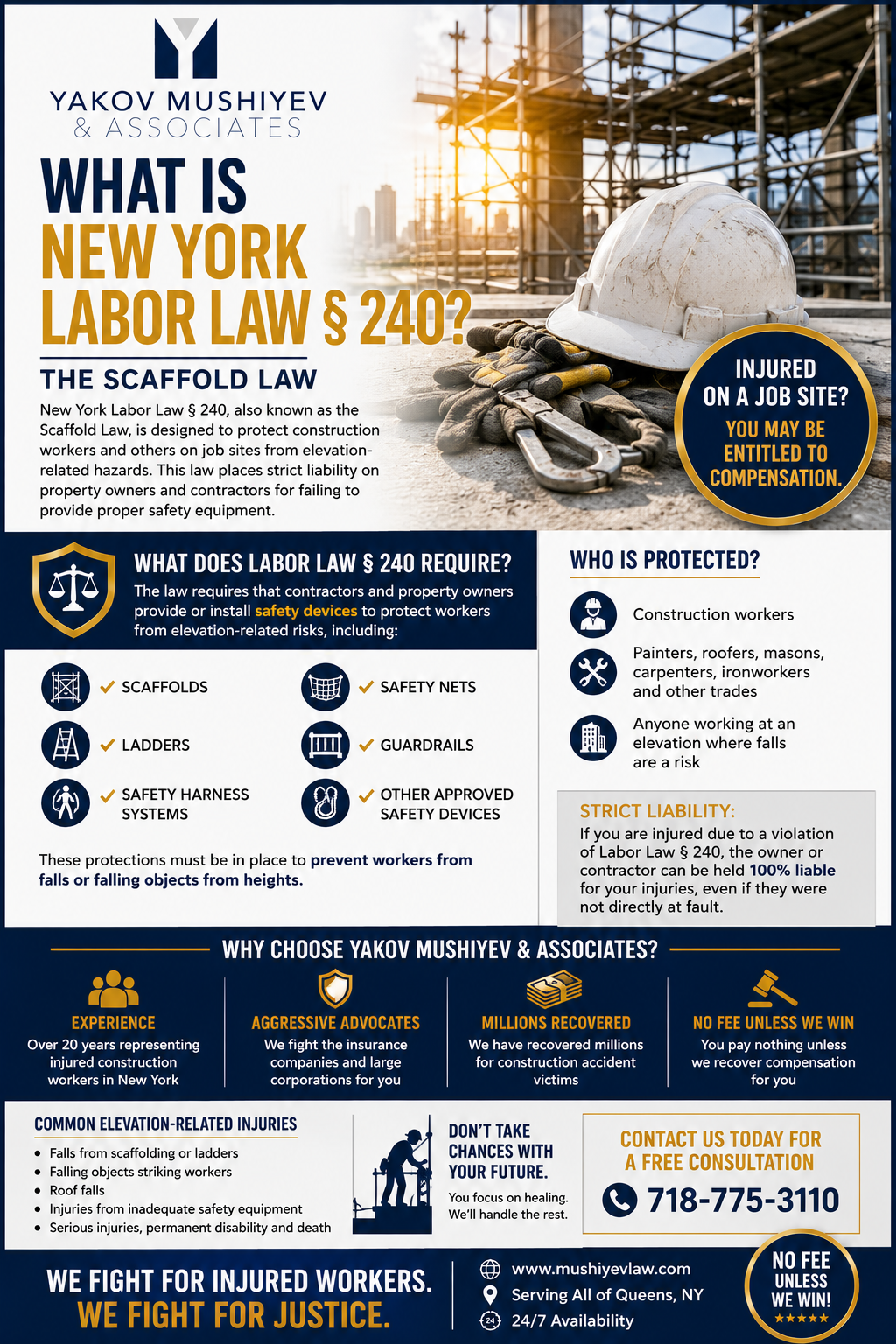
New York’s construction industry is one of the most dangerous in the country. High-rise projects, renovation work, and infrastructure construction expose workers to serious fall risks every day. Fortunately, New York State provides some of the strongest legal protections for construction workers anywhere in the nation — most notably through Labor Law § 240, commonly known as the ‘Scaffold Law.’
If you were injured in a fall or struck by a falling object on a New York construction site, Labor Law § 240 may entitle you to significant compensation. This guide explains how the law works and what you need to do to protect your rights.
What Is New York Labor Law § 240?
New York Labor Law § 240, codified at NY Labor Law § 240, imposes absolute liability on property owners and general contractors for certain gravity-related construction accidents. This means that if a worker falls from an elevated surface — or is struck by a falling object — because the site owner or contractor failed to provide adequate safety equipment, they are liable for the worker’s injuries, regardless of the worker’s own conduct.
The law covers a wide range of construction activities, including work on scaffolding, ladders, and elevated platforms; roofing work; demolition; excavation; painting, cleaning, and repairing buildings; and steel erection and structural work.
What Makes Labor Law § 240 So Powerful for Workers?
Unlike typical negligence claims where fault is apportioned between the parties, Labor Law § 240 imposes absolute (strict) liability on owners and contractors for covered accidents. The worker does not need to prove the owner or contractor was negligent. Comparative negligence — the idea that the worker’s own negligence reduces recovery — generally does not apply under § 240. Even if the worker made a mistake, the owner/contractor remains fully liable as long as the inadequate safety equipment was a proximate cause of the injury.
This is an extraordinarily worker-friendly legal standard that does not exist in most other states. It reflects New York’s strong policy of protecting construction workers from the dangers of height-related accidents.
Who Is Covered by Labor Law § 240?
Labor Law § 240 applies to workers employed in construction, demolition, renovation, excavation, and repair of buildings and structures. Covered workers include general laborers, ironworkers, carpenters, painters, electricians, and virtually any trade worker performing work in connection with a building or structure. Independent contractors are also typically covered.
Who Can Be Sued Under Labor Law § 240?
The law imposes liability on property owners (with some exceptions for one- and two-family homeowners who are not directing the work), general contractors, construction managers, and any party who has the authority to direct and control the work. This means your employer’s workers’ compensation coverage is not the only source of compensation available — you may have a separate personal injury claim against the property owner or general contractor, significantly increasing your total recovery.
Labor Law § 241(6) and § 200: Additional Worker Protections
In addition to § 240, injured construction workers may have claims under Labor Law § 241(6), which requires property owners and contractors to maintain construction sites in a safe condition and comply with specific Industrial Code regulations, and Labor Law § 200, which is New York’s codification of the common law duty of site owners and contractors to maintain reasonably safe work conditions. These statutes often work together to provide comprehensive protection for injured workers.
Common Construction Accident Injuries
Falls from scaffolding, ladders, and rooftops are the most devastating type of construction accident. Common injuries include spinal cord injuries and paralysis, traumatic brain injury (TBI), multiple fractures, internal organ damage, and death.
According to OSHA’s Fatal Four data, falls account for approximately 36% of all construction fatalities nationally. In New York, with its concentration of high-rise projects, fall accidents are especially prevalent and often catastrophic.
What to Do After a Construction Accident
If you are injured on a New York construction site: seek emergency medical treatment immediately; report the accident to your supervisor in writing; photograph the accident scene and the equipment involved; preserve any defective equipment; file a workers’ compensation claim; and contact a construction accident attorney before speaking with any insurance company.
Our team at Mushiyev Law has extensive experience representing construction workers injured in New York City. Learn more about our construction accident practice in Homecrest and across NYC.
Statute of Limitations for Labor Law § 240 Claims
Personal injury claims under Labor Law § 240 must generally be filed within three years of the accident under CPLR § 214. However, if a government entity owns the property, a Notice of Claim must be filed within 90 days. Do not wait — evidence at construction sites is frequently destroyed or altered after an accident.
Conclusion
New York Labor Law § 240 is one of the most powerful tools available to injured construction workers. If you suffered a fall or were struck by a falling object on a New York construction site, Mushiyev Law can evaluate your claim and pursue every dollar you are owed. Contact us today for a free consultation — we work on contingency and you pay nothing unless we win.

