
Construction Accident Lawyer in Great Neck, NY
A construction injury in Great Neck rarely happens on a tower-crane job. It happens on a roof off Baker Hill Road, on a ladder against a two-story addition near Cutter Mill Road, in a trench cut into Middle Neck Road, or inside a school gutted over the summer. The sites are small, spread across ZIP codes 11020, 11021, 11023 and 11024. The law is not small at all: New York’s Labor Law gives an injured worker in Nassau County protections among the strongest in the country, and they apply on Long Island exactly as in Midtown. Yakov Mushiyev & Associates, P.C. has recovered over $50 million for injured clients and brings these cases in Supreme Court, Nassau County, in Mineola.
If you were hurt on a job site anywhere on the peninsula, call 718.775.3110 for a free case review. We advance all case expenses, there is no fee unless we win, and we will come to you.
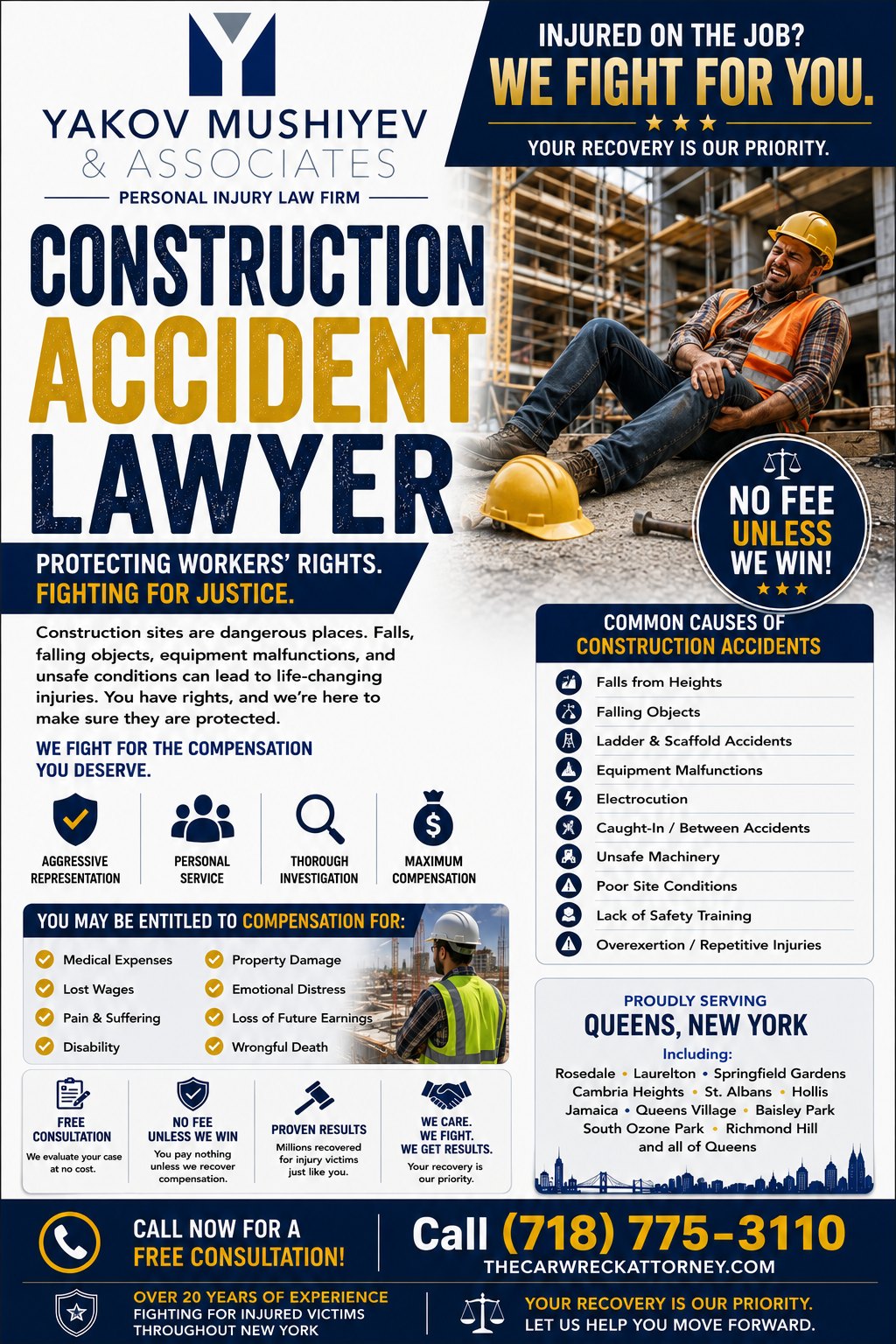
Construction Accident Lawyer Serving Great Neck and the Nine Villages
The peninsula sits inside the Town of North Hempstead and holds nine incorporated villages — the Village of Great Neck, Great Neck Estates, Great Neck Plaza, Kensington, Kings Point, Lake Success, Russell Gardens, Saddle Rock and Thomaston — plus unincorporated territory run by the Town. The permit for your job came from one specific building department, and the plans, inspections and correspondence telling the contractor what he could and could not do sit there. Those documents usually decide whether the owner controlled the work.
The patchwork also decides who else can be sued. A school project brings in the Great Neck Union Free School District; a park or the LIRR commuter lots bring in the Great Neck Park District; a county-owned roadway brings in Nassau County. Each is a separate public corporation. See our Great Neck injury lawyer page and our Nassau County coverage.
Nassau County Construction Accident Lawyers on Great Neck Job Sites
Work here concentrates in four settings: private homes, where renovations, dormers, additions and roofing run nearly year-round; the commercial corridor, where fit-outs and facade repair happen with no staging room; institutional projects — school buildings, village facilities, utilities; and roadway work, which on Middle Neck Road through the commercial corridor means a road owned and maintained by Nassau County.
Each produces its own injuries. Residential work produces ladder and roof falls, falls through unguarded openings, and collapsing or improperly footed scaffolds. Fit-outs produce falls from baker’s scaffolds and lifts, and struck-by injuries from material dropped overhead. Roadway work produces trench collapses and live traffic feet from the crew — near the Lakeville Road and Community Drive interchange on the Long Island Expressway, that traffic never stops. A worker struck by a passing vehicle may have both a Labor Law claim and an ordinary negligence claim; see Truck Accident Lawyer Great Neck.
Injuries We See
Gravity does most of the damage. Falls from ladders, roofs, scaffolds and open floor edges produce spinal fractures, brain injuries and complex fractures of the wrist, ankle and heel. Falling tools and sheet material produce skull fractures and crush injuries from a short drop. Trench work produces crush and asphyxial injuries, unguarded saws produce amputations, and electrical contact produces burns worse than they look.
Seriously injured workers are typically transported to North Shore University Hospital, 300 Community Drive, Manhasset — the nearest Level I trauma center. Neither Long Island Jewish Medical Center nor St. Francis Hospital appears on the state’s designated trauma center list. Get those first-admission records early; operative reports describe the mechanism of injury more honestly than accident reports do.
The New York Law That Applies
The Labor Law is statewide, and that is the good news
New York’s construction Labor Law is state law, and it does not stop at the New York City line. A worker hurt in Great Neck has the same rights under Labor Law §§ 240(1), 241(6) and 200 as a worker hurt on a Manhattan high-rise. What differs in Nassau is not the statute — it is who the owner turns out to be.
Labor Law § 240(1) — the Scaffold Law
Labor Law § 240(1) requires owners, contractors and their agents to furnish and place scaffolds, hoists, ladders, slings and braces so as to give proper protection. It reaches elevation-related and gravity risks specifically: falls from height, and objects falling onto a worker. Liability is absolute and non-delegable — the owner cannot shift it to the sub who ran the job — and the worker’s own comparative negligence is not a defense. The Court of Appeals said so in Blake v Neighborhood Hous. Servs. of N.Y. City, 1 NY3d 280.
“Absolute” oversells it. Blake preserved the defense that the worker’s own conduct was the sole proximate cause — classically, a worker who had a proper safety device available, knew he was expected to use it, and chose not to. Where that defense has real facts behind it, a § 240(1) case can fail, which is why investigating what equipment was on site matters so early.
The single-family homeowner exemption — the Great Neck question
This provision decides more Great Neck construction cases than any other. Both § 240(1) and § 241(6) exempt owners of one- and two-family dwellings who contract for but do not direct or control the work. On a Queens high-rise that exemption is irrelevant. On a peninsula built overwhelmingly of single-family houses, under constant renovation, it is live in nearly every residential case.
So the case turns on one question: did the homeowner direct or control the work? Contracting for the job — hiring a roofer, agreeing a price, picking the shingles, being home while the crew works — is not direction or control. Telling the crew how to work, supplying the ladder or scaffold, setting the sequence, or acting as one’s own general contractor is a different picture. Homeowners who pull their own permits and coordinate their own trades often do not realize they have stepped outside the exemption. Permits, texts, emails and payment records answer that, early or not at all.
Even where the exemption protects the homeowner, it protects no one else. The general contractor, the roofer, the scaffold supplier, the equipment lessor and any agent with authority over the work stay in the case. It is a reason to widen the defendant list, not to close the file.
Labor Law § 241(6) and the Industrial Code
Labor Law § 241(6) requires areas where construction, excavation or demolition work is performed to be shored, equipped, guarded and operated so as to give reasonable and adequate protection to the people working there. The duty is non-delegable. But the claim must be pleaded on a specific provision of the Industrial Code at 12 NYCRR Part 23 — a rule commanding a particular thing, not a general call to be safe. And unlike § 240(1), comparative fault applies: a worker’s share of the fault reduces damages rather than ending the claim.
Labor Law § 200 and the common-law duty
Section 200 codifies the common-law duty to provide a safe place to work. It is not strict liability. Where the injury came from a dangerous condition, it requires proof the defendant created it or had notice of it. Where it came from the means and methods of the work, it requires authority to supervise and control how that work was done — the same evidence that answers the homeowner question.
OSHA does not give you a claim
Federal OSHA construction standards, 29 CFR Part 1926, create no private right of action, and an OSHA violation cannot support a § 241(6) claim — only the New York Industrial Code can. A citation is still useful evidence of an unsafe practice, but it is evidentiary only, and a client should hear that on day one.
Contact Us Now
Hurt in Great Neck or anywhere in Nassau County? Talk to a lawyer today — the consultation is free, we advance all case expenses, and there is no fee unless we win.
Call 718.775.3110 | Contact Us Now →
We answer 24/7 and we will come to you on Long Island if you cannot travel.
Why a Long Island Construction Accident Case Is Different From a New York City One
The statutes are identical. The job sites are not. A Long Island construction accident is far likelier to have happened on a one- or two-family house, which puts the homeowner exemption on the table immediately, and likelier to involve a small contractor with thin insurance, so finding every additional insured and excess layer becomes a priority. The owner is often an individual, not a company, and individuals keep no site logs. Compare our Queens page on construction accidents in Fresh Meadows: same law, a different proof problem.
Two local specifics matter. On roadway and utility work, who owns the road decides who else is a defendant: Middle Neck Road is owned and maintained by Nassau County through the commercial corridor, while north of Redbrook Road in Kings Point it continues as a village-maintained road, and other streets vary. And the U.S. Merchant Marine Academy at 300 Steamboat Road, Kings Point is federal property, operated by the U.S. Department of Transportation. An injury there is a federal claim against the United States under the Federal Tort Claims Act, not New York’s municipal claim rules — a different defendant and a different process, so get it in front of a lawyer immediately.
Workers’ Compensation and the Third-Party Case
Workers’ Compensation Law § 11 makes compensation exclusive and in place of any other liability against your employer. You generally cannot sue the company you work for. That is why the Labor Law case matters: it runs against the owner, the general contractor and their agents, who are not your employer, and that is where recovery for pain and suffering and full lost earnings lives. The two run in parallel — comp pays treatment and wage benefits while the third-party case is litigated. Section 11 also bars passing liability back to your employer unless you suffered a statutory “grave injury,” a short list including death, paraplegia or quadriplegia, amputations, total permanent blindness or deafness, and permanent and severe facial disfigurement.
One trap deserves its own paragraph. Workers’ Compensation Law § 29 governs third-party actions and the carrier’s lien on what you recover from the owner and contractor, and it conditions your continued benefits on handling that settlement correctly — settling without the carrier’s consent or the required approval can jeopardize benefits you are still receiving. Do not settle anything without a lawyer looking at both files together; our work-related injury practice runs them side by side.
And plainly: immigration status does not remove the protections of the Labor Law. Undocumented workers are covered by §§ 240(1), 241(6) and 200 like anyone else on the site.
What To Do Right Now
- Get treated, and tell the emergency department how it happened — from what height, off what device, struck by what.
- Report the injury to your employer in writing. A verbal report to a foreman disappears.
- Photograph the ladder or scaffold, the tie-offs or lack of them, the opening you fell through, and any contractor signage.
- Write down every company on site — general contractor, subs, equipment supplier — and the owner’s name.
- Note who told you to do the task, who supplied the equipment, and whether the owner gave instructions.
- Give no recorded statement to an insurer or investigator before you speak with a lawyer.
- Sign nothing closing out a claim, and take no cash offered to make it go away.
- Call 718.775.3110. The scaffold you fell from will not be there next week.
Deadlines in a Great Neck Construction Accident Case
Against a private owner or contractor, CPLR § 214(5) allows three years from the date of injury, and a wrongful death action runs on its own two-year period. Those are outside limits, not a schedule.
Public work changes everything. On a school district, county, town, village or special district project, a notice of claim under General Municipal Law § 50-e must be served within ninety days, on the correct public corporation, as the statute requires. Nassau County receives written notice at the Office of the County Attorney, One West Street, Mineola. Serving one public corporation does not serve another, and missing the ninety days can end the claim however clear the violation was.
Villages are the sharpest edge. A village claim needs a notice of claim within ninety days, a claim filed with the village clerk, and a waiting period before suit — and two statutes, General Municipal Law § 50-i and CPLR § 9802, set different periods for starting the action, one as short as a single year. Because the shorter may apply, a village case runs on a contested clock and must be reviewed by a lawyer immediately. Your compensation claim has its own separate deadlines; both belong on one calendar.
How We Build a Great Neck Construction Accident Case
We start with ownership and control: the deed, the permit file from the village or Town, the inspection history, and every contract from the owner down to the sub that employed you. On a residential job those documents are the whole homeowner-exemption fight, and they can be obtained before suit. We identify the safety devices that were and were not on site, preserve the ladder or scaffold where possible, and photograph the location before the job finishes.
Then we plead § 241(6) on an Industrial Code provision that fits the mechanism of injury, locate every policy — homeowners, the GC’s CGL, the sub’s coverage, additional-insured endorsements, excess layers — manage the comp lien rather than discover it at settlement, and file in Mineola. If the injury was fatal, see Wrongful Death Lawyer Great Neck. Where the hazard was a building condition rather than the work, see Premises Liability Lawyer Great Neck, Slip and Fall Lawyer Great Neck and our personal injury practice. We do the same work in Manhasset and New Hyde Park, and across the rest of the Great Neck peninsula.
Frequently Asked Questions
I was hurt working on a private house in Great Neck. Can I still sue?
Often, yes. Labor Law §§ 240(1) and 241(6) exempt owners of one- and two-family dwellings who contract for but do not direct or control the work. That protects only the homeowner, and only if they truly did not direct or control the job — one who acts as his own general contractor, supplies the ladder, or sets the sequence can fall outside it. The general contractor, subcontractors and equipment supplier are not exempt at all.
My employer says workers’ compensation is all I get. Is that right?
Right as to your employer. Workers’ Compensation Law § 11 makes compensation the exclusive remedy against the company that employs you. It says nothing about the property owner, the general contractor or another subcontractor. Those are third parties, and a Labor Law case against them runs in parallel with your compensation claim.
Does it hurt my case that I was partly at fault?
Under Labor Law § 240(1), comparative negligence is not a defense at all — liability is absolute and non-delegable. What survives is the sole proximate cause defense, which typically means an adequate safety device was available and you chose not to use it. Under §§ 241(6) and 200, comparative fault reduces damages rather than barring the claim.
The site got an OSHA citation. Does that win my case?
No. Federal OSHA standards at 29 CFR Part 1926 create no private right of action, and an OSHA violation cannot support a Labor Law § 241(6) claim — that requires a specific provision of New York’s Industrial Code, 12 NYCRR Part 23. The citation can be useful evidence of an unsafe practice, but it is evidentiary only.
I am not documented. Can I bring a claim?
Yes. The Labor Law protects construction workers regardless of immigration status, and §§ 240(1), 241(6) and 200 apply to you like anyone else on the site. A contractor who ignored safety rules does not get a pass because of who he hired.
Other Great Neck Case Types
- Car Accident Lawyer Great Neck
- Truck Accident Lawyer Great Neck
- Motorcycle Accident Lawyer Great Neck
- Bicycle Accident Lawyer Great Neck
- Pedestrian Accident Lawyer Great Neck
- Bus Accident Lawyer Great Neck
- Slip and Fall Lawyer Great Neck
- Premises Liability Lawyer Great Neck
- Dog Bite Lawyer Great Neck
- Wrongful Death Lawyer Great Neck
- All Great Neck Practice Areas
Authoritative Resources
- Labor Law § 240 — scaffolding and other devices
- Labor Law § 241 — construction, excavation and demolition
- Workers’ Compensation Law § 11 — exclusive remedy
- General Municipal Law § 50-e — notice of claim
- CPLR § 214 — three-year personal injury period
- NYS Department of Health designated trauma centers
- Nassau County Supreme Court, Mineola
Contact Us Now
Hurt in Great Neck or anywhere in Nassau County? Talk to a lawyer today — the consultation is free, we advance all case expenses, and there is no fee unless we win.
Call 718.775.3110 | Contact Us Now →
We answer 24/7 and we will come to you on Long Island if you cannot travel.
This page is general information about New York law, not legal advice, and reading it does not create an attorney-client relationship. New York’s auto injury statutes were amended effective May 26, 2026, and claims against Nassau County, the Town of North Hempstead and the incorporated villages run on short and differing deadlines that may apply differently to your case. Prior results do not guarantee a similar outcome. Speak with a lawyer about your specific situation.
