
What to Say in a Recorded Statement to an Insurance Company: A New York Advocate’s Guide
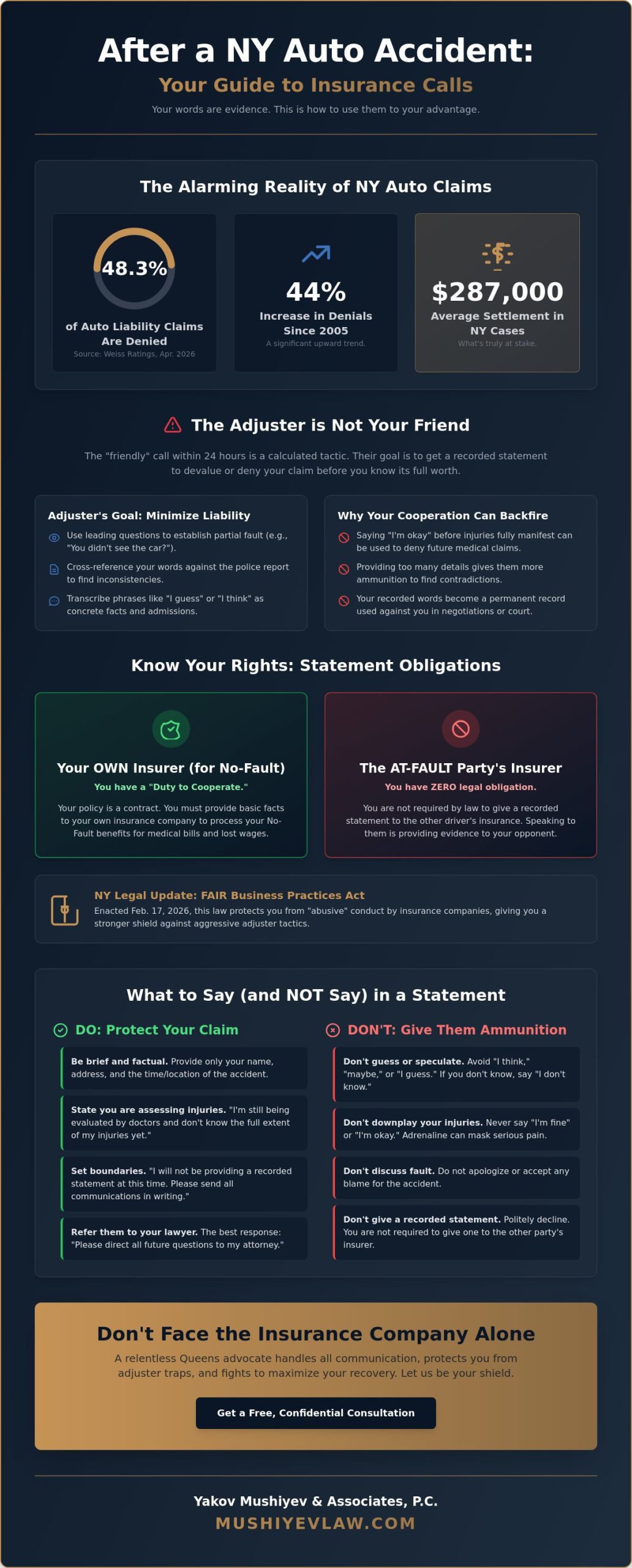
Did you know that nearly half of all auto liability claims in New York are now denied before a single dollar is paid? According to Weiss Ratings in April 2026, insurance companies rejected 48.3% of liability claims last year, which represents a massive 44% increase in denials since 2005. You likely feel that the adjuster on the phone is a neutral party, but they’re often a tactical prosecutor looking for any excuse to devalue your case. Understanding what to say in a recorded statement to an insurance company is the difference between a fair recovery and a total claim rejection. It’s normal to feel vulnerable when facing aggressive corporations, but you don’t have to face them alone.
This guide arms you with the clinical precision needed to handle these high-stakes calls without damaging your legal rights in Queens or across the state. You’ll learn how the FAIR Business Practices Act protects you from abusive conduct and why the new $35,000 minimum liability limits change your recovery strategy. We’ll detail exactly how to avoid common traps, meet strict No-Fault deadlines, and position your claim to reach the $287,000 average settlement currently seen in New York cases. Your words are evidence; it’s time to use them to your advantage.
Key Takeaways
- Identify why an adjuster’s immediate, “friendly” outreach is a tactical move designed to catch you off guard before you realize the full extent of your injuries.
- Learn exactly what to say in a recorded statement to an insurance company to provide essential facts without falling into traps regarding fault or precision measurements.
- Understand the critical legal distinction under New York law between your No-Fault “duty to cooperate” and the high-risk nature of speaking with a third-party liability insurer.
- Protect your recovery by setting firm boundaries and reviewing official documentation before committing any words to a permanent record.
- Discover how a dedicated legal shield prevents adjusters from using “gotcha” questions to justify a lowball settlement or an outright denial.
The Friendly Adjuster Myth: Why They Want a Recorded Statement Now
The insurance adjuster usually calls within 24 hours of your accident. They sound empathetic. They offer a “friendly” ear to help speed up your claim. This is a calculated tactic designed to lower your guard before you’ve had time to process your trauma or consult with a Queens advocate. Their goal is simple: they want to extract admissions that minimize their financial liability. Every word you speak is recorded and becomes a permanent part of the file. In future litigation, they’ll use these transcripts to contradict your testimony and slash your compensation.
Insurance companies are major corporations. They prioritize their bottom line over your physical and emotional recovery. While they have a duty to handle claims fairly, many engage in tactics that border on Insurance Bad Faith by prioritizing their profits over your legitimate needs. They want you to commit to a version of events before you understand the full scope of your legal rights or medical condition.
To better understand why this phone call is actually a tactical deposition, watch this explanation from a legal perspective:
The Goal of the Adjuster: Devaluation
Adjusters use leading questions to steer your narrative toward a conclusion that favors them. They might ask, “You didn’t see the other car until the moment of impact, correct?” If you agree, they’ve just established that you weren’t “keeping a proper lookout.” This is a common way to assign partial fault to an innocent victim. They also cross-reference your words against the police report. Any minor inconsistency is framed as a lie, which can devastate your settlement value. Knowing what to say in a recorded statement to an insurance company is about recognizing these traps before you fall into them.
Why Your Cooperation Can Backfire
Being “too helpful” is a liability. In the days following an accident, your adrenaline is high and your injuries may not have fully manifested. If you tell an adjuster “I’m okay” or “I don’t think I’m hurt,” and then discover a herniated disc three days later, they’ll use your own words to deny your medical claims. Phrases like “I think” or “I guess” are transcribed as concrete facts. In the eyes of the insurer, a guess is a definitive admission. You must be truthful, but you must also be brief. Providing details beyond the basic time and location only gives the insurer more ammunition to use against you.
Your Rights in New York: Do You Legally Have to Give a Statement?
You aren’t required by law to speak to the at-fault driver’s insurance company. While they may act as though your cooperation is mandatory, it’s often a trap designed to undermine your claim. Understanding what to say in a recorded statement to an insurance company is a matter of legal strategy, not just honesty. You have rights, and protecting them is your first priority.
The legal landscape in New York changed significantly on February 17, 2026, with the enactment of the FAIR Business Practices Act. This law prohibits “abusive” business practices, giving you a stronger shield against aggressive adjusters. While official insurance claim guidance often highlights the insurer’s right to investigate, it doesn’t grant them permission to exploit your vulnerability in the wake of a crisis.
Your Own Insurer vs. The At-Fault Party’s Insurer
Your insurance policy is a binding contract. Within that contract is a “duty to cooperate” clause. This means you must provide your own carrier with basic facts to process your No-Fault benefits. However, you have zero obligation to provide a statement to the other driver’s insurer. If you speak to them, you’re essentially providing evidence to your opponent. This risk is even higher in “dual representation” scenarios where both parties share the same insurance carrier. In these cases, the company’s internal goal is to minimize the total payout, regardless of who was at fault. Before you decide what to say in a recorded statement to an insurance company, you should recognize that the other side is looking for reasons to pay you nothing.
NY No-Fault Law and Your Statement
New York’s No-Fault system is designed to cover medical bills and lost wages quickly, regardless of liability. But this system is governed by strict, unforgiving deadlines. You must file your NF-2 application within 30 days of the accident. Medical bills must be submitted within 45 days of treatment, and lost wage claims must be filed within 90 days. If you’re feeling overwhelmed, Personal Injury Lawyer in Rosedale, Queens: Navigating the NY Claim Process can provide the specific regional expertise you need to stay compliant. Queens-specific traffic patterns and local liability rules often complicate these statements, making it vital to have an advocate who understands the nuances of our borough’s streets. If you’re being pressured for an immediate interview, securing legal representation is the most effective way to stop the harassment and ensure your rights remain intact.
What to Say in a Recorded Statement: The ‘Dos and Don’ts’
Precision is your greatest weapon. When determining what to say in a recorded statement to an insurance company, less is always more. You aren’t there to tell your story or find closure. You are there to provide specific, limited data points that satisfy your contractual obligations without compromising your future recovery. Stick to the clinical facts: the date of the occurrence, the exact time, the street names, and the names of the parties involved. Anything beyond these objective markers provides the insurer with a platform to build a case against you.
Human memory is notoriously fallible under stress. Adjusters know this. They will push you for specific measurements, such as how many feet you were from the intersection or exactly how many seconds passed before impact. Never guess. “I don’t know” and “I don’t recall” are perfectly valid, truthful answers. If you provide an estimate that later proves slightly inaccurate, the insurance company will label it a “material misrepresentation” to justify denying your claim. Avoid “feeling” words and subjective descriptions. Stick to what you observed with your own eyes. Furthermore, never discuss your medical history or prior injuries. The adjuster will try to frame your current trauma as a “pre-existing condition.” Your medical history is private and irrelevant to the fact that a negligent driver struck you.
The ‘Say This, Not That’ Framework
The language you use can either protect your settlement or destroy it. Use this framework to maintain control of the conversation and avoid common pitfalls:
- Instead of “I’m fine”: Say “I am still receiving medical evaluation.” Adrenaline masks pain. Injuries like herniated discs or internal bruising often take days to manifest.
- Instead of “I think I was going 30mph”: Say “I was traveling at a safe speed.” Unless you were staring at your speedometer at the exact moment of impact, any number you give is a guess.
- Instead of “It was my fault” or “I’m sorry”: Describe the other driver’s actions objectively. For example, “The other vehicle entered my lane of travel” or “The other driver did not stop at the red light.”
Handling Trick Questions About the Accident
Adjusters often open with “How are you today?” This isn’t a social greeting. It’s an attempt to get you on record saying you feel “good” or “well” before you discuss your injuries. Respond by stating you are there to discuss the facts of the accident. If they press for measurements or timing, repeat that you are not sure of the exact figures. Most importantly, never agree to the adjuster’s “summary” at the end of the call. They often rephrase your words to sound like an admission of guilt. If they ask if their summary is accurate, simply state that the recorded statement speaks for itself. Knowing what to say in a recorded statement to an insurance company means knowing when to stop talking.
How to Prepare for the Statement (If You Must Give One)
Preparation transforms a vulnerable moment into a controlled transaction. If you’ve determined that you must provide a statement to your own carrier, you cannot afford to go into the conversation blind. You are entering a tactical environment where the adjuster is trained to find discrepancies. Review the official police report and your own scene photos before the phone rings. If your verbal account differs even slightly from the written record, the insurance company will use that gap to challenge your credibility. Your goal is consistency, not storytelling.
Pre-Call Checklist for Accident Victims
Before you pick up the phone, follow these four defensive steps to protect your claim:
- Step 1: Gather the police report and scene photos. These are your anchors to the truth.
- Step 2: Write a one-sentence summary of the accident. This prevents rambling and keeps your answers concise.
- Step 3: Find a quiet, private place. Distractions lead to slips of the tongue that can cost you thousands.
- Step 4: Have your attorney’s contact information ready. If the questions become invasive, provide this info and end the call.
Control the rhythm of the conversation from the start. Inform the adjuster that you have a limited amount of time, such as 10 minutes. This creates a sense of urgency that discourages them from digging for irrelevant personal details. You should also record the call on your own device. New York is a one-party consent state, meaning you can record your own conversation without the other party’s permission. At the end of the call, formally request a copy of their recording immediately. This protocol puts the adjuster on notice that you are organized and prepared for future litigation. Knowing what to say in a recorded statement to an insurance company is only half the battle; the other half is documenting exactly what they asked.
Managing the Adjuster’s Tactics During the Call
Adjusters often try to “put words in your mouth” by summarizing your answers with a slight, damaging twist. If they say, “So, you didn’t see the car because it was dark,” and that isn’t what you said, correct them immediately. Say, “No, that is not accurate. I saw the vehicle when it ran the light.” Politely decline to answer any questions about your personal life, your medical history, or your destination. If you feel pressured, remember that Car Accident Lawyer Jamaica Avenue: Queens Injury Advocates Who Fight for You can step in to manage these communications for you.
If you are feeling intimidated or confused by the adjuster’s line of questioning, stop the call. You have the right to seek professional guidance before continuing. For a relentless defense of your rights, contact our firm today to ensure your statement doesn’t become a weapon used against you.
Why a Relentless Queens Advocate Should Handle the Statement
The moment you retain our firm, the power dynamic of your case shifts immediately. You no longer have to worry about what to say in a recorded statement to an insurance company because we become your legal shield. We step between you and the aggressive adjusters who are trained to dismantle your claim. By taking over all communications, we ensure that you can focus entirely on your physical recovery while we manage the clinical precision of your legal battle. Our intervention stops the harassment and forces the insurance company to deal with a professional who knows their tactics inside and out.
Insurance companies employ teams of adjusters and investigators whose sole objective is to protect the corporate bottom line. When they see our firm on the other side of a claim, they know they’re facing a fighter who won’t settle for a lowball offer. We prevent “gotcha” questions from ever reaching you. These questions are often designed to create a record that justifies a denial. We control the narrative from day one, ensuring that the facts of your car, truck, or construction accident are presented accurately and persuasively. This street-smart approach is essential for navigating the high-stakes legal environment of a major metropolitan area like Queens.
Leveling the Playing Field Against Big Insurance
You deserve an advocate who is as intimidating to opponents as they are approachable to you. Our firm operates on a risk-free financial arrangement, which is a core part of our client-first philosophy. This “No Win, No Fee” model ensures that you receive elite legal representation without any upfront costs or financial stress. We prepare our clients for high-stakes depositions and statements with the same tireless dedication that we bring to the courtroom. We understand the nuances of New York law and use every available legal tool to secure the maximum compensation for your trauma.
Take Action Before You Sign or Say Anything
The first 72 hours after an accident are the most critical for your legal rights. This is the window when insurance companies are most aggressive, hoping to catch you in a state of crisis or confusion. They often offer a “quick check” in exchange for a recorded statement or a signed release of liability. Never accept these offers without a professional review. These checks are almost always a fraction of what your case is actually worth, especially when dealing with long-term injuries that haven’t fully manifested. If you’ve been involved in a motorcycle, pedestrian, or slip and fall accident, you need to act with urgency. Contact Yakov Mushiyev & Associates, P.C. for a complimentary initial assessment before you speak to any adjuster. Let a relentless Queens advocate protect your future and fight for the justice you deserve.
Secure Your Recovery with Professional Advocacy
Navigating the aftermath of a collision is a high-stakes journey where a single misstep can derail your future. You’ve learned that the insurance adjuster is not your ally and that their friendly inquiry is actually a calculated effort to devalue your claim. By mastering exactly what to say in a recorded statement to an insurance company, you’ve taken the first step toward protecting your rights. However, the most effective defense is a relentless legal shield that prevents these tactical traps from ever reaching you.
Our firm brings clinical precision to every case, leveraging deep expertise in NY Labor Law and No-Fault regulations to outmaneuver major insurance carriers. We provide the bold advocacy needed to secure the justice you deserve while ensuring you face zero financial risk. We operate on a contingency basis, meaning there’s no fee unless we win your case. Don’t leave your settlement to chance or let an adjuster dictate your worth. Don’t let the insurance company trick you—get a free consultation with a relentless Queens accident lawyer today. Your path to restoration starts with decisive action. We’re ready to fight for you.
Frequently Asked Questions
Can I refuse to give a recorded statement to the other driver’s insurance?
Yes, you can and should refuse to speak with the at-fault driver’s insurance carrier. You have no legal or contractual obligation to provide them with any information. These adjusters are looking for admissions of fault to protect their company’s profits. Politely decline their request and direct them to your legal representative to ensure your rights remain protected.
What happens if I accidentally admit fault in a recorded statement?
An admission of fault can significantly devalue or even result in the total denial of your claim. The insurance company will treat your words as a permanent record to be used against you in future litigation. If this occurs, you need a relentless advocate to analyze the transcript and determine if the statement was extracted through leading or abusive questioning.
Should I tell the insurance company I have a lawyer?
You should inform the adjuster immediately that you have legal representation. Once they’re notified, they must stop contacting you directly and go through your attorney’s office instead. This simple step prevents you from being pressured into deciding what to say in a recorded statement to an insurance company without professional guidance. It shifts the burden of communication to your defender.
Do I have to talk to my own insurance company after a NY accident?
You have a contractual duty to cooperate with your own insurance provider to secure No-Fault benefits. This cooperation is necessary to pay your medical bills and recover lost wages within New York’s strict 30 day filing window. However, you should still limit your answers to basic facts like the time and location of the accident. Avoid discussing the extent of your injuries until you have a full medical diagnosis.
Can I change my statement later if I remember more details?
Changing a statement is possible but extremely difficult because it creates a “credibility gap.” The insurance company will frame any new information as a contradiction rather than a refreshed memory. They use these inconsistencies to justify lower settlement offers. It’s far safer to say you don’t recall a specific detail than to provide an estimate that you have to correct later.
Is a recorded statement the same as a deposition in New York?
No, they are different but equally dangerous. A deposition is a formal legal proceeding under oath, while a recorded statement is an informal interview with an adjuster. Both are transcribed and can be used to impeach your testimony in court. Because of this, you should treat every conversation with an insurance company with the same clinical precision as a courtroom appearance.
What if the adjuster says they can’t process my claim without a statement?
This is a common high-pressure tactic used to force you into a conversation. While your own carrier needs basic facts for No-Fault processing, a third-party insurer can determine liability using police reports and witness statements. If an adjuster threatens to stall your claim, it’s a sign that they’re prioritizing their bottom line over a fair investigation. A firm legal intervention usually resolves these artificial delays quickly.
Should I mention my previous car accidents or injuries?
You should never volunteer information about your medical history or past accidents. Adjusters are trained to frame current trauma as a “pre-existing condition” to avoid paying for your recovery. If they ask about previous injuries, state that you are focused on the injuries caused by this specific occurrence. Refer all complex questions about your medical background to your attorney to prevent the insurer from weaponizing your past against your future.

