
Filing a Personal Injury Claim for a Minor in New York: The 2026 Parent’s Guide

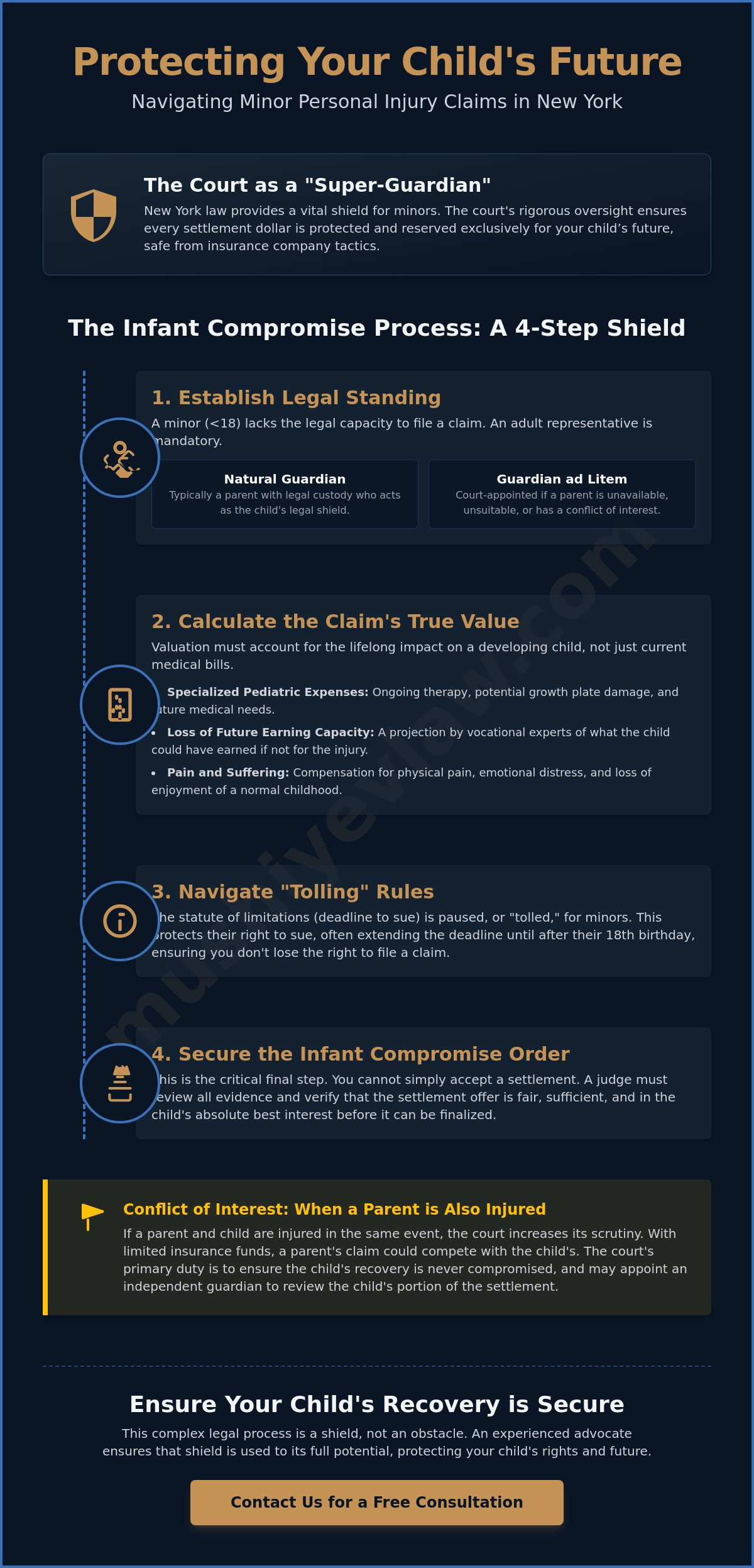
In New York, the court acts as a “super-guardian” for your child. This means you cannot simply sign a settlement release and move on. When you file a personal injury claim for a minor in New York, the law mandates a level of oversight that can feel like an obstacle, but it’s actually a vital shield. This rigorous process is designed to ensure that every dollar recovered is protected from insurance company tactics and reserved exclusively for your child’s future.
You’re likely carrying the heavy burden of rising pediatric medical costs while worrying if a legal battle will further traumatize your child. It’s natural to feel uncertain about who truly controls the settlement funds or how the May 2026 shift to modified comparative negligence affects your case. This guide provides the clinical precision and strategic roadmap you need to secure the compensation your child deserves. We’ll explain the Infant Compromise process, the impact of the 2026 serious injury threshold changes, and how we ensure your child’s recovery remains safe until they turn 18.
Key Takeaways
- Identify who qualifies as a “Natural Guardian” and how to secure the legal standing necessary to fight for your child’s rights.
- Calculate the true value of a claim by accounting for specialized pediatric expenses and the long-term impact of physical trauma.
- Navigate the “tolling” rules that extend the deadline for a personal injury claim for a minor in New York; this ensures you don’t lose the right to sue.
- Prepare for the Infant Compromise Order, the critical legal step where a judge verifies that a settlement offer is fair and sufficient.
- Understand how a fierce advocate navigates the specific local regulations of the Queens County Supreme Court to shield your family.
Legal Standing: Who Can File a Personal Injury Claim for a Minor in New York?
In New York, children under the age of 18 are legally considered to have a “legal disability.” This technical term, defined under CPLR § 1201, does not imply a lack of physical or mental capacity. Instead, it means the law views minors as lacking the legal standing to represent themselves in court or sign binding contracts. Consequently, a child cannot independently initiate a personal injury claim. To bridge this gap, a qualified adult must step forward to act as a necessary shield, ensuring the child’s rights are protected against powerful insurance companies and negligent parties.
Most often, this responsibility falls to the “Natural Guardian,” which is typically a parent with legal custody. If a parent is unavailable or deemed unsuitable by the court, a “Guardian ad Litem” may be appointed to oversee the litigation. This representative is the individual who signs legal documents, consults with the attorney, and makes strategic decisions. Whether the case involves a car accident or a pedestrian incident, the representative’s role is to navigate the complex legal landscape on the child’s behalf. To successfully file a personal injury claim for a minor in New York, the representative must demonstrate they have the child’s best interests at heart at every stage of the process.
To better understand how medical care and injury severity impact the value of these legal matters, watch this helpful video:
The ‘Next Friend’ Doctrine in NY Courts
New York courts utilize the “Next Friend” doctrine to allow a parent to bring a lawsuit in the child’s name. This isn’t a mere formality; it’s a heavy legal obligation. You’ll need to verify your identity and legal relationship to the minor through birth certificates or formal custody orders. The court requires absolute certainty that the representative is authorized to act. Every decision made during a personal injury claim for a minor in New York must be documented and justified as being in the child’s best interests. If a judge suspects that a representative’s choices are motivated by personal gain rather than the child’s welfare, they can intervene or disqualify the representative immediately.
What Happens if the Parent is Also Injured?
Complexity increases when a parent and child are injured in the same event, such as a truck or motorcycle accident. Managing dual claims requires clinical precision to avoid potential conflicts of interest. If the at-fault party has limited insurance coverage, the parent’s claim for damages might compete with the child’s need for recovery. In these scenarios, the court may scrutinize the situation more closely.
- Shared settlement pots can create tension between a parent’s financial recovery and the child’s future needs.
- The court might appoint an independent Guardian ad Litem to review the child’s portion of the settlement specifically.
- Separate legal evaluations are often necessary to ensure that neither party’s rights are sacrificed for the other’s.
We treat these family dynamics with the seriousness they deserve. Protecting a child’s future means ensuring their recovery is never compromised, even when the entire family is suffering from the same trauma.
Calculating Damages: What is a Child’s Injury Claim Worth?
Determining the value of a child’s injury requires more than a simple audit of hospital bills. It demands a forward-looking analysis of a life that has barely begun. When you file a personal injury claim for a minor in New York, we must account for the reality that a child’s body is still developing. Injuries that might be manageable for an adult can cause permanent growth plate damage, skeletal deformities, or cognitive delays in a minor. We utilize vocational experts and economists to project a “loss of future earning capacity.” This involves calculating what the child would have likely earned over their lifetime had the accident never occurred. It’s a high-stakes calculation that insurance companies often try to minimize by using conservative growth estimates.
According to data from Richman Law in 2026, New York personal injury settlements vary significantly based on injury severity. While minor soft-tissue injuries had a median settlement of $28,500, cases meeting the “serious injury” threshold reached a median of $134,656. Catastrophic injuries averaged $2.1 million. These figures highlight the necessity of a precise legal strategy. We engage life care planners to map out every medical necessity the child will face through adulthood, including specialized surgeries, physical therapy, and home modifications. We don’t guess at these numbers; we use clinical data to ensure the settlement covers the true cost of a lifetime of care. You can consult with a legal advocate to understand how these valuation methods apply to your family’s unique situation.
Economic vs. Non-Economic Damages for Minors
Young victims often face severe psychological hurdles that are harder to quantify than a broken bone. PTSD, night terrors, and sudden anxiety can follow a car accident or a construction site incident. Non-economic damages address this loss of a “normal” childhood and the enduring emotional distress. It is vital to document these changes through pediatric mental health professionals. Non-economic damages often constitute the largest portion of a minor’s recovery. If your child’s quality of life has been compromised, the law provides a pathway to seek justice for that invisible trauma.
The Parent’s Derivative Claim
New York law recognizes that parents suffer direct financial losses when a child is hurt. Through a “derivative claim,” you can seek reimbursement for out-of-pocket medical costs, specialized equipment, and transportation to appointments. There is also the concept of “loss of services.” This compensates parents for the loss of the child’s companionship and the additional household burden created by the injury. Unlike the child’s award, which is strictly protected in a court-supervised account until they turn 18, derivative funds are typically paid directly to the parents. This ensures you aren’t left drowning in debt while trying to provide the best possible care for your recovering child.
The Statute of Limitations: Understanding ‘Tolling’ for Minors
Time is a silent predator in legal matters. In a standard New York case, an adult has exactly three years from the date of an accident to file a lawsuit. However, the law recognizes that children are in a state of “legal disability.” Under New York Civil Practice Law and Rules (CPLR) § 208, the statute of limitations is “tolled,” or paused, until the child reaches the age of 18. This legal mechanism provides a vital safety net, effectively giving an injured minor until their 21st birthday to initiate a personal injury claim for a minor in New York. While this extension offers breathing room, it is not an invitation for complacency. We’ve seen critical evidence disappear in months, not years. Surveillance footage is overwritten. Witnesses move away. Forensic evidence at a construction site or a slip and fall location vanishes. Waiting years to file may preserve your legal right to sue, but it can simultaneously destroy your ability to win.
Critical Exceptions: Medical Malpractice and Wrongful Death
You must be aware of the strict boundaries surrounding medical malpractice. Unlike general negligence cases, the tolling period for pediatric malpractice is capped at a maximum of ten years from the date of the error. This is a “statute of repose,” creating an absolute deadline regardless of the child’s age. If a birth injury isn’t litigated before the child’s tenth birthday, the right to seek justice may be permanently extinguished. Wrongful death claims involving a parent’s passing also carry much tighter windows, often requiring action within two years. Precision in these dates is non-negotiable. We track these deadlines with clinical accuracy to ensure your family’s path to recovery remains open.
Municipal Claims: The 90-Day Warning
If your child was injured on public property, the rules change instantly. Accidents occurring at a New York City public school, on an MTA bus, or in a Queens city park are subject to “Notice of Claim” requirements. You don’t have years; you have 90 days. This short window is a frequent trap for families. Failing to file this formal notice within 90 days of the incident can bar you from ever pursuing a personal injury claim for a minor in New York against a government entity.
- The 90-day deadline applies to the City of New York, the Department of Education, and the New York City Transit Authority.
- A “Late Notice of Claim” can sometimes be petitioned, but a judge must grant permission based on specific legal criteria.
- Acting immediately after a school or transit accident is the only way to guarantee your child’s rights are shielded.
Our firm moves with a sense of urgency because we know how quickly these windows close. We handle the complex paperwork and municipal filings so you can focus on your child’s healing process.
The Infant Compromise Process: Securing Court Approval
In New York, a settlement agreement isn’t final just because you and the insurance company agree on a number. The court acts as an independent protector of your child’s interests. When you file a personal injury claim for a minor in New York, the law requires a judge to issue an Infant Compromise Order. This document is the only way to legally bind a settlement and release the negligent party from further liability. Judges take this duty seriously. They scrutinize every deduction, from attorney fees to medical liens, to ensure the maximum possible amount reaches your child’s account. Effective November 21, 2025, a new rule under CPLR 2106 has simplified the paperwork by allowing an “Affirmation of Truth Statement” instead of a notarized affidavit, but the underlying judicial oversight remains as rigorous as ever.
Step-by-Step: From Settlement Offer to Blocked Account
The journey from a successful negotiation to a secured fund involves several technical hurdles. Once we secure a top-tier offer from the insurance carrier, we prepare a detailed petition for the court. This includes medical reports, a breakdown of expenses, and a justification for the settlement amount. The process culminates in an Infant Compromise Hearing. For cases in the Queens County Supreme Court, this hearing is often the most intimidating moment for parents. The judge will speak with you and the child to assess the current state of the injury and verify that you understand the terms. They aren’t there to judge your parenting; they are there to ensure the insurance company isn’t shortchanging a vulnerable minor. If you need a relentless advocate to guide you through this hearing, contact our team for a case evaluation.
Structured Settlements vs. Court-Ordered Deposits
Protecting the recovery is just as important as winning the case. For most settlements, the court orders the funds to be placed in a “Blocked Account.” This is a specialized bank account where the money earns interest but cannot be accessed by anyone, including the parents, until the child turns 18. If a genuine emergency arises or the child needs specific medical equipment, we must petition the judge for an “order of withdrawal” to release a portion of those funds early.
- Court-Ordered Deposits: These are standard for smaller settlements, keeping the money liquid but locked in a local bank.
- Structured Settlements: For larger recoveries, we often recommend an annuity. This provides tax-free payments at specific milestones in the child’s life, such as college tuition or their 25th birthday.
- Judicial Scrutiny: In 2026, New York courts have increased their oversight of settlement-related expenses to maximize the child’s financial future.
We move with momentum to ensure these accounts are set up correctly from day one. Our goal is to create a financial foundation that remains untouched and growing until your child is ready to manage it themselves.
Protecting Your Child’s Future with a Queens Personal Injury Advocate
At Yakov Mushiyev & Associates, P.C., we don’t just process paperwork. We act as a relentless advocate for families who have been pushed into a state of vulnerability by a sudden accident. Navigating the Queens County Supreme Court demands a specialized understanding of local NYC regulations and a street-smart approach that intimidates formidable opponents. We provide the clinical precision of high-stakes legal expertise balanced with a deep, empathetic understanding of your family’s trauma. Our firm operates on a risk-free financial arrangement; you owe us nothing unless we successfully recover compensation for your child. This client-first philosophy ensures that justice is accessible to everyone in our community, regardless of their current financial situation.
Filing a personal injury claim for a minor in New York is a high-stakes endeavor that leaves no room for error. We take on the entire burden of the legal process so you can dedicate your energy to your child’s healing and recovery. Whether the injury resulted from a truck accident or a slip and fall incident, our team is prepared to move with a sense of momentum. We serve as the necessary shield against negligent parties and powerful entities who hope your family is too overwhelmed to fight back. Our presence in the case signals to the opposition that you won’t settle for anything less than what is perceived as fair and just.
A Relentless Shield Against Insurance Tactics
Insurance carriers often attempt to settle minor claims quickly before the full extent of a child’s future needs is fully realized. This is a calculated tactic to minimize their financial exposure. Our strategy involves a meticulous projection of future-dated medical and educational damages, ensuring that your child’s recovery accounts for a lifetime of potential challenges. We refuse to let insurance adjusters dictate the value of your child’s future. If you are seeking a Personal Injury Lawyer in Rosedale, Queens, our firm provides the protective advocacy required to secure a definitive resolution.
Start Your Child’s Recovery Today
Time is of the essence in these high-stakes matters. Immediate evidence collection in neighborhoods like Rosedale and Rochdale is critical to building a dominant case before facts are obscured or witnesses vanish. We offer complimentary initial assessments to all New York families, acting as a steady, calm, and approachable guide through the legal chaos. If your child was injured near a major thoroughfare or during a commute, our Car Accident Lawyer Jamaica Avenue team is ready to intervene immediately. We are the fighters who remain intimidating to your opponents but tireless in our duty to your family.
Secure the Justice Your Child Deserves
Your child’s recovery is more than a legal case; it is the foundation of their entire adult life. We’ve detailed how the Infant Compromise process acts as a vital shield and how the 2026 legislative changes, including the shift to modified comparative negligence, demand a strategic approach. Every decision you make today, from calculating future earning capacity to meeting strict municipal deadlines, will resonate for decades. Filing a personal injury claim for a minor in New York requires clinical precision to ensure that settlement funds remain safe and growing in court-ordered blocked accounts.
Our firm brings decades of experience in Queens County courts to every family we represent. You don’t have to face powerful insurance entities alone. With our contingency-based “No Win, No Fee” arrangement, you receive fierce advocacy without any financial risk. We are prepared to move with urgency to protect your child’s future. Schedule a Free Consultation with a Queens Child Injury Advocate to transition from a state of uncertainty into a state of decisive action.
You have the strength to protect your family’s future. Your child deserves a recovery that is both fair and just, and we are here to ensure they get it.
Frequently Asked Questions
Can I settle my child’s injury claim without going to court in New York?
You cannot settle a minor’s case privately in New York. Even if you and the insurance company reach a verbal or written agreement, a judge must review the terms through an Infant Compromise Order to ensure they are fair. This judicial oversight prevents parents or guardians from making decisions that might not serve the child’s long-term interests. Without a signed court order, the settlement is not legally binding and the insurance company will not release the funds.
What happens to the settlement money if my child is under 18?
The funds are typically placed in a court-supervised “blocked account” at a bank, where they earn interest but remain inaccessible until the child turns 18. For larger recoveries, we may structure the settlement as an annuity to provide tax-free payments at specific milestones, such as college graduation. These protections ensure that the financial recovery from a personal injury claim for a minor in New York is preserved exclusively for the child’s future needs.
How long do I have to file a personal injury claim for my child in NY?
Most cases allow you to file until the child turns 21 because the three-year statute of limitations is “tolled” until they reach age 18. However, medical malpractice claims have a strict 10-year limit, and municipal claims against New York City require a Notice of Claim within 90 days of the incident. Delaying action is dangerous because evidence like witness testimony and surveillance footage can vanish within weeks of the accident, making it harder to prove liability.
Does my child have to testify or give a deposition in a personal injury case?
A child may be required to give a deposition if they are old enough to understand the oath and provide relevant facts about the incident. We act as a protective shield during this process, ensuring the environment is as non-threatening as possible for the minor. In many instances, the child’s testimony isn’t necessary if medical records and other evidence clearly establish the facts. Our goal is always to secure justice while minimizing any emotional stress on your family.
Can I use my child’s settlement money to pay for their current medical bills?
You generally cannot access the child’s portion of the settlement for immediate medical bills without a specific court order for withdrawal. However, parents often file a “derivative claim” alongside the child’s case to recover out-of-pocket expenses they’ve already paid. If a judge determines that an early withdrawal is absolutely necessary for the child’s health or education, they may authorize a release of specific funds from the blocked account, but this requires a formal petition.
What is an ‘Infant Compromise Hearing’ and do we both have to attend?
An Infant Compromise Hearing is a formal proceeding where a judge examines the proposed settlement and the child’s current physical condition. In Queens County, the court typically requires the presence of both the representative parent and the injured minor. The judge may ask simple questions to confirm the child has recovered as expected and that you understand the settlement terms. We prepare you thoroughly for this appearance so it feels like a manageable step toward your child’s restoration.
Can I still file a claim if my child was partially at fault for the accident?
You can still pursue a personal injury claim for a minor in New York even if the child contributed to the accident. Under the modified comparative negligence rule effective May 26, 2026, the child can recover damages as long as they are not more than 50% at fault for the incident. If they are found partially responsible, the total award is simply reduced by that percentage. We fight to minimize any fault attributed to the minor to maximize their financial recovery.
How much does a personal injury lawyer charge for a minor’s case in NY?
Our firm utilizes a risk-free financial arrangement where you pay nothing unless we win your case. The court strictly regulates attorney fees in minor cases, typically capping them at one-third of the final settlement after expenses are deducted. This ensures that the majority of the recovery remains in your child’s hands for their future needs. We handle all investigative costs and the heavy lifting, positioning ourselves as a necessary shield against the financial burden of litigation.

