
Long-Term Effects of a Traumatic Brain Injury from a Fall: The Lifetime Impact

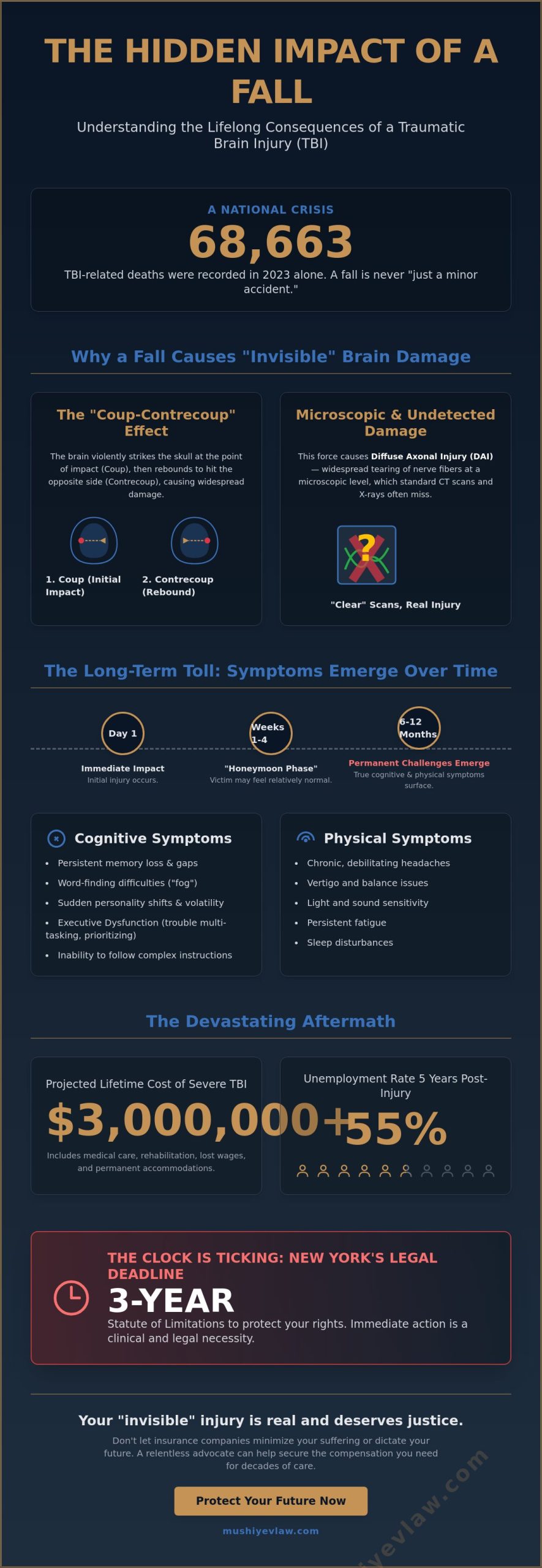
An insurance adjuster might call your injury minor because it doesn’t show up on a standard X-ray, but they aren’t the ones struggling to keep pace with New York City’s competitive market. With 68,663 TBI-related deaths recorded in 2023 alone, a fall is never just a minor accident. It’s a life-altering event. You aren’t imagining the persistent memory loss or the sudden personality shifts that make daily life feel like an uphill battle. These are the documented long-term effects of a traumatic brain injury from a fall, and they require a relentless advocate who recognizes that your “invisible” injury is a permanent reality.
We understand the fear of a future where you can no longer provide for your family or navigate the city you love. It’s a heavy burden to carry, but you don’t have to carry it alone. This guide will provide a clear understanding of the potential life-long symptoms you face and a roadmap for securing a settlement that covers your medical needs for decades to come. We’ll examine the financial reality of injuries that can cost over $3 million across a lifetime and explain how to navigate New York’s three-year statute of limitations to protect your rights. Your recovery is a marathon, and you deserve a strategy that ensures you’re supported every step of the way.
Key Takeaways
- Learn how the “Coup-Contrecoup” effect causes microscopic brain damage that standard CT scans frequently overlook during initial emergency room visits.
- Identify the persistent cognitive and physical symptoms that define the long-term effects of a traumatic brain injury from a fall, ensuring your struggles are validated.
- Discover the strategic methods used to overcome the “invisible disability” stigma when insurance companies attempt to minimize your legitimate suffering.
- Understand the critical distinction between immediate medical bills and the projected $3 million lifetime cost of managing a severe brain injury.
- Navigate the specific legal hurdles in Queens courts and learn why the three-year statute of limitations makes immediate action a clinical and legal necessity.
Why Falls Cause Unique Traumatic Brain Injury (TBI) Long-Term Complications
A fall isn’t just a trip; it’s a violent collision between the brain and the skull. In a traumatic brain injury (TBI) resulting from a fall, the damage is often caused by sudden deceleration. When your body stops abruptly against a concrete floor in a Queens construction site or a tiled apartment lobby, your brain continues to move inside the skull. This high-velocity impact creates unique complications that differ significantly from other types of trauma. Because the brain is soft and the skull is rigid, the resulting internal collision can lead to permanent damage even if there is no visible wound.
To better understand how these injuries manifest over time, watch this helpful report:
The “Coup-Contrecoup” effect is a signature of fall-related injuries. This occurs when the brain strikes the point of impact (coup) and then rebounds to strike the opposite side of the skull (contrecoup). While a focal injury might involve a specific bruise or bleed, falls frequently cause diffuse axonal injury (DAI). This is a widespread shearing of the brain’s long connecting nerve fibers. Because DAI happens at a microscopic level, it often evades detection on standard imaging, laying the groundwork for the devastating long-term effects of a traumatic brain injury from a fall.
The Mechanics of a Fall Impact
Gravity acts as a force multiplier. When you fall from a ladder or down a flight of stairs, the height increases the velocity of the impact, sending shockwaves through the skull base. This area is particularly vulnerable because it is jagged and uneven; as the brain slides across these bony ridges, it sustains internal shearing. Even a “minor” fall from a standing position can generate enough force to tear delicate neural pathways, leading to permanent cognitive deficits that don’t always appear on a first-round scan.
Immediate vs. Delayed Long-Term Symptoms
Recovery rarely follows a straight line. Many victims experience a “honeymoon phase” where they feel relatively normal immediately after the incident. However, the long-term effects of a traumatic brain injury from a fall may not fully surface for 6 to 12 months. Once the initial swelling subsides, patients often hit a plateau where progress stalls and new, permanent challenges, such as executive dysfunction or emotional volatility, emerge. TBI neurodegeneration is a progressive process rather than a static event.
The Cognitive and Physical Toll: Life 5+ Years After a Brain Injury
Five years after a fall, the world expects you to be “back to normal.” The reality is often far more complex. The long-term effects of a traumatic brain injury from a fall frequently coalesce into a permanent cognitive “fog” that makes every day a struggle. Survivors deal with debilitating memory gaps and word-finding issues that turn standard social interactions into exhausting exercises in frustration. Physically, the legacy of a fall-related impact persists through chronic headaches and vertigo that can strike without warning. These symptoms aren’t just medical footnotes; they are the reasons why 55% of TBI survivors remain unemployed five years post-injury. We refuse to let insurance companies minimize these life-altering obstacles just because they don’t appear on a standard X-ray.
Executive Dysfunction and the Workplace
Executive dysfunction is the silent career-killer for TBI survivors. It destroys the brain’s ability to multi-task, prioritize, or follow the complex instructions required in a fast-paced metropolitan workplace. Returning to work without significant, permanent accommodations is often impossible, yet insurance adjusters frequently claim these issues are exaggerated. We know they aren’t. There is a documented, scientific link between the long-term consequences of TBI and the potential for early-onset dementia or Alzheimer’s. If your career has been derailed by a fall, seeking legal representation for slip and fall accidents is the first step in protecting your financial future against these progressive risks.
The Emotional Burden on Families
The emotional toll on families is often the most painful part of the journey. When a TBI causes sudden personality changes or uncharacteristic aggression, the family dynamic shifts forever. This leads to profound social isolation for the survivor and a heavy emotional burden on their caregivers. In the legal world, we address this through “loss of consortium” claims, which recognize that your spouse and children have also suffered a significant loss of companionship and support. Dealing with the depression and anxiety that follows a permanent lifestyle change requires more than just medicine; it requires a strategic settlement that covers comprehensive, long-term mental health support and specialized therapy.
Overcoming the “Invisible Disability” Stigma in TBI Fall Claims
Insurance adjusters love a clean X-ray. They use it as a weapon to deny your claim, arguing that if no massive bleed or fracture appears on a standard scan, your injury must be minor. This is a calculated deception. The long-term effects of a traumatic brain injury from a fall are frequently invisible to the naked eye and basic medical imaging. While you struggle with cognitive lapses and emotional volatility, the defense will focus on your outward appearance to suggest you are “fine.” We dismantle this “But You Look Fine” trap by using clinical precision to expose the microscopic damage that insurance companies try to bury.
Advanced Imaging and Medical Proof
A normal MRI is not a clean bill of health. Standard imaging is designed to find large-scale structural anomalies, but it often misses the cellular destruction common in fall-related trauma. We leverage advanced diagnostic tools like Diffusion Tensor Imaging (DTI) to identify axonal damage that traditional tests overlook. DTI tracks the movement of water molecules along neural pathways, revealing exactly where the brain’s wiring has been severed. Clinical recovery does not equal functional recovery in the legal sense. Even if your condition has stabilized, the inability to process complex information or manage a busy work environment remains a compensable loss.
Documenting the Daily Struggle
Proving an invisible injury requires a mountain of secondary evidence that goes beyond a doctor’s note. We guide our clients in maintaining a detailed symptom diary to track cognitive lapses, sudden irritability, and the frequency of chronic headaches. This log serves as a chronological record of your daily reality. We also gather testimony from friends, family members, and former coworkers who can explain the “before and after” of your personality and capabilities. This human element is vital for countering defense attorneys who try to blame your symptoms on pre-existing conditions or the natural process of aging.
Yakov Mushiyev & Associates, P.C. doesn’t just present medical records; we tell a story of profound loss through expert testimony. By bringing in neuropsychologists and vocational experts, we make your invisible damage visible to a jury. We demonstrate exactly how a microscopic tear in the frontal lobe translates to a lost career in a competitive market and a fractured home life. This level of clinical and legal precision is the only way to secure a settlement that accounts for the next 40 years of your life. We are the shield you need against powerful entities that want to minimize your suffering for the sake of their bottom line.
Calculating the Lifetime Cost of TBI: Beyond the Initial Medical Bill
A $50,000 emergency room bill is a staggering burden, but it’s only the start of a much longer financial crisis. For those navigating the long-term effects of a traumatic brain injury from a fall, the total lifetime expenditure often exceeds $3 million for severe cases. We look beyond the immediate invoices to calculate your total economic and non-economic damages. Economic damages cover quantifiable losses like medical debts and lost wages, while non-economic damages account for the profound loss of quality of life and the daily pain you endure. Securing a settlement that only covers the past is a recipe for future bankruptcy.
Yakov Mushiyev & Associates, P.C. utilizes certified Life-Care Planners to project your needs for the next 30 to 40 years. These specialists analyze the high cost of living in New York and the rising prices of specialized neurological care to ensure your claim isn’t undervalued. Without this clinical foresight, you may accept an offer that fails to account for medical inflation or the inevitable progression of your symptoms. We fight to ensure the negligent parties are held accountable for every projected dollar required to maintain your dignity and health.
Future Medical and Home Care Needs
Recovery is an ongoing expense that lasts a lifetime. You may require decades of cognitive rehabilitation, physical therapy, and psychiatric support to manage the emotional volatility associated with brain trauma. If your injury results in motor impairment, the cost of home modifications and assistive technology becomes a permanent part of your budget. In some cases, 24/7 care or vocational retraining is the only way to navigate a permanent lifestyle shift. We document these requirements with precision to build a case that insurance adjusters cannot ignore.
Lost Earning Capacity and Economic Damage
A TBI doesn’t just impact your current job; it destroys your future professional potential. We calculate the loss of future promotions, raises, and retirement benefits that were stolen by the accident. Proving this loss requires a deep understanding of liability and the specific safety violations that occurred. Our team provides expert Slip and Fall Legal Representation to tie these economic losses directly to the property owner’s negligence. If you can no longer provide for your family at your previous level, you need an advocate who treats your financial survival as a priority. Contact Yakov Mushiyev & Associates, P.C. today to request a comprehensive financial evaluation.
Protecting Your Future: Legal Advocacy for TBI Victims in Queens
While we have established the clinical and financial gravity of your injury, the legal path to recovery in Queens requires a specific tactical approach. Pursuing a claim for the long-term effects of a traumatic brain injury from a fall isn’t a task for a general practitioner who handles minor traffic tickets. It is high-stakes litigation against powerful insurance companies that have a vested interest in your failure. In New York, the three-year statute of limitations for personal injury claims sets a hard deadline, but the clock for preserving evidence runs out much faster. You need a shield that is already prepared for battle.
Yakov Mushiyev & Associates, P.C. operates on a “No Win, No Fee” promise. This client-first philosophy ensures that victims have access to the same level of legal firepower as a major corporation, regardless of their current bank balance. We absorb the financial risk of the investigation and the expert testimony required to win. We don’t get paid until we secure a settlement or verdict that validates the reality of your trauma. This commitment allows you to focus on your medical recovery while we handle the aggressive litigation required to hold negligent parties accountable.
Proving Negligence in a Fall Case
Legal success hinges on the concept of “notice.” We must prove that a property owner or manager knew about a hazard, or should have known about it, and failed to act. In construction-related falls, we apply the strict protections of New York Labor Law to ensure workers aren’t left behind by corporate negligence. Our investigators move with urgency to secure surveillance footage and eyewitness accounts before they disappear. We build a foundation of evidence that connects the property owner’s failure directly to your lifetime of cognitive and physical challenges.
Why Your Choice of Lawyer Matters
Choosing the right firm is a decisive act that determines the quality of your future care. Our experience in major metropolitan TBI litigation gives us a street-smart edge when navigating the complex Queens court system. We don’t just negotiate; we prepare every case for the possibility of a jury trial to ensure the defense knows we are serious. This proactive momentum is what forces insurance companies to offer settlements that actually reflect your needs. Contact Yakov Mushiyev & Associates, P.C. for a free TBI case evaluation.
Secure the Lifetime Support You Deserve
A fall is never just a momentary lapse in balance. It’s a life-altering event that can derail your career and your family’s stability for decades. We’ve explored how the long-term effects of a traumatic brain injury from a fall involve microscopic damage and astronomical costs that insurance adjusters desperately want to ignore. You’ve seen the reality of the “invisible disability” and the necessity of a clinical legal strategy. Now, it’s time to act. You need a fighter who understands the streets of Queens and the complexities of the courtroom. We refuse to let powerful entities minimize your suffering or gamble with your future care.
Yakov Mushiyev & Associates brings over 20 years of experience in NY Personal Injury Law to your corner. We provide dedicated advocacy for “invisible” brain injuries and operate with zero upfront fees; we only get paid if you win. This risk-free arrangement ensures that you have access to top-tier experts without any financial strain. Don’t settle for a future defined by someone else’s negligence. Get a Free Consultation with a Queens TBI Lawyer Today and take the first step toward reclaiming your life. Your recovery is our mission, and we’re ready to move forward today.
Frequently Asked Questions
Can I still file a claim if my TBI symptoms appeared months after the fall?
Yes, you can still pursue a claim if your symptoms were delayed. It’s common for the long-term effects of a traumatic brain injury from a fall, such as cognitive decline or personality shifts, to manifest months after the initial impact. We use expert medical testimony to bridge the gap between the accident and your current condition, ensuring these late-onset symptoms are fully compensated.
What is the average settlement for a traumatic brain injury from a fall in New York?
There is no “average” settlement because every brain injury is a unique medical and legal challenge. Your compensation is calculated based on your specific medical bills, the total of your lost future earnings, and the severity of your permanent impairment. While some cases settle for hundreds of thousands, severe injuries requiring lifetime care frequently reach into the millions. We focus on your specific needs to maximize your recovery.
How do I prove my TBI is real if my MRI came back normal?
We prove your injury through advanced diagnostics and functional evidence rather than relying solely on basic imaging. While a standard MRI often misses microscopic damage, we utilize neuropsychological testing and advanced tools like DTI to reveal cellular shearing. We also gather “before and after” testimony from family and coworkers to document the tangible changes in your cognitive abilities and behavior. This makes your “invisible” injury undeniable.
Will I have to go to court for a brain injury lawsuit?
Most cases settle during negotiations, but we prepare every claim as if it is going to trial. This aggressive preparation gives us the necessary leverage to secure a fair settlement without stepping into a courtroom. If an insurance company refuses to offer a just amount, we are fully prepared to fight for your rights before a judge and jury in Queens. We handle the litigation so you can focus on healing.
Can I sue my employer if I fell and hit my head at a construction site?
You can often file a third-party lawsuit in addition to your workers’ compensation claim. While New York law generally prevents you from suing your direct employer, Labor Laws allow you to hold property owners and general contractors accountable for safety failures. This is essential because workers’ comp doesn’t cover the full long-term effects of a traumatic brain injury from a fall, such as your pain and suffering or loss of quality of life.
How long do I have to file a TBI lawsuit in Queens?
In New York, the statute of limitations for personal injury claims is generally three years from the date of the accident. However, cases involving government entities or specific medical scenarios may have significantly shorter deadlines, sometimes as little as 90 days for a notice of claim. Waiting too long can result in the permanent loss of your right to seek justice. We recommend a complimentary assessment immediately to protect your rights.
What if I was partially at fault for my fall?
You can still recover compensation even if you were partially responsible for the accident. New York follows a “pure comparative negligence” rule, which means your final award is simply reduced by your percentage of fault. If you are found 25% responsible, you can still collect 75% of the total damages. We work relentlessly to minimize your assigned fault and shift the liability to the negligent parties where it belongs.
How much does it cost to hire a brain injury lawyer at Mushiyev Law?
Hiring our firm costs you nothing upfront. We operate on a contingency fee basis, meaning we only receive payment if we successfully secure a settlement or verdict for you. We cover all the expenses of your litigation, including the high costs of hiring neurological experts and vocational specialists. This risk-free arrangement ensures that every victim has access to elite legal representation regardless of their current financial status.

