
Bicycle Accident Lawyer in Fresh Meadows, Queens
Cycling in Fresh Meadows, ZIP codes 11365 and 11366, means threading between a 358-acre park and a highway. Riders come out of Cunningham Park onto Francis Lewis Boulevard, pick up the Kissena Corridor Park greenway heading west, and sooner or later have to cross the Horace Harding Expressway service roads or ride the length of 188th Street. Yakov Mushiyev & Associates, P.C. is a Rosedale, Queens personal injury firm that appears regularly in Queens County Supreme Court and has recovered over $50 million for injured clients.
If a driver hit you on a bicycle or an e-bike, call 718.775.3110 or ask for a free case review. The consultation costs nothing, we advance every case expense, and there is no fee unless we win.
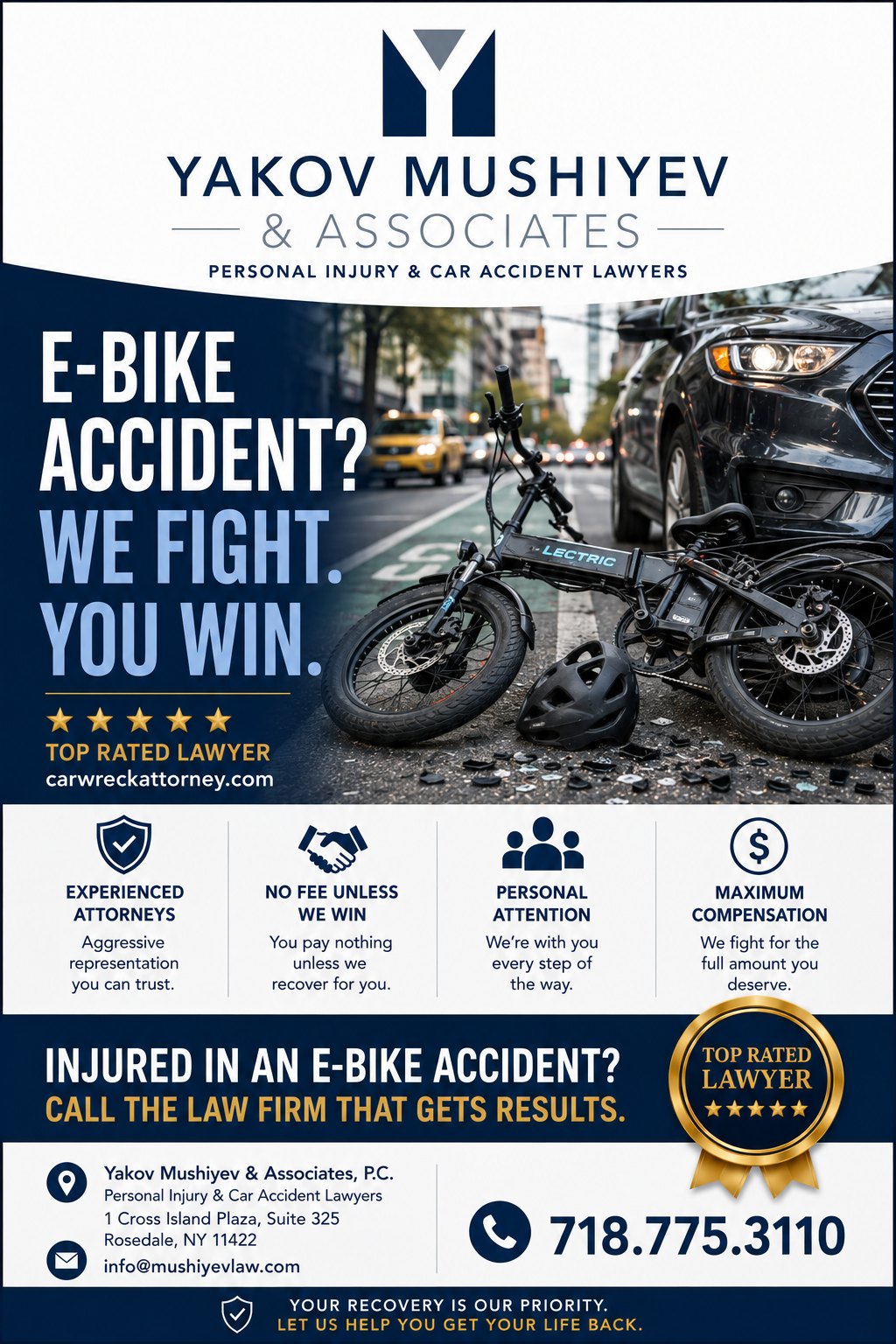
Bicycle Accident Lawyer Serving Fresh Meadows, NY 11365 and 11366
Start with the sentence that decides more bicycle cases in this state than any other, and that almost no competing page bothers to print. Vehicle and Traffic Law § 1238(7) says helmet non-use cannot be used against you. Not to reduce your damages, not to prove you were careless, not at all. An adjuster who opens the call by asking whether you were wearing a helmet is asking a question New York law has already answered.
The rest follows from a second rule that surprises people on both sides of a crash: on the roadway, a cyclist is legally a driver. That cuts both ways, and a lawyer who understands where it helps you and where it does not is worth more than one who tells you the driver is automatically at fault.
How Bicycle Crashes Happen in Fresh Meadows
Francis Lewis Boulevard runs along the western edge of Cunningham Park, and locals call that stretch the Franny Lew Speedway for a reason. It has a long association with drag racing and street racing, and the City has installed speed cameras on it. Speed cameras in New York City run 24 hours a day, seven days a week, and the program is authorized through 2030. A cyclist rolling out of a park path onto a boulevard where cars are moving at highway speed is the crash pattern we see most often on the west side of the neighborhood.
The Kissena Corridor greenway produces a different pattern. Greenway users move continuously; cross streets do not. Every point where the corridor meets a street is a place where a driver is looking for cars coming from one direction and a cyclist arrives from another.
Union Turnpike forms the southern boundary: four lanes split by a narrow concrete median. That median is too thin to be a refuge. A cyclist caught mid-crossing when the light changes has nowhere safe to stand, which is how riders get clipped by turning traffic rather than by cars traveling straight.
The Horace Harding Expressway service roads carry drivers who have just left the Long Island Expressway and have not yet adjusted to city speed, and the merges and slip ramps put cars across the bike line of travel repeatedly. And 188th Street, the commercial spine, is a dooring corridor. Curbside parking, constant turnover, delivery vans double-parked, and a rider pushed left into the moving lane by a door that opens without a look.
The City’s own numbers cover that spine. NYC DOT counted 77 total injuries on 188th Street between the Horace Harding Expressway and 73rd Avenue from 2012 to 2016, including 2 cyclist injuries, 24 pedestrian injuries with 2 severe and 1 fatality, and 51 motor vehicle occupant injuries. The intersection of 188th Street and 73rd Avenue is a designated NYC DOT Vision Zero Priority Intersection. Citywide, 2025 closed with 205 traffic deaths, the lowest since record-keeping began in 1910, and Queens fell 23 percent, from 74 deaths in 2024 to 57 in 2025. The direction is good. It is no comfort to the person who is hurt.
One more thing about this neighborhood matters. The Fresh Meadows development, built by New York Life between 1947 and 1962 to Ralph Thomas Walker’s design, was among the first communities in the United States laid out for the automobile rather than the pedestrian. Its internal Circles, Crescents and Lanes were deliberately arranged to keep through traffic out. The result is that bicycles and cars are funneled together onto a handful of wide arterials, which is exactly where the collisions happen.
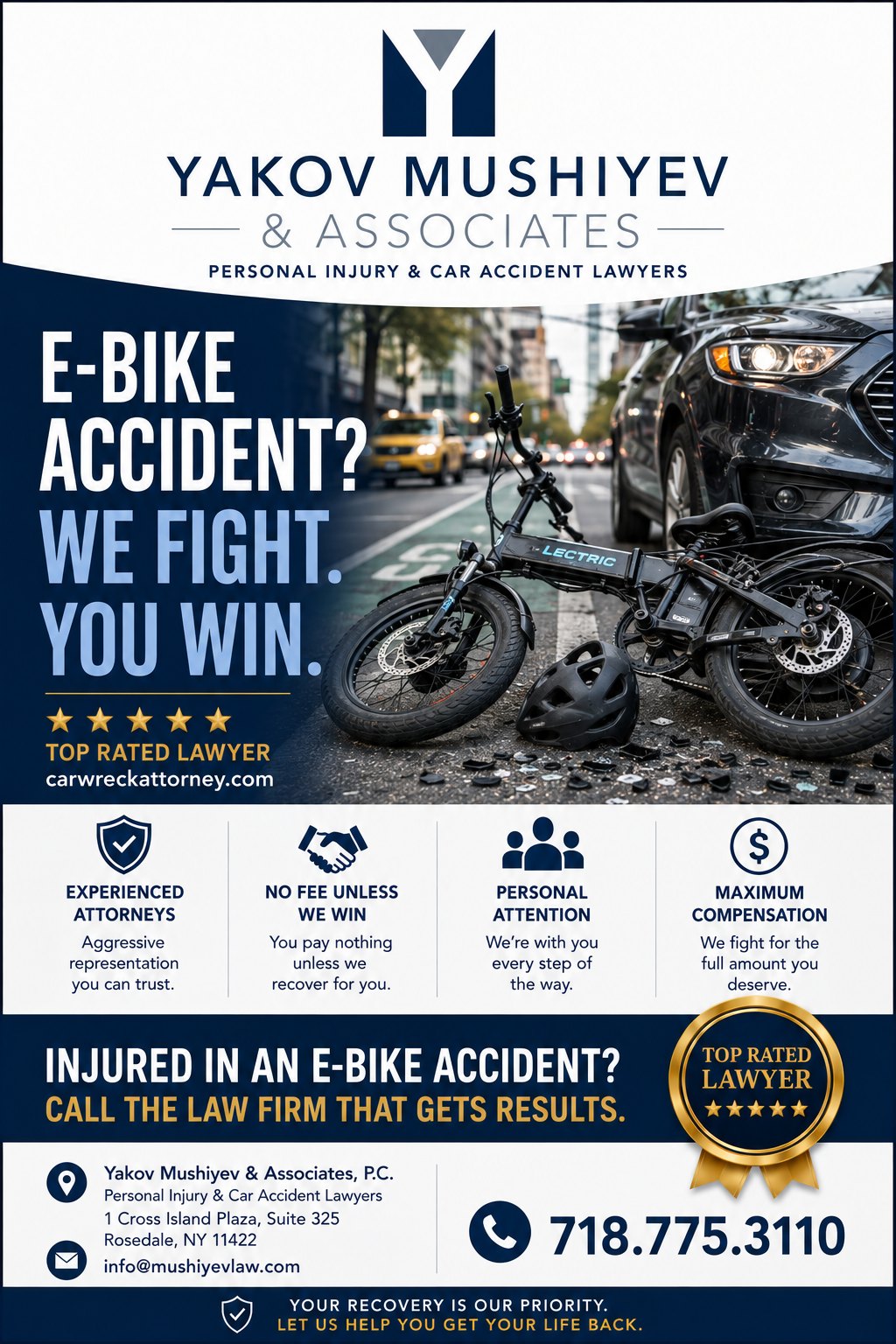
Injuries We See in Fresh Meadows Bicycle Cases
A cyclist hit from the side goes down on the shoulder and hip. A cyclist doored goes over the bars. Those two mechanisms produce most of what we handle: clavicle and scapula fractures, distal radius fractures from the outstretched hand, acetabular and pelvic fractures, ACL and meniscal tears, and traumatic brain injury even where a helmet was worn. Handlebar impacts to the abdomen cause spleen and liver injuries that can stay quiet for hours. E-bikes weigh substantially more than a road bike and carry that mass into the impact, so we see more femur and tibial plateau fractures and more spinal injury in e-bike cases.
Seriously injured riders from this part of Queens are typically transported to NewYork-Presbyterian Queens at 56-45 Main Street in Flushing, the nearest Level I Trauma Center. Jamaica Hospital Medical Center is also a Level I Trauma Center, and Long Island Jewish and NYC Health + Hospitals/Queens take patients from here as well. Whatever the mechanism, be examined the same day and tell the intake nurse you were on a bicycle. A gap between the crash and the first medical record is the first thing a carrier will argue about.
The New York Law That Applies
VTL § 1238(7): the helmet cannot be used against you
Here is the language. A failure to comply with § 1238 “shall not constitute contributory negligence or assumption of risk, and shall not in any way bar, preclude or foreclose an action for personal injury or wrongful death by or on behalf of such person, nor in any way diminish or reduce the damages recoverable in any such action.” The Legislature wrote a civil-liability shield directly into the helmet statute. Read the full text of VTL § 1238.
The underlying requirement is narrow. Section 1238(5) requires a helmet for a person at least one year old and under fourteen who operates a bicycle. Section 1238(5-c) requires one for the operator of a Class 3 e-bike at any age. The section also bars carrying a passenger under one year old on a bicycle and requires helmets for child passengers aged one to four riding in a proper seat. If you were an adult on a pedal bike with your head bare, you broke no law at all, and subdivision 7 means it would not matter for your damages even if you had.
VTL § 1231: you had the rights of a driver
The statute reads that “every person riding a bicycle or skating or gliding on in-line skates upon a roadway shall be granted all of the rights and shall be subject to all of the duties applicable to the driver of a vehicle by this title,” except for the special bicycle rules and the provisions that by their nature cannot apply. See VTL § 1231. Practically, that means the driver who turned left across your path violated a right of way you actually held. It also means the duties are real: signal, obey the light, ride with traffic. We would rather tell you that at the first meeting than have a defense lawyer tell a jury.
No-fault: the striking vehicle’s policy pays
A cyclist struck by a car is not occupying a motor vehicle or a motorcycle, so under Insurance Law § 5103 the rider is an eligible injured person under the striking vehicle’s no-fault coverage, and a covered person under § 5102(j). That policy pays basic economic loss up to $50,000 per person: medical treatment, lost earnings at $2,000 a month for up to three years subject to a 20 percent statutory offset, and other necessary expenses up to $25 a day for a year. An OBEL endorsement adds $25,000. Written notice must reach the insurer within 30 days of the crash, normally by filing form NF-2, under 11 NYCRR 65-1.1. Bills go in within 45 days of service and wage proof within 90 days. See Insurance Law § 5103.
Because you are a covered person, the serious injury threshold gates your pain and suffering claim. That is the trade New York made.
Serious injury and the May 26, 2026 amendments
Part EE of Chapter 58 of the Laws of 2026 governs actions commenced on or after May 26, 2026, regardless of when the crash happened. It repealed one category from Insurance Law § 5102(d), the one that turned on a temporary limitation of a person’s usual activities. Eight remain: death; dismemberment; significant disfigurement; a fracture; loss of a fetus; permanent loss of use of a body organ, member, function or system; permanent consequential limitation of use of a body organ or member; and significant limitation of use of a body function or system. A fracture qualifies outright, which matters in bicycle cases because so many of them involve one. A new § 5104(d) caps non-economic loss at $100,000 for certain at-fault drivers, and under the amended § 5104(a) the trier of fact decides fault before reaching serious injury. The DFS circular letter explains the package.
Comparative fault: the new 50 percent bar
The same 2026 legislation added CPLR 1411(b). In motor vehicle cases governed by Insurance Law Article 51, a claimant found more than 50 percent at fault may be barred from recovery entirely. Its exact scope has not been tested. Subdivision (a) still governs claims outside that category, so a rider hurt by a defective sidewalk or a dangerous premises is in a different posture than a rider hit by a car. See CPLR 1411. The consequence is simple: fault is now the whole ballgame, and the record has to be built in the first week. That is why our Fresh Meadows personal injury lawyer team canvasses for video before anything else.
E-bikes: the classes and the City’s 15 mph cap
Under VTL 102-c an e-bike has a motor under 750 watts and falls into three classes. Class 1 is pedal-assist that cuts out at 20 mph. Class 2 is throttle-assisted to 20 mph. Class 3 is throttle to 25 mph and is legal only in a city of more than one million people, which in this state means New York City. An e-bike cannot be registered as a motorcycle, limited-use motorcycle, moped or ATV, and needs no license or insurance. Since October 24, 2025, the City has capped e-bikes, e-scooters and pedal-assist commercial bicycles at 15 mph under 34 RCNY §§ 4-01 and 4-06. Carriers now argue speed reflexively in every e-bike file. See NYC DOT on e-bikes.
The unsettled question for e-bike riders
Whether an e-bike rider struck by a car is a no-fault covered person is unsettled in New York. The logic points one way, because an e-bike is not a motor vehicle and the rider is not occupying one, but there is no statute, regulation, DFS opinion or appellate decision squarely deciding it. It is fact-specific and it is worth asking a lawyer about before you accept a denial. We will not promise you no-fault coverage on an e-bike, and you should be skeptical of any firm that does. The analysis is different again for a moped or limited-use motorcycle under VTL Article 48-A, which our Moped Accident Lawyer Fresh Meadows page covers, and different from a standing e-scooter, handled on our Scooter Accident Lawyer Fresh Meadows page.
Contact Us Now
Hurt in Fresh Meadows? Talk to a lawyer today — the consultation is free, we advance all case expenses, and there is no fee unless we win.
Call 718.775.3110 | Contact Us Now →
We answer 24/7 and we will come to you in Fresh Meadows if you cannot travel.
What To Do Right Now
- Be examined the same day, and say a motor vehicle struck you while you were riding.
- Call 911 and insist on a police report. The 107th Precinct at 71-01 Parsons Boulevard, (718) 969-5100, covers most of Fresh Meadows; the 111th Precinct in Bayside covers the area north of the LIE and east of Utopia Parkway.
- Do not repair the bicycle and do not throw out the helmet or the wheel. Frame deformation and a cracked shell show impact direction and force.
- On an e-bike, keep the battery and the display unit. Many store speed and trip data that answers the 15 mph argument directly.
- Photograph the driver’s license, registration and insurance card, the vehicle damage, the parked cars, the lane markings and the light sequence.
- Get names and numbers for witnesses at the scene. They disperse in minutes.
- Note every camera facing the spot: storefronts on 188th Street, Fresh Meadows Place, apartment lobbies, school entrances. Much of it overwrites within days.
- Say nothing recorded to any insurer until you have spoken with a lawyer, and answer no questions about your helmet.
Deadlines in a Fresh Meadows Bicycle Case
Against a private driver, you have three years from the crash under CPLR 214(5). A wrongful death claim runs two years from the date of death under EPTL 5-4.1, and New York still limits those damages to pecuniary loss; our Wrongful Death Lawyer Fresh Meadows page explains that track.
The trap is municipal, and it closes fast. If a City vehicle was involved, or a pavement defect, a sunken utility cut, a missing grate or the design of a lane contributed, a notice of claim must be served within 90 days under General Municipal Law § 50-e, with suit to follow within one year and 90 days under GML 50-i. In New York City the notice is served on the Comptroller. Separately, the City cannot be sued over a street or sidewalk defect unless it received prior written notice under Admin Code § 7-201(c) and failed to repair within 15 days. Miss the 90 days and a good case is usually gone, so bring it to a Fresh Meadows accident lawyer early rather than late.
How We Build a Fresh Meadows Bicycle Case
We send a preservation letter the same week and start canvassing. Commercial blocks on 188th Street, the QM1, QM7 and QM31 express bus terminal at Horace Harding, the Queens Public Library branch at 193-20 Horace Harding, and the buildings along Union Turnpike all carry cameras that record over themselves quickly.
Then the physical evidence. The bicycle itself is a record: where the frame bent, which side the paint transferred to, whether the rear wheel is taco’d or the fork is folded back. On an e-bike we download the controller. We photograph the roadway before DOT repaves, measure sight lines at the intersection, and pull the crash report, any speed camera or red light camera data, and the driver’s phone records where the facts justify it. If a commercial vehicle or a delivery fleet is involved, we go after the telematics and the dispatch record, the same way our Commercial Truck Accident Lawyer Fresh Meadows team does.
On the money side, we identify every payer: the driver’s liability policy, any commercial or fleet policy behind the vehicle, and uninsured and underinsured motorist coverage on any household auto policy, which is what answers a hit-and-run. Cases are filed in Supreme Court, Queens County, 88-11 Sutphin Boulevard in Jamaica. For background on how we handle motor vehicle claims generally, see our New York car accident and personal injury pages, or the Fresh Meadows injury practice overview.
Frequently Asked Questions
I was not wearing a helmet. Can the insurance company use that against me?
No. VTL § 1238(7) states that failure to comply with the helmet section is not contributory negligence or assumption of risk, does not bar the action, and does not diminish or reduce recoverable damages. Adjusters still ask. The answer is that the Legislature already took that argument away.
Who pays my medical bills after a car hits my bicycle?
The striking vehicle’s no-fault coverage does. As a cyclist you are a covered person, so that policy pays basic economic loss up to $50,000 per person, including treatment and lost earnings, on written notice to the insurer within 30 days of the crash, normally by filing the NF-2.
Does the same answer apply if I was on an e-bike?
That is unsettled in New York. No statute, regulation or appellate decision squarely holds that an e-bike rider struck by a car is a no-fault covered person. It is fact-specific and it is worth asking a lawyer about, especially before you accept a denial letter. We will not promise you coverage.
The driver says I ran the light. Is my case over?
Not automatically, but it is now the central fight. Under CPLR 1411(b), added effective May 26, 2026, a claimant more than 50 percent at fault in a motor vehicle case may be barred from recovering. Fault is decided before serious injury. That is why camera footage and the physical evidence from the bike matter so much in the first days.
What if the driver drove off?
Report it immediately to the 107th or 111th Precinct and call us the same day. These cases get built from partial plates, paint and glass at the scene, and camera canvassing along the route the car took. If the driver is never identified, uninsured motorist coverage on a household auto policy may still apply.
Other Fresh Meadows Case Types
- Fresh Meadows Personal Injury Lawyer (Hub)
- Car Accident Lawyer Fresh Meadows
- Truck Accident Lawyer Fresh Meadows
- Commercial Truck Accident Lawyer Fresh Meadows
- Motorcycle Accident Lawyer Fresh Meadows
- Scooter Accident Lawyer Fresh Meadows
- Moped Accident Lawyer Fresh Meadows
- Pedestrian Accident Lawyer Fresh Meadows
- Bus Accident Lawyer Fresh Meadows
- Taxi Accident Lawyer Fresh Meadows
- Uber Accident Lawyer Fresh Meadows
- Lyft Accident Lawyer Fresh Meadows
- Rideshare Accident Lawyer Fresh Meadows
- Slip and Fall Lawyer Fresh Meadows
- Trip and Fall Lawyer Fresh Meadows
- Premises Liability Lawyer Fresh Meadows
- Construction Accident Lawyer Fresh Meadows
- Work Injury Lawyer Fresh Meadows
- Electrocution Accident Lawyer Fresh Meadows
- Dog Bite Lawyer Fresh Meadows
- Wrongful Death Lawyer Fresh Meadows
See also our Queens accident lawyer hub and our premises liability practice.
Authoritative Resources
- VTL § 1231 — Rights and duties of a cyclist
- VTL § 1238 — Bicycle helmets
- Insurance Law § 5102 — Serious injury
- Insurance Law § 5103 — No-fault benefits
- CPLR 1411 — Comparative fault
- NY DFS Circular Letter No. 3 (2026)
- NYC DOT — E-Bikes
Contact Us Now
Hurt in Fresh Meadows? Talk to a lawyer today — the consultation is free, we advance all case expenses, and there is no fee unless we win.
Call 718.775.3110 | Contact Us Now →
We answer 24/7 and we will come to you in Fresh Meadows if you cannot travel.
This page is general information about New York law, not legal advice, and reading it does not create an attorney-client relationship. New York’s auto injury statutes were amended effective May 26, 2026, and the rules described here may apply differently to your case. Prior results do not guarantee a similar outcome. Speak with a lawyer about your specific situation.
