
Electrocution Accident Lawyer in Fresh Meadows, Queens
Electricity runs above and below every block in Fresh Meadows, ZIP codes 11365 and 11366. Overhead distribution lines follow Utopia Parkway and Union Turnpike, feeders and service boxes sit under the Horace Harding Expressway service roads, and the postwar apartment buildings near 188th Street run panels and branch wiring designed for a much smaller electrical load. Yakov Mushiyev & Associates, P.C. is a Rosedale, Queens personal injury firm that appears regularly in Queens County Supreme Court, and we have recovered over $50 million for injured clients.
If you or a family member was shocked, burned or knocked down by current at a job site, in an apartment, or on a street here, call 718.775.3110 or send us a free case review. No fee unless we win.
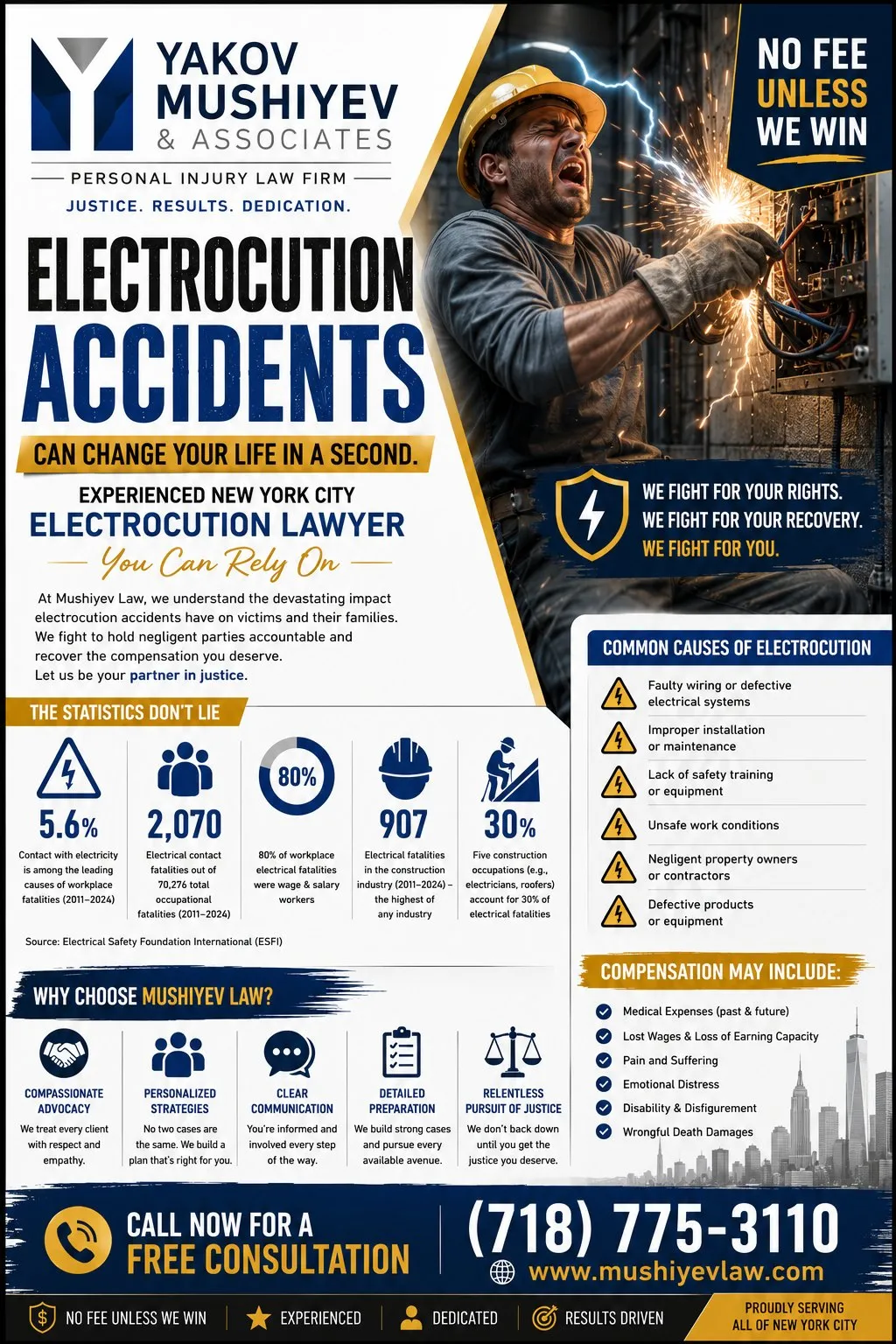
Electrocution Accident Lawyer Serving Fresh Meadows, NY 11365 and 11366
Electrical injury cases are argued differently from every other construction and premises case. New York’s most famous worker-protection statute, the Scaffold Law, is built around gravity. A shock is not gravity. The statute that carries an electrical case is a different one, it has a pleading requirement, and the case is usually won or lost on which sentence of the Industrial Code fits the facts.
So we start with the circuit, not the burn: who owned it, who energized it, who was supposed to check it before anyone touched it, and who could shut it off. Our Fresh Meadows personal injury lawyer practice covers the rest of our Queens work.
How Electrocutions Happen in Fresh Meadows
Worker cases. The 188th Street commercial spine turns over constantly, and every store build-out means panel work, sign power and temporary feeds inside an occupied building. Renovation crews across the roughly 3,000 apartments of the Fresh Meadows development open walls holding decades of unlabeled, spliced wiring. Contractors at St. John’s University on Utopia Parkway work around campus distribution, and utility crews on the Horace Harding service roads dig within reach of live underground feeders and run booms near energized overhead lines. The recurring mechanisms: contact with an overhead line by a ladder, boom or length of pipe; a circuit somebody swore was dead; a temporary panel with no ground; a trench that finds an unmarked cable; an arc flash on gear a worker was told was isolated.
Non-worker cases. Storms bring conductors down across Cunningham Park and onto the streets along its edge, and a downed line stays lethal while it stays energized. Inside buildings: ungrounded outlets, failed appliance grounds, a washing machine or water heater that energizes its own chassis, flooded basement panels, and landlords who answer a tenant’s shock complaint with a logbook entry. Outdoors: contact voltage in wet weather, where a corroded service energizes a streetlight base, a hatch cover or a fence. Pool circuits and landscape lighting without ground-fault protection produce their own injuries every year.
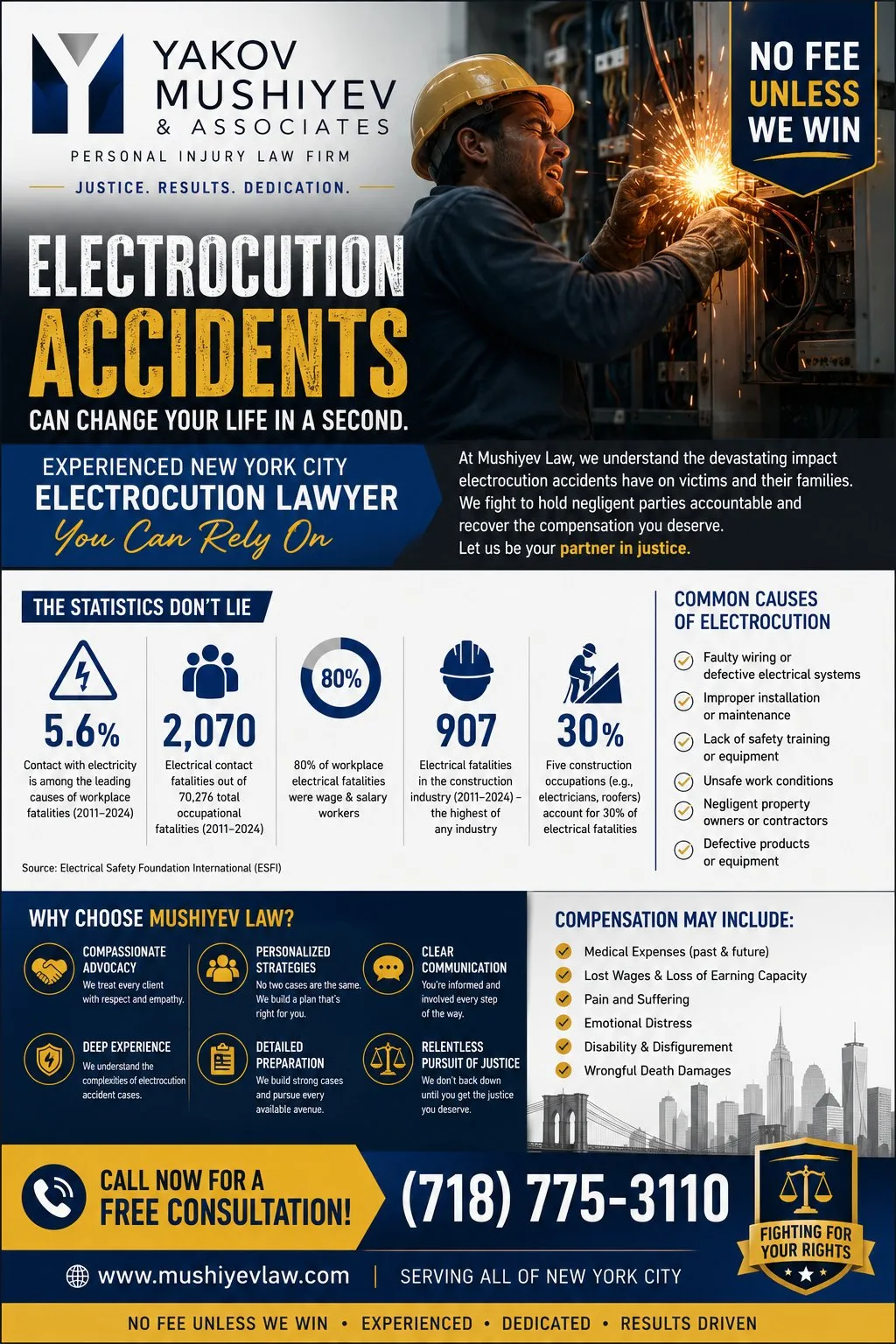
Injuries We See in Fresh Meadows Electrocution Cases
Electrical trauma is the injury most often underestimated in the first forty-eight hours, by patients and by insurers. The skin lies. You see an entry wound and an exit wound, sometimes no larger than a coin. You do not see the path the current took between them.
Current follows nerve, vessel and muscle, converting to heat as it goes, so deep tissue and muscle destruction routinely exceeds anything the surface suggests and keeps declaring itself over days. Destroyed muscle releases myoglobin, which is why kidney function is watched closely. Swelling inside a fascial compartment of the forearm, hand, leg or foot produces compartment syndrome, a surgical emergency that can end in fasciotomy or amputation.
The heart is the other reason nobody should be sent home casually. Current across the chest can throw the heart into arrhythmia, and rhythm disturbances sometimes appear hours after a shock that looked minor at the scene. Neurological and cognitive effects are common and frequently dismissed: memory and concentration problems, headache, chronic neuropathic pain, numbness, weakness, and personality changes that family notices before the patient does. Nerve damage along the current path can be permanent.
Arc flash is its own category. A fault in energized gear releases heat, light, pressure and vaporized metal, causing deep burns without any contact at all, plus blast injury, hearing loss and corneal damage. And many electrical cases carry a second, mechanical injury: the shock throws the worker off a ladder, a lift or a roof, and the fractures and head trauma from that fall dominate the hospital chart even though current caused it.
People hurt this way are typically transported to NewYork-Presbyterian Queens at 56-45 Main Street in Flushing, the nearest Level I Trauma Center. Go the same day even if you walked away, and make sure the record says electrical injury rather than burn.
The New York Law That Applies
Labor Law § 241(6) is the workhorse
Labor Law § 241(6) is the statute that carries an electrical injury case on a construction, excavation or demolition site. It requires those areas to be equipped, guarded, arranged and operated so as to give reasonable and adequate protection, and the duty is non-delegable. It binds owners, contractors and their agents whether or not they controlled the work, with the usual exception for owners of one- and two-family dwellings who contract for but do not direct the job.
The price of admission is pleading a specific provision of the Industrial Code, 12 NYCRR Part 23. Comparative fault stays available to reduce damages, and in a non-motor-vehicle case it operates under CPLR 1411(a): a percentage of fault lowers the recovery, it does not bar it.
Why the Scaffold Law usually does not apply
Nearly every competing page tells an electrocution reader that Labor Law § 240(1) gives them absolute liability. On a pure electric shock that is wrong, and believing it costs a worker time he does not have.
Section 240(1) is elevation-specific by its own text. It lists scaffolding, hoists, ladders, slings, hangers, blocks, pulleys, braces and ropes, and it exists to address gravity-related risks: a person falling from height, or an object falling because it was not properly hoisted or secured. Current does not fall.
The Scaffold Law reaches an electrical case only through a gravity event. If the shock threw a worker off a ladder, scaffold or roof, that fall is a § 240(1) claim and it can be enormously valuable, because comparative negligence is no defense to it. A falling energized line or object works the same way. But a man who took 277 volts through his hands standing flat on a concrete floor has no Scaffold Law claim, and telling him otherwise builds the case on a foundation that collapses on the first motion. Our Fresh Meadows construction accident page covers the elevation cases.
12 NYCRR 23-1.13 — “Electrical hazards”
12 NYCRR 23-1.13 is the Industrial Code section written for this hazard, and it supplies the predicate.
Read subdivision (a) first, because the defense will. None of the section applies to operations conducted by employers, owners, contractors and their agents subject to the jurisdiction of the Public Service Commission. That is a real carve-out for utility operations and the first thing a utility-adjacent defendant raises. It has limits: it does not shield a general contractor merely because a utility’s lines run nearby, and it does not touch a § 200 claim.
Then subdivision (b), where the concrete commands live. (b)(1) requires all power lines near a construction, demolition or excavation site to be considered energized until qualified representatives of the owner give assurance otherwise. (b)(2) requires voltages to be determined and circuits identified by voltage level and phase. (b)(3) requires that before work is begun the employer ascertain, by inquiry, observation or instruments, whether any part of a power circuit, exposed or concealed, sits where the work may bring a person, tool or machine into contact with it, with warning signs posted and employees informed. (b)(4) is the most-cited sentence in this practice: no employer may permit an employee to work in such proximity to a power circuit that he may contact it unless the circuit is de-energized and grounded or guarded by effective insulation or other means. (b)(5) is the lockout rule — open switches and circuit-interrupting devices must be guarded against inadvertent closing until the exposure ends. (b)(6) requires the employer to notify the utility in writing at least five normal working days before work within 10 feet of a live overhead line, or before excavation that might disturb a live underground line.
Specificity is governed by Toussaint v Port Authority of New York and New Jersey, 38 NY3d 89 (2022): only Industrial Code provisions mandating compliance with concrete specifications create a non-delegable § 241(6) duty, and a regulation that merely restates common-law care will not do. Toussaint is the yardstick, and (b)(3), (b)(4) and (b)(6) clear it comfortably — each tells a named party to do a particular thing at a particular time. The general precaution in (b)(1) is more vulnerable, which is why we never rest on it alone.
Labor Law § 200 — the notice and supervision route
Labor Law § 200 codifies the common-law duty to provide a reasonably safe workplace and stays available when the Industrial Code predicate is contested. It requires fault. For a dangerous premises condition — a live unmarked conductor in a wall, a panel with no cover — you show the defendant created it or had actual or constructive notice. For means and methods, you show authority to supervise and control how the work was performed.
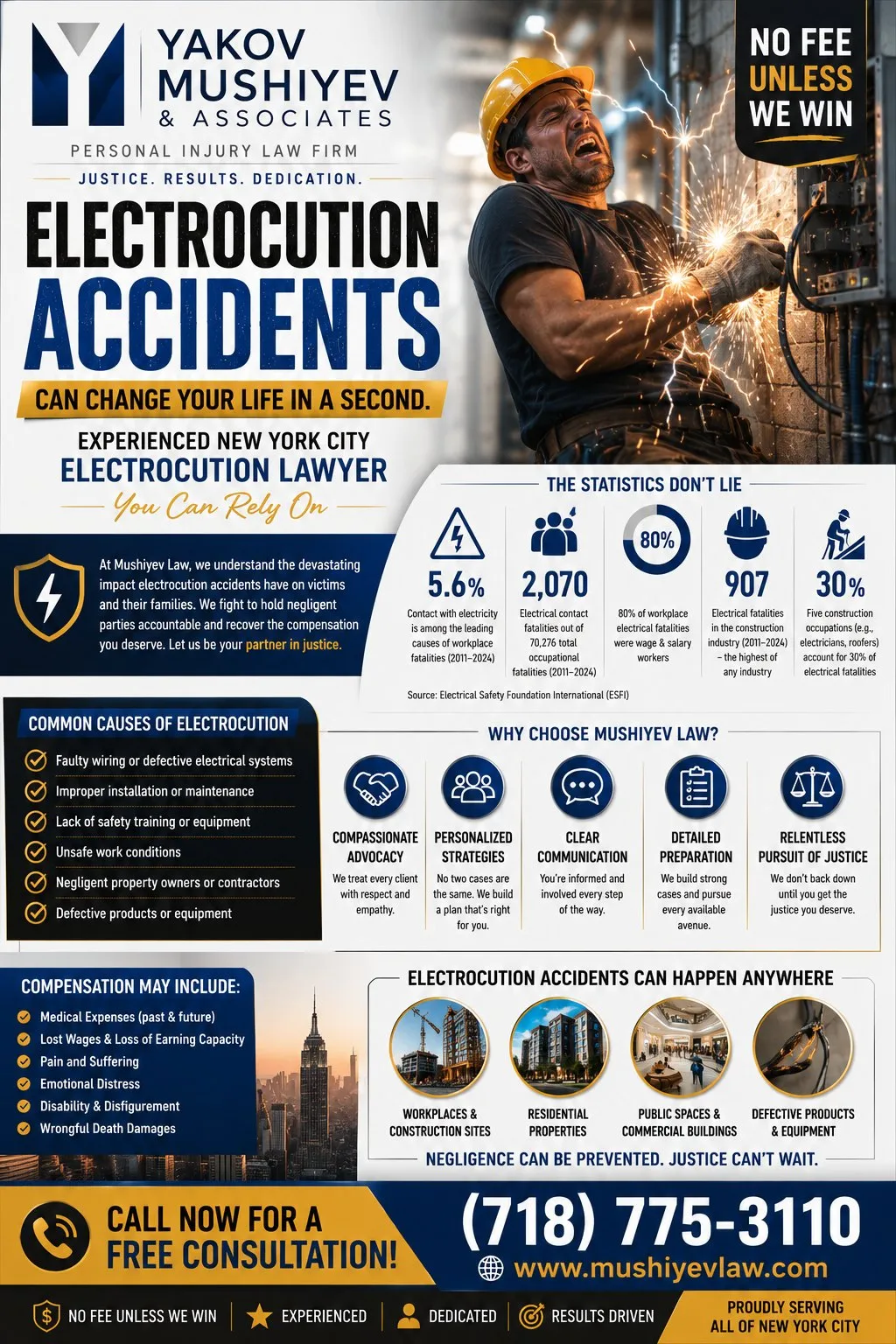
Contact Us Now
Hurt in Fresh Meadows? Talk to a lawyer today — the consultation is free, we advance all case expenses, and there is no fee unless we win.
Call 718.775.3110 | Contact Us Now →
We answer 24/7 and we will come to you in Fresh Meadows if you cannot travel.
What To Do Right Now
- Get to an emergency room the same day and say “electrical injury.” Ask about cardiac monitoring.
- Never approach a downed line or anyone touching one. Call 911 and let the utility de-energize it.
- Photograph the source — panel, outlet, appliance, cord, pole, trench, lift — before it is repaired or removed.
- Photograph entry and exit wounds on day one and again every few days. They change.
- Write down every company on the job: truck lettering, permit board, electrical sub, utility crew.
- Keep the item — the cord, tool, fixture or appliance. Do not surrender it to a landlord or contractor.
- Report it in writing to your employer, or to your landlord and managing agent if it happened at home.
- Give no recorded statement to an insurer or utility representative before you speak with a lawyer.
- Call within days, so a preservation letter beats the repairs, the outage records and the recycled video.
Deadlines in a Fresh Meadows Electrocution Case
The ordinary personal injury deadline is three years under CPLR 214(5). A wrongful death claim is two years from the date of death under EPTL 5-4.1, and New York death damages remain limited to pecuniary loss; see our Fresh Meadows wrongful death page.
Now the point readers get wrong most often. Consolidated Edison is a private, investor-owned corporation. The Public Service Commission regulates it, but it is not a municipal, district or public benefit corporation. General Municipal Law § 50-e reaches only public corporations, so a claim against Con Edison requires no notice of claim and runs on the ordinary three-year statute of limitations. Do not let anyone push a Con Ed case down the 90-day municipal path, and do not let anyone tell you it died at 90 days.
The 90-day rule is real, but it belongs to other defendants. If the City owned or controlled the equipment — a streetlight, traffic signal, DOT infrastructure, a City building or street job — GML § 50-e requires notice of claim within 90 days, served on the Comptroller, and suit within one year and 90 days. NYCHA property has its own notice-of-claim track with the same one year and 90 days. Identifying who owned the energized equipment is the first urgent question, because it decides which clock you are on.

Electrocution Cases That Are Not Work Injuries
A tenant shocked by a bathroom fixture, a child who touched an energized fence, a pedestrian who stepped on a live hatch cover in the rain, a guest hurt by a pool light — none are Labor Law cases. They run on ordinary negligence and premises liability. The owner or managing agent owes reasonable care, and the case usually turns on notice: whether the condition was visible and apparent and lasted long enough to be found and fixed. Prior tenant complaints, superintendent logs, violation history and electricians’ invoices are the proof. Our Fresh Meadows premises liability page covers that framework, and our firmwide premises liability practice handles these buildings across Queens.
If you were hurt on the job, workers’ compensation is the exclusive remedy against your own employer under Workers’ Compensation Law § 11, and it pays nothing for pain and suffering. The real recovery comes from the third-party case against the owner, general contractor, other trades, the utility or an equipment manufacturer. Our Fresh Meadows work injury page explains the comp lien and the consent-to-settle trap.
How We Build a Fresh Meadows Electrocution Case
The first job is proving who owned and controlled the circuit. We pull the Department of Buildings permit and job filing, the electrical permits and inspection certificates, the deed, and the contracts and certificates of insurance down the chain, because indemnity language usually decides who funds the resolution. Where a utility asset is involved we seek its outage and trouble-ticket history and any record of prior repair.
A preservation letter goes out within days demanding the physical item — panel, breaker, cord, tool, fixture or appliance — be kept unrepaired, along with lockout logs, the site safety plan, daily reports, the written five-day notice to the utility required by 23-1.13(b)(6), and surveillance video, which is often recycled within weeks. We depose the foreman, the electrical subcontractor and the coworkers on site, because the § 241(6) case comes down to what was ascertained before work began and who said the circuit was dead. Where the mechanism is disputed we retain an electrical engineer, and in appliance cases a product failure analyst. Cases that do not settle are tried in Supreme Court, Queens County, 88-11 Sutphin Boulevard in Jamaica, by the same Fresh Meadows accident lawyer team that handles our general personal injury work.
Frequently Asked Questions
Does the Scaffold Law cover my electrocution?
Usually not on its own. Labor Law 240(1) addresses elevation-related, gravity-driven risks — falling from a height or being struck by a falling object. A pure electric shock is not an elevation risk. It reaches an electrical case only where the shock caused a fall from height or where something fell on the worker. Many firm pages promise the Scaffold Law on every construction injury, and on electrocution facts that is usually wrong. What carries the case is Labor Law 241(6) with a specific Industrial Code violation.
Do I have to file a notice of claim within 90 days against Con Edison?
No. Consolidated Edison is a private, investor-owned corporation regulated by the Public Service Commission. It is not a municipal, district or public benefit corporation, so General Municipal Law 50-e does not apply. There is no notice of claim, and the ordinary three-year statute of limitations under CPLR 214(5) governs. The 90-day rule applies where the City, NYCHA or a transit authority owns or controls the equipment, so identifying the owner comes first.
What makes 12 NYCRR 23-1.13 strong enough to support a claim?
Under Toussaint v Port Authority of New York and New Jersey, 38 NY3d 89 (2022), only Industrial Code provisions imposing concrete specifications create a non-delegable duty under Labor Law 241(6). Section 23-1.13(b)(3) requires the employer to ascertain before work begins whether a circuit sits where the work may bring a person, tool or machine into contact with it. Subdivision (b)(4) bars permitting work near a circuit unless it is de-energized and grounded or effectively guarded. Subdivision (b)(6) requires written notice to the utility at least five working days before work within ten feet of a live overhead line. Each commands a specific act. Note that 23-1.13(a) exempts operations subject to Public Service Commission jurisdiction.
I only had a small burn on my hand. Is that worth a case?
The surface wound is a poor measure of electrical injury. Current travels through nerve, vessel and muscle and burns tissue along the way, so internal damage routinely exceeds what the skin shows. Compartment syndrome, muscle breakdown affecting the kidneys, cardiac rhythm disturbances appearing hours later, and lasting neurological and cognitive effects all follow shocks that looked minor at the scene. Get evaluated the same day and do not let an insurer value the case off a photograph of your hand.
My landlord knew the outlet was bad and my child was shocked. What claim is that?
That is ordinary negligence and premises liability, not a Labor Law claim. The owner and managing agent owe reasonable care to people lawfully in the building, and the case usually turns on notice — whether the condition was visible and apparent and existed long enough for them to find and repair it. Prior complaints, superintendent and work-order logs, violation history and past electrical repairs are the evidence. The deadline is three years, unless a public entity owns the building, in which case the 90-day notice of claim applies.
Other Fresh Meadows Case Types
- Fresh Meadows Personal Injury Lawyer (hub)
- Car Accident Lawyer Fresh Meadows
- Truck Accident Lawyer Fresh Meadows
- Commercial Truck Accident Lawyer Fresh Meadows
- Motorcycle Accident Lawyer Fresh Meadows
- Scooter Accident Lawyer Fresh Meadows
- Moped Accident Lawyer Fresh Meadows
- Bicycle Accident Lawyer Fresh Meadows
- Pedestrian Accident Lawyer Fresh Meadows
- Bus Accident Lawyer Fresh Meadows
- Taxi Accident Lawyer Fresh Meadows
- Uber Accident Lawyer Fresh Meadows
- Lyft Accident Lawyer Fresh Meadows
- Rideshare Accident Lawyer Fresh Meadows
- Slip and Fall Lawyer Fresh Meadows
- Trip and Fall Lawyer Fresh Meadows
- Premises Liability Lawyer Fresh Meadows
- Construction Accident Lawyer Fresh Meadows
- Work Injury Lawyer Fresh Meadows
- Dog Bite Lawyer Fresh Meadows
- Wrongful Death Lawyer Fresh Meadows
See also our Queens accident lawyer page.
Authoritative Resources
- Labor Law § 241 — Construction, excavation and demolition work
- Labor Law § 240 — Scaffolding and other devices
- Labor Law § 200 — General duty to protect health and safety
- 12 NYCRR 23-1.13 — Electrical hazards
- Toussaint v Port Authority, 38 NY3d 89 (2022)
- CPLR 214 — Three-year statute of limitations
- General Municipal Law § 50-e — Notice of claim
Contact Us Now
Hurt in Fresh Meadows? Talk to a lawyer today — the consultation is free, we advance all case expenses, and there is no fee unless we win.
Call 718.775.3110 | Contact Us Now →
We answer 24/7 and we will come to you in Fresh Meadows if you cannot travel.
This page is general information about New York law, not legal advice, and reading it does not create an attorney-client relationship. New York’s auto injury statutes were amended effective May 26, 2026, and the rules described here may apply differently to your case. Prior results do not guarantee a similar outcome. Speak with a lawyer about your specific situation.