
Picture a Saturday afternoon on Liberty Avenue. (This is a hypothetical, but anyone who shops in Richmond Hill will recognize it.) A woman finishes her errands near Lefferts Boulevard, steps off the curb with two grocery bags, and a green cab swings around a double-parked delivery van to grab a fare waving from the other side of the street. She never sees it coming. By evening she is at the hospital with a broken wrist, a phone full of missed calls, and one big question: who is supposed to pay for all of this?
That question has a real answer, and it is more specific than most people expect. Taxis, green Boro Taxis, app-based cars and car services in New York City carry their own insurance rules, and several important rules changed in 2026. This page walks through how a taxi accident claim works for people in Richmond Hill and South Richmond Hill, what deadlines matter, and how Yakov Mushiyev & Associates, P.C. can help. If you would rather just talk it through, call 718.775.3110. Consultations are free, available in English, Russian and Spanish, and you pay no fee unless we win.
The Short Answer: Three Layers of Coverage
When people ask us “who pays?”, we usually sketch three layers on a notepad. Understanding them early saves a lot of worry later.
- No-fault (PIP) benefits. New York is a no-fault state. Personal injury protection pays medical bills, lost earnings and other basic economic loss regardless of who caused the crash, under Insurance Law § 5102.
- The at-fault driver’s liability policy. If your injury meets New York’s serious injury threshold, you can step outside no-fault and claim pain and suffering and economic losses that no-fault does not cover.
- Other sources. Depending on the facts, that can include another driver’s policy, your own coverage, or a claim against a city agency if a public vehicle was involved.
Which no-fault policy pays you depends on where you were. As a general rule, a passenger claims no-fault benefits from the vehicle they were riding in, and a pedestrian or cyclist claims from the vehicle that struck them. So the woman on Liberty Avenue in our example would look first to the green cab’s insurer.
What Is Different About a TLC Vehicle
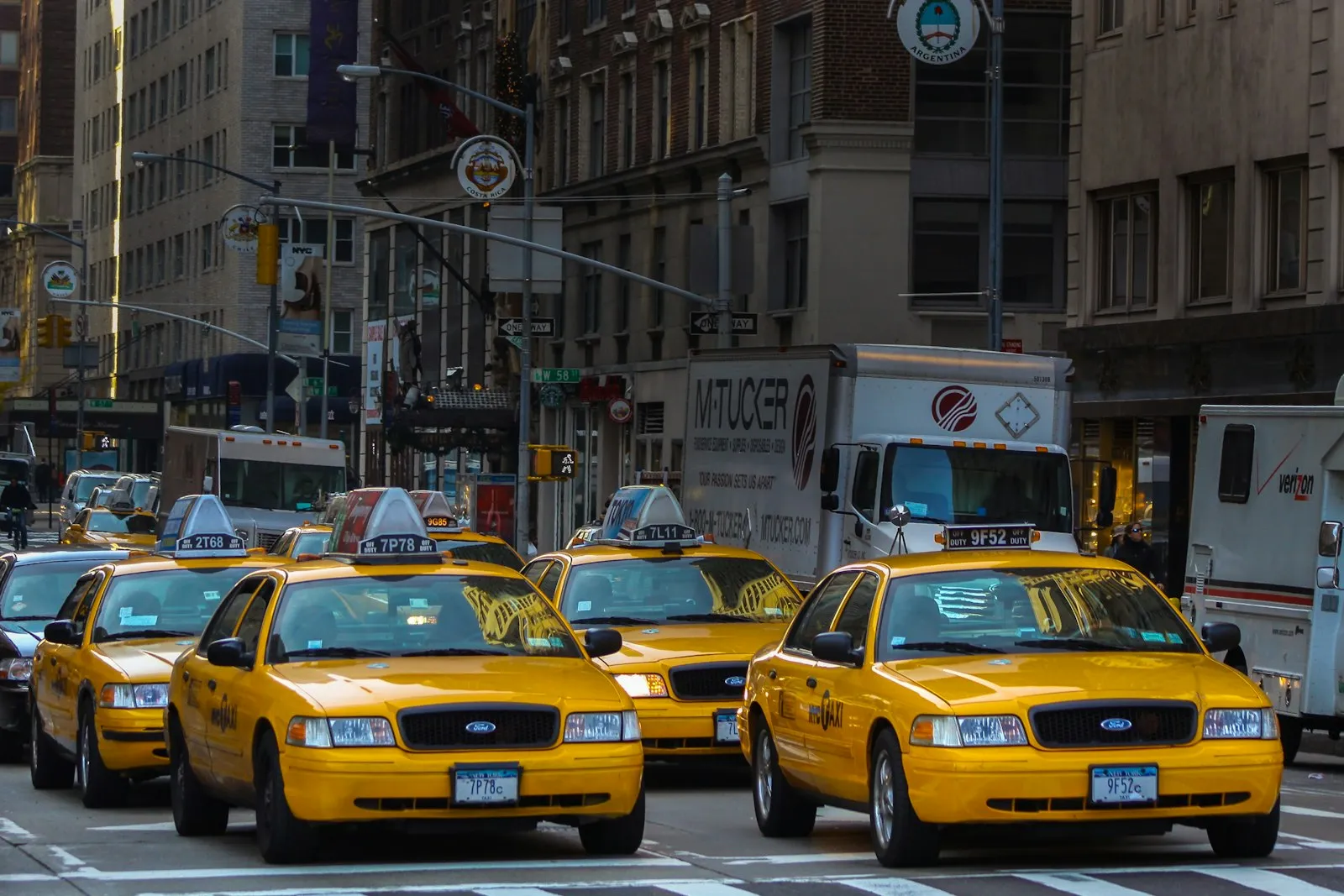
Vehicles licensed by the NYC Taxi and Limousine Commission include yellow medallion taxis, green Boro Taxis, for-hire vehicles such as Uber and Lyft cars, and limousines. They are held to insurance requirements that are higher than the state minimum for a private car. Here is how the numbers compare, using only the figures we have verified:
| Coverage | Private car (state minimum) | TLC-licensed vehicle |
|---|---|---|
| No-fault / PIP per person | $50,000 | $100,000 (effective March 1, 2026) |
| Bodily injury liability, medallion taxi | Not applicable | $100,000 per person / $300,000 per occurrence minimum |
The TLC no-fault requirement was reduced to $100,000 per person on March 1, 2026, under a TLC rule implementing Local Law 90 of 2025. If you read an older article quoting a higher figure, it is out of date. For app-based rides, the policy that applies can depend on what the driver was doing at the moment of the crash, so we always gather the trip records before assuming which insurer is responsible.
Practical Takeaway: Deadlines in Bold
If you remember nothing else from this page, remember these dates. Missing one can shrink a claim or end it.
- 30 days from the accident to file your no-fault application (11 NYCRR 65-1.1).
- 90 days to file a notice of claim if a New York City or MTA vehicle was involved, such as a city bus on Liberty Avenue or Jamaica Avenue (General Municipal Law § 50-e).
- 3 years to file a personal injury lawsuit (CPLR 214(5)).
- 2 years for a wrongful death action (EPTL 5-4.1), which in New York still allows pecuniary damages only.
The 30-day no-fault deadline is the one people miss most, usually because they are busy recovering. A phone call in the first week takes that worry off your plate.
How the 2026 Law Changes Affect Richmond Hill Claims
New York’s 2026 budget rewrote parts of the no-fault system. These changes apply to lawsuits filed on or after May 26, 2026, regardless of when the accident happened, so they reach many crashes that occurred before this year.
The serious injury threshold is narrower
To sue for pain and suffering after a car or taxi crash, you must show a “serious injury.” The budget removed the category that used to be based on a set number of days of disability. There are now eight categories: death; dismemberment; significant disfigurement; fracture; loss of a fetus; permanent loss of use of a body organ, member, function or system; permanent consequential limitation of use of a body organ or member; and significant limitation of use of a body function or system. A broken wrist, like in our Liberty Avenue example, is a fracture and fits the list. Soft-tissue injuries need careful medical documentation.
Fault now matters more
Under new CPLR 1411(b), in motor vehicle injury cases under Insurance Law Article 51 that are commenced on or after May 26, 2026, a claimant whose fault is greater than the defendant’s (or all defendants’ combined) recovers nothing. A claimant who is 50% or less at fault has the recovery reduced in proportion. Claims that do not involve a motor vehicle remain under the older proportional rule in CPLR 1411(a). And under Insurance Law § 5104, the judge or jury must now decide fault before deciding whether the injury is serious.
A cap for certain at-fault claimants
New Section 5104(d) caps non-economic damages at $100,000 for an at-fault claimant who was driving uninsured (with an exception for a lapse of under 30 days that was not their own responsibility), was convicted of impaired driving, or was convicted of a felony committed while driving. It does not cap economic damages, other people’s claims, or wrongful death. The Department of Financial Services explained these changes in Circular Letter 2026-01; its auto insurance consumer pages are a good plain-language reference.
The practical lesson: because fault can now decide whether you recover anything at all, evidence about how the crash happened is worth gathering early, before the cab is repaired and before memories fade. For more on how this works for passengers and drivers in the neighborhood, see our article on what to do after a taxi accident in Richmond Hill.
Richmond Hill’s Streets: Where the Trouble Tends to Start
Richmond Hill is a neighborhood of long commercial avenues running under elevated trains, with quieter residential blocks in between. That layout creates a few recurring situations that come up when we look at taxi crashes here. We are not quoting crash counts; these are simply the patterns the street design invites.
- Under the el. The A train runs above Liberty Avenue and the J train runs above Jamaica Avenue. Steel columns narrow sight lines at intersections, and drivers turning left can lose sight of pedestrians stepping out between pillars.
- Double parking and curb pickups. Deliveries and quick stops along Liberty and Jamaica Avenues push cabs and app-based cars into the travel lane, where sudden stops and swerves happen.
- Expressway connections. The Van Wyck Expressway on the east side and Woodhaven Boulevard on the west carry heavy traffic, including taxis headed to and from JFK, and the ramps feed fast-moving cars onto local streets.
- Park edges. Along Park Lane South and Myrtle Avenue by Forest Park, drivers meet joggers, dog walkers and families crossing to the park.
- Lefferts Boulevard. A busy north–south route connecting Kew Gardens, Richmond Hill and South Richmond Hill, with transit stops, school traffic and shops along much of its length.
Forest Park and the Liberty Avenue Strip: Two Very Different Destinations
Richmond Hill’s two best-known destinations could not be more different, and each produces its own kind of taxi and for-hire traffic.
Forest Park, Richmond Hill side
Forest Park is one of the largest parks in Queens, a stretch of woods, trails, ballfields and a golf course that runs along the northern edge of Richmond Hill toward Woodhaven, Glendale and Kew Gardens. People come for the trails and wooded paths, weekend games, and simply a breath of green between the avenues. Its Richmond Hill edge follows Park Lane South and Myrtle Avenue, and the Jackie Robinson Parkway cuts through the park nearby.
Taxi and app-based traffic here is mostly drop-offs and pickups at park entrances along Park Lane South and Myrtle Avenue, plus through traffic using the park drives and the parkway as a shortcut. Cars pulling over at park edges, people stepping out of a stopped car into the road, and faster traffic coming off the parkway are the situations to watch.

Liberty Avenue’s commercial strip
Liberty Avenue, often called “Little Guyana,” is the heart of Richmond Hill’s Indo-Caribbean community, lined with restaurants, bakeries, sari and jewelry shops, and grocery stores. People come from across the city to shop and eat here, and the A train’s stations at 104th Street, 111th Street and Lefferts Boulevard bring steady foot traffic.
That foot traffic is exactly what draws taxis and car services. Pickups happen at the curb wherever a passenger is standing, cars stop mid-block, and drivers cruise slowly looking for fares or addresses. Add the el columns, double-parked delivery trucks and crowded crosswalks, and you have the setting for the kind of crash in our opening story. If you were hurt on Liberty Avenue, note the nearest cross street and the closest storefront; many shops have cameras, and that footage is often overwritten quickly.
What We Do, Step by Step
Here is how a typical taxi case moves with our firm, told from the client’s side of the table.
- We listen first. A free conversation, by phone, by video, at your home or at the hospital, in English, Russian or Spanish.
- We secure the no-fault claim. We help you file within the 30-day window with the correct insurer so medical bills and lost wages start getting paid.
- We identify every vehicle and policy. TLC license information, trip records for app-based rides, and police reports help us find who is responsible and which coverage applies.
- We preserve the evidence. Video requests to nearby businesses, witness statements, scene photos and vehicle damage records, gathered early because fault now carries more weight.
- We document your injury. We work with your doctors so your records clearly show which serious injury category applies.
- We negotiate, and file suit when needed. Cases from Richmond Hill are typically filed in Queens County Supreme Court in Jamaica.
Why Richmond Hill Families Call Us
Our office is at 1 Cross Island Plaza in Rosedale, a short drive down the Van Wyck and the Belt Parkway, and we handle accident claims throughout Queens, including Richmond Hill and its neighbors like Kew Gardens and South Ozone Park. A few things people tell us they value:
- No fee unless we win. You do not pay us out of pocket to get started.
- Consultations in English, Russian and Spanish.
- Home, hospital and video visits if getting to an office is hard right now.
- Phone intake 24/7, with office hours Monday through Friday, 9 to 6.
- Focused experience with car and taxi accident claims in Queens. You can review our past settlements, keeping in mind that every case is different.
Taxi Accident FAQs
I was a passenger in a cab. Do I need to prove the driver was at fault?
Not for no-fault benefits. As a passenger, you generally claim PIP from the taxi you were riding in, and those benefits pay regardless of fault. Fault matters if you pursue a claim for pain and suffering beyond no-fault.
How much no-fault coverage does a taxi carry now?
TLC-licensed vehicles must carry $100,000 per person in no-fault coverage, effective March 1, 2026. Private cars must carry at least the state minimum of $50,000 per person.
What counts as a “serious injury” in 2026?
There are now eight categories under Insurance Law § 5102(d), including fracture, significant disfigurement, permanent consequential limitation of use of a body organ or member, and significant limitation of use of a body function or system. The former disability-days category was removed.
What if the insurer says I was partly at fault?
For motor vehicle injury suits filed on or after May 26, 2026, you can still recover if your share of fault is 50% or less, though your recovery is reduced by that share. If your fault is greater than the defendant’s, you recover nothing. That is why early evidence matters.
I was hit while crossing Liberty Avenue. Whose insurance pays?
Pedestrians generally claim no-fault benefits from the vehicle that struck them. If that was a taxi or for-hire vehicle, its insurer handles your no-fault claim.
How long do I have to file?
The no-fault application is due within 30 days. A personal injury lawsuit generally must be filed within 3 years, a wrongful death action within 2 years, and a notice of claim against a city or MTA vehicle within 90 days.
Do I need a police report?
A police report is very helpful evidence. Drivers may also need to file a report with the DMV; the New York DMV explains when the MV-104 accident report is required. More general questions are answered on our FAQ page.
What does it cost to hire your firm?
The consultation is free, and we work on a contingency basis: no fee unless we win.
About Richmond Hill: Local FAQs
What subway lines serve Richmond Hill?
The A train runs on an elevated line above Liberty Avenue, with stations including 104th Street, 111th Street and Lefferts Boulevard. The J train runs above Jamaica Avenue, with stops including 111th Street and 121st Street.
What ZIP codes cover the neighborhood?
Richmond Hill is mainly 11418, and South Richmond Hill is mainly 11419.
Which neighborhoods border Richmond Hill?
Woodhaven lies to the west, Kew Gardens and Forest Park to the north, Jamaica to the east, and Ozone Park and South Ozone Park to the south.
Where is the nearest major hospital?
Jamaica Hospital Medical Center sits by the Van Wyck Expressway near Jamaica Avenue, at the eastern edge of Richmond Hill. In an emergency, always call 911.
Which court would hear a Richmond Hill injury case?
Richmond Hill is in Queens County, so a personal injury lawsuit is typically filed in Queens County Supreme Court on Sutphin Boulevard in Jamaica. Information about the courts is available from the New York State Unified Court System.
Any tips for getting around Liberty Avenue safely?
Cross at corners with signals rather than between el columns, watch for cars pulling out of double-parked spots, and if you are taking a cab or app-based ride, ask to be let out at the curb on a side street rather than in the travel lane.
How do I get from Richmond Hill to JFK?
Most taxis and car services take the Van Wyck Expressway south to the airport. Leave extra time; the Van Wyck is often congested.
Back to Liberty Avenue: What Happens Next Is Up to You
The woman in our hypothetical has choices. She can try to navigate insurers on her own, or she can make one call and let someone who handles taxi claims every week sort out which policy pays, which deadlines apply, and whether her injury qualifies for more than no-fault. The same is true for you.
Call 718.775.3110 for a free case review, or send us a message online. Phone intake is open 24/7. Our office is at 1 Cross Island Plaza, Suite 325, Rosedale, NY 11422, and we are glad to come to you in Richmond Hill, at home or in the hospital.

Attorney Advertising. This is general information about New York law, not legal advice, and reading it does not create an attorney-client relationship. Every case depends on its own facts. The scenario described on this page is hypothetical. Prior results do not guarantee a similar outcome.