
Slip and Fall Lawyer in Fresh Meadows, Queens
Fresh Meadows covers ZIP codes 11365 and 11366, and the falls we hear about cluster in the same places: the stores at Fresh Meadows Place at 188th Street and the Horace Harding Expressway, the supermarkets and pharmacies along Union Turnpike, and the lobbies and stairwells of the Fresh Meadows apartment development. Yakov Mushiyev & Associates, P.C. is a Rosedale, Queens personal injury firm that appears regularly in Queens County Supreme Court, and we have recovered over $50 million for injured clients.
If you slipped on a wet floor, tracked-in slush, spilled produce or freshly waxed tile, call 718.775.3110 or use our free case review form. The consultation is free, we advance case expenses, and there is no fee unless we win.
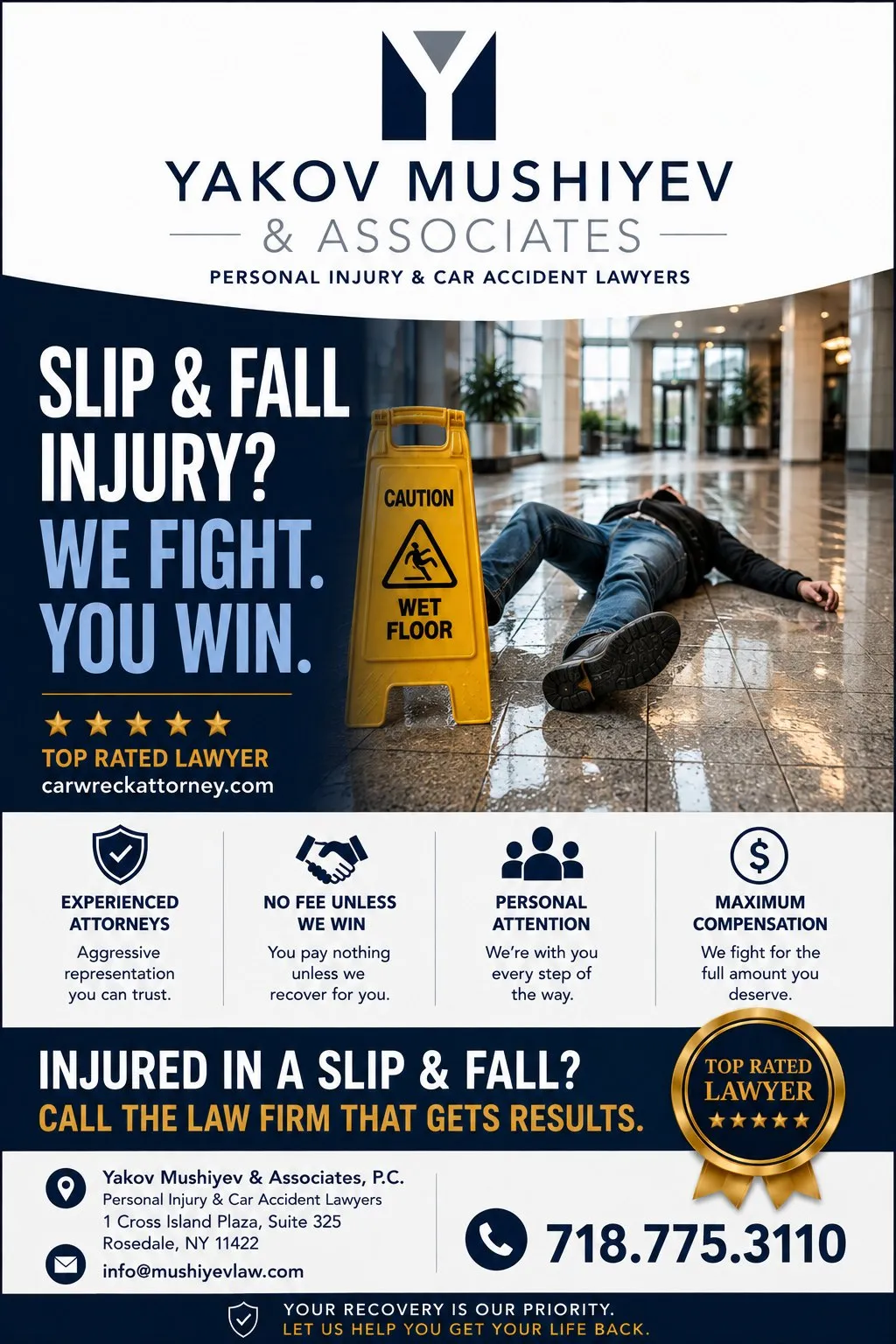
Slip and Fall Lawyer Serving Fresh Meadows, NY 11365 and 11366
A slip and fall is not a trip and fall. A trip involves a permanent defect you can still photograph a year later. A slip involves a transitory substance: water, ice, grease, floor wax, spilled milk, condensation off a leaking cooler. It sat there a while, somebody mopped it, and the evidence is gone.
That is the whole fight — not whether you fell, but notice: whether the owner knew about the condition, or should have known, and had a chance to clean it up. For the full picture, see our Fresh Meadows personal injury lawyer page.
How These Falls Happen in Fresh Meadows
Fresh Meadows was built for cars. The New York Life development designed by Ralph Thomas Walker between 1947 and 1962 was among the first communities in the United States laid out for the automobile rather than the pedestrian. People drive, park, and do their walking indoors on hard commercial flooring. That is where slips happen.
- Tracked-in water and slush. The first twenty feet inside an entrance off the Horace Harding service road on a wet January day. Mats saturate, nobody swaps them, and the tile past the mat line turns slick.
- Leaking refrigeration. Staff often know a cooler drips and have known for weeks. That is actual notice, and it is provable.
- Spilled product. Produce, cooking oil, detergent. The question is how long it sat.
- Waxing and mopping. Freshly waxed tile with no cone, or a cone set out afterward.
- Lobbies and stairwells. Worn stair treads plus water carried in from the parking areas.
- Snow and ice. Parking lots, ramps and walkways after a Queens storm.
Injuries We See in Fresh Meadows Slip and Fall Cases
A slip is a backward fall. You land on the tailbone, hip, elbow and the back of the head without getting your hands out. That produces a different injury list than a forward trip: hip and femur fractures, wrist fractures from the one arm that braced, lumbar disc herniations, rotator cuff tears, and closed head injuries.
Ambulances from Fresh Meadows typically transport to NewYork-Presbyterian Queens at 56-45 Main Street in Flushing, the nearest Level I Trauma Center. Others go to NYC Health + Hospitals/Queens, Jamaica Hospital Medical Center, or Long Island Jewish. Go even if you can walk — the emergency room record anchors everything.
The New York Law That Applies
Notice: created, actual, or constructive
To win a slip and fall in New York you generally have to prove one of three things. That the owner created the condition — an employee mopped it, waxed it, or dropped it. That the owner had actual notice, because someone told them or the leaking cooler had been written up before. Or that the owner had constructive notice: the condition was visible and apparent and sat there long enough that a reasonable inspection would have caught it.
Constructive notice is where these cases are won and lost, and it is a question of time. Five minutes is usually not enough. Forty-five minutes usually is. The case turns on evidence that puts a clock on the spill.
Cleaning logs, sweep sheets and inspection records
Most chain supermarkets, pharmacies and shopping centers run a documented sweep program — a sweep sheet, an hourly inspection log, a porter’s checklist, a scanner that logs when someone walked a zone. If the log shows the aisle was last checked two hours before you fell, that is constructive notice. If the whole day was filled in at the end of the shift in one handwriting, a jury can be told what that means. And if a defendant claims a sweep program but cannot produce the paper for your day, the absence is evidence too.
Surveillance video, and how fast it disappears
Nearly every store at Fresh Meadows Place and along 188th Street has cameras, and so do most apartment lobbies. That video shows the spill appear, shows how many people walked past it, shows whether an employee stepped over it, and shows your fall.
Commercial systems commonly overwrite themselves on a loop measured in days to weeks — some at seven or fourteen days, many at thirty. Nobody has to save it just because you fell, and once the loop comes around it is lawfully gone. That is why we send a written preservation letter within days, demanding the full day of recording rather than a ten-second clip, plus the sweep logs and incident report. Sent early, it turns destroyed video into a spoliation issue. Sent late, it turns into nothing.
Storm in progress
New York does not require an owner to clear snow and ice while it is still falling. Under the storm in progress doctrine, the duty to remedy a snow or ice hazard is suspended during an ongoing storm and for a reasonable time after the precipitation stops. It is a real defense and we say so honestly.
It is also narrower than defendants argue. It does not cover ice that existed before the storm, or ice the owner created — a downspout draining across a walkway, a snow pile that melts and refreezes overnight. And “reasonable time” is a fact question, not a free pass. Certified hourly weather data usually settles when precipitation ended, which is why the exact time of your fall matters.
Comparative fault: CPLR 1411(a) still protects you here
This is the point most people get wrong. New York amended its comparative fault rules effective May 26, 2026. The new CPLR 1411(b) bar, which may prevent recovery entirely by a claimant more than 50% at fault, applies to motor vehicle cases governed by Insurance Law Article 51. It does not apply to premises cases.
Your slip and fall is still governed by CPLR 1411(a) — pure comparative negligence. If a jury finds you 30% responsible for looking at your phone, your award drops 30% and you recover the rest. Even a finding past 50% reduces a premises recovery rather than eliminating it. So when an adjuster says you should have seen the water and therefore have no case, that is not the law. Being partly at fault reduces the number; it does not close the door. Our premises liability practice is built around contested-fault cases.
No serious injury threshold, and no no-fault
The serious injury threshold in Insurance Law § 5102(d) gates auto cases, not premises cases. You do not have to prove a fracture to sue the store. The flip side: no no-fault carrier pays your bills after a fall. Your health insurance does, and any lien is resolved at the end of the case.
Contact Us Now
Hurt in Fresh Meadows? Talk to a lawyer today — the consultation is free, we advance all case expenses, and there is no fee unless we win.
Call 718.775.3110 | Contact Us Now →
We answer 24/7 and we will come to you in Fresh Meadows if you cannot travel.
What To Do Right Now
- Photograph the substance before anyone cleans it — wide, then close-ups of the puddle, the drip, the wax sheen, the track marks.
- Photograph what is missing. No cone, no mat, a saturated mat, a mop bucket two aisles over.
- Report it to a manager and ask for the incident report. If they refuse, get the manager’s name.
- Write down the exact time you fell. Constructive notice is measured in minutes.
- Get witness names and numbers, especially anyone who says “that’s been there a while.”
- Keep the shoes and do not clean them. Defendants routinely blame footwear.
- Get medical attention the same day.
- Call a lawyer within days, so a preservation letter beats the video loop.
- Do not give a recorded statement to the property’s insurer first.
Deadlines in a Fresh Meadows Slip and Fall Case
Against a private owner, store, landlord or cleaning contractor, the statute of limitations is three years under CPLR 214(5). A wrongful death claim is two years under EPTL 5-4.1, and New York death damages remain limited to pecuniary loss.
If you fell on public property — a City building, a public school, a library, a Parks facility, an NYCHA property — the clock is far shorter. A notice of claim must be served within 90 days under General Municipal Law § 50-e, and suit filed within one year and 90 days. In New York City the notice goes to the Comptroller, and missing it is the most common way a strong premises claim dies. The evidence has its own clock: the statute gives you three years, the surveillance system gives you weeks.
How We Build a Fresh Meadows Slip and Fall Case
We identify every entity with a duty first. At a shopping center like Fresh Meadows Place that can be the tenant store, the landlord, the management company, a janitorial contractor and a refrigeration vendor. Leases and maintenance contracts tell us who was responsible for the floor you fell on. The preservation letter then goes to all of them, demanding the full day of video, the sweep logs for that shift, the incident report, prior complaints about the same condition, and work orders on the leaking unit. A store with three falls at one cooler has a notice problem it cannot explain away.
In discovery we depose the manager on duty and the porter who walked the floor: what the sweep interval was, who checked it, what happened that shift. Where the flooring is at issue, coefficient-of-friction testing can show the surface was unreasonably slick when wet. For snow and ice we pull certified hourly weather observations and match them against the snow removal records.
Cases that do not resolve get filed in Supreme Court, Queens County, 88-11 Sutphin Boulevard in Jamaica. If your fall happened at work, our work injury practice handles the comp and third-party overlap, and our Fresh Meadows injury practice covers the rest.
Frequently Asked Questions
Do I have a case if I did not see the wet floor before I fell?
Yes. Not seeing it is normal and is not a defense by itself. The question is whether the owner created the condition, knew about it, or should have known because it sat there long enough for a reasonable inspection to catch it. Inattention can reduce your recovery under pure comparative negligence, but it does not eliminate it.
The store says the spill had only been there a minute. How do I prove otherwise?
With their own records and their own cameras. Sweep logs show when the area was last inspected. Video shows the spill appearing and how many people passed it. Cart tracks through the liquid and the condition of the substance also speak to elapsed time. That is why a preservation letter has to go out within days.
I fell on ice while it was still snowing. Is that automatically a losing case?
No, but the storm in progress doctrine applies. An owner gets a reasonable period after precipitation stops to clear snow and ice. The doctrine does not protect an owner where the ice predated the storm, where the owner’s own snow piling or drainage created it, or where a reasonable time had already passed.
Can I still recover if I was partly at fault?
In a premises case, yes. CPLR 1411(a) pure comparative negligence still governs slip and fall claims. Your damages are reduced by your percentage of fault, and that is all. The new 50% bar in CPLR 1411(b), effective May 26, 2026, applies only to motor vehicle cases under Insurance Law Article 51, not to a fall inside a store or an apartment building.
Who pays my medical bills after a slip and fall?
There is no no-fault coverage in a premises case, so your health insurance typically pays as you treat and any lien is resolved out of the recovery at the end. We also work with providers who treat on a letter of protection where no insurance is available.
Other Fresh Meadows Case Types
- Fresh Meadows Personal Injury Lawyer (hub)
- Car Accident Lawyer Fresh Meadows
- Truck Accident Lawyer Fresh Meadows
- Commercial Truck Accident Lawyer Fresh Meadows
- Scooter Accident Lawyer Fresh Meadows
- Moped Accident Lawyer Fresh Meadows
- Trip and Fall Lawyer Fresh Meadows
- Construction Accident Lawyer Fresh Meadows
- Taxi Accident Lawyer Fresh Meadows
- Uber Accident Lawyer Fresh Meadows
- Lyft Accident Lawyer Fresh Meadows
- Rideshare Accident Lawyer Fresh Meadows
See also our Queens slip and fall practice and our general personal injury practice.
Authoritative Resources
- CPLR 1411 — Comparative negligence
- CPLR 214 — Three-year statute of limitations
- General Municipal Law § 50-e — Notice of claim
- NYC Comptroller — File a Claim
- Insurance Law § 5102 — Serious injury definitions
- Supreme Court, Queens County — Civil Term
Contact Us Now
Hurt in Fresh Meadows? Talk to a lawyer today — the consultation is free, we advance all case expenses, and there is no fee unless we win.
Call 718.775.3110 | Contact Us Now →
We answer 24/7 and we will come to you in Fresh Meadows if you cannot travel.
This page is general information about New York law, not legal advice, and reading it does not create an attorney-client relationship. New York’s auto injury statutes were amended effective May 26, 2026, and the rules described here may apply differently to your case. Prior results do not guarantee a similar outcome. Speak with a lawyer about your specific situation.