
Taxi & For-Hire Vehicle Accident Lawyer in Long Island City
Long Island City is where a great deal of New York’s for-hire fleet actually lives. Garages, dispatch bases and vehicle-leasing operations cluster in the industrial blocks off Jackson Avenue, Borden Avenue and Northern Boulevard, and the Queensboro and Pulaski Bridge approaches funnel that traffic into Manhattan and back all day. If you were injured by or inside a for-hire vehicle here, the most valuable question is not who was driving. It is who owned the car — because in New York that answer frequently determines how much insurance is available to you.
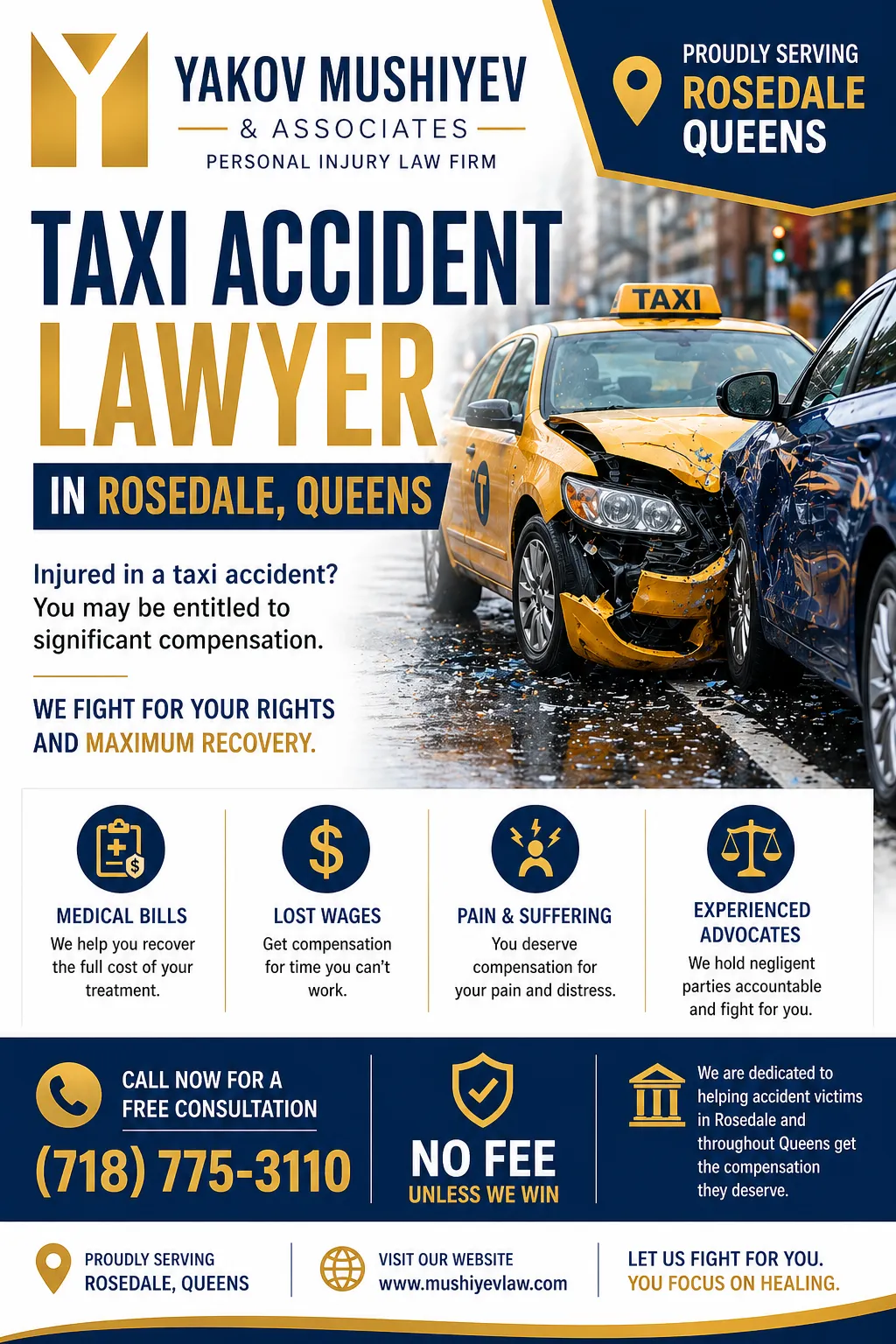
Vehicle and Traffic Law § 388: the owner is liable too
Under Vehicle and Traffic Law § 388, every owner of a vehicle used or operated in this state is liable for death or injury resulting from negligence in the use or operation of that vehicle by any person driving it with the owner’s permission. The driver does not have to be an employee. The owner does not have to have done anything wrong personally. Permission is enough.
In the for-hire economy that provision does a great deal of work, because the person at the wheel very often owns nothing. A medallion may be held by a corporation. The car may belong to a fleet that leases it out by the shift. A driver may be renting the vehicle weekly from an operator with no other connection to the trip. Each of those owners is reachable under § 388, and each of them typically carries far more coverage than an individual driver.
There is one significant limit worth being straight about. Federal law shields companies whose trade or business is renting or leasing vehicles from pure vicarious liability where they were not themselves negligent. Since a large share of LIC-garaged vehicles are leased rather than owned by their drivers, the practical question becomes whether the titled entity is a genuine leasing company or an operator — and, if it is a lessor, whether it was independently negligent, for instance by putting an unlicensed driver in the car or failing to maintain it. That distinction is worth resolving in the first weeks, not after a year of litigation.
Layered coverage, and why identifying the vehicle matters so much
Licensed for-hire vehicles in New York City are required to carry liability coverage above the ordinary private-car minimum, and fleets frequently carry more still. Where the trip was arranged through an app, a separate policy applies whose limits depend on the driver’s status at impact — app off, logged in and waiting, or carrying a passenger. Those three states differ enormously, and the trip record is what establishes which applied.
All of that is only reachable if the vehicle is identified. The TLC plate or medallion number, the base name on the door, and the trip receipt are the threads. Photograph them at the scene if you can. If you cannot, the police report and your own payment records usually preserve enough to find the owner later.
No-fault first, then the threshold
Whoever was at fault, no-fault pays your medical treatment and a share of your lost earnings. Passengers are covered by the vehicle they were riding in; people struck while walking or cycling are covered by the striking vehicle’s policy, with no need to own a car. The application — form NF-2 — generally must reach the insurer within 30 days, and missing it converts covered treatment into personal debt.
To be compensated for the injury itself you must satisfy the serious injury threshold in Insurance Law § 5102(d) — fracture, significant disfigurement, permanent consequential limitation, significant limitation of use, or the 90/180-day category. That is proven with measured clinical findings and treatment that does not stop and restart. Against a private defendant the suit deadline is the three years under CPLR 214; under CPLR 1411 partial fault reduces recovery proportionally rather than barring it; and where a City vehicle or the MTA is involved a § 50-e Notice of Claim is due within 90 days.
Case results
A selection of recoveries our firm has obtained in vehicle cases:
- $1,600,000 — a commercial vehicle rear-ended our client’s car in the course of his employment; neck herniations requiring surgery. Queens County, settled before depositions.
- $300,000 — passenger in a rear-end collision; neck herniations requiring surgery. Queens County.
- $250,000 — passenger riding a public bus involved in a rear-end collision; herniated discs in the neck and lower back corrected surgically. Queens County, settled pre-suit.
More recoveries are listed on our settlements page. Prior results do not guarantee a similar outcome. Every case depends on its own facts.
Frequently Asked Questions
The driver told me he owns the car himself. Does that limit what I can recover?
Possibly, but it is worth checking rather than accepting. Registration records, the base affiliation and the certificate of insurance often tell a different story from what is said at the roadside. If a fleet or corporate entity holds title, § 388 reaches it, and that usually means a considerably larger policy.
The car was rented or leased. Can I sue the leasing company?
Not on vicarious liability alone — federal law protects companies in the business of renting or leasing vehicles where they were not themselves at fault. You can still pursue them where their own negligence contributed, such as leasing to a driver without a valid license or failing to maintain the vehicle. And the driver, and any operator who is not a true lessor, remain fully exposed.
How do I find out who owns the vehicle?
That is our job, not yours. Registration and insurance records, TLC licensing records and the police report together identify the registered owner, the base and the insurer. What helps most is any detail you captured at the scene — a plate, a medallion number, a base name, a photograph, a receipt.
What does it cost to hire you?
Nothing up front. We work on contingency: the consultation is free and there is no fee unless we recover for you. Home and hospital visits are available if you cannot travel to Rosedale.
Courts that hear Long Island City taxi cases
- Queens County Supreme Court, Civil Term — its Long Island City courthouse at 25-10 Court Square is in the neighborhood itself; the other building is 88-11 Sutphin Boulevard, Jamaica.
- NYC Civil Court, Queens County — 89-17 Sutphin Boulevard, Jamaica.
Our Office & Directions from Long Island City
Yakov Mushiyev & Associates, PC
1 Cross Island Plaza, Suite 325
Rosedale, NY 11422
Phone: 718.775.3110
Monday – Friday, 9:00 a.m. – 6:00 p.m. Home and hospital visits available.
Open these directions in Google Maps
What Our Clients Say
Rated across 586+ Google reviews, pulled live from our Google Business Profile:
Request a Free Case Review
Related: Personal Injury Lawyer Long Island City · Taxi Accident Lawyer Astoria · Astoria · Personal Injury Practice · About Yakov Mushiyev · All Queens Locations
This page is general information about New York law, not legal advice about your situation. Every case turns on its own facts, and deadlines vary. Prior results do not guarantee a similar outcome. Speak with an attorney before relying on anything here.