
You tapped “Request,” the car pulled up on Main Street, and a few minutes later you were in an emergency room instead of where you meant to go. If that is how your week went, you need answers fast, not a wall of legal text. This page is built to be scanned: short sections, plain lists and the deadlines in bold. Yakov Mushiyev & Associates, P.C. is a Queens personal injury firm, and as a Lyft accident lawyer in Flushing, we handle claims for riders, pedestrians, cyclists and other drivers hurt in crashes involving Lyft cars across downtown Flushing and the rest of the borough.
The 60-Second Version
- File for no-fault within 30 days. This is the deadline that sinks the most claims.
- Inside New York City, TLC rules decide the insurance floor, not the state rideshare law.
- Screenshot the Lyft receipt and trip details now. Do not delete the app.
- Riders usually claim no-fault from the Lyft car; pedestrians and cyclists from the car that hit them.
- Lawsuit deadline: generally 3 years for personal injury, 2 years for wrongful death.
- New 2026 rules changed the serious injury list and added a fault cutoff for motor-vehicle suits.
The rest of this page unpacks each point. Skip to whatever matches your situation.
Who Pays When a Lyft Crashes in Flushing?
Short answer: it depends on where the trip started and where you were when the crash happened. Here is how the layers stack up.
Layer 1: TLC insurance on the Lyft car
- In New York City, a Lyft car is a for-hire vehicle licensed by the NYC Taxi & Limousine Commission (TLC). The driver holds a TLC license, the car has TLC plates, and it carries commercial for-hire insurance.
- For for-hire cars with fewer than 8 seats, the TLC requires at least $100,000 per person / $300,000 per occurrence in liability coverage.
- No-fault (PIP) on TLC vehicles is $100,000 per person since March 1, 2026, after the TLC cut the earlier requirement. A crash before that date may still fall under the policy then in force.
Layer 2: The state rideshare rule (usually not yours)
New York State’s rideshare law requires $1.25 million in liability coverage while a passenger is aboard, but that state rule exempts cities of 1 million or more people, so it does not govern a trip that starts in Flushing. It matters only for rides that begin outside the city, such as a pickup in Nassau County. A Lyft that picks you up in Great Neck and crashes on Northern Boulevard in Flushing may be treated differently from one that picks you up on Main Street.
Layer 3: Possible extra coverage from Lyft
Lyft may carry additional coverage above the TLC minimums on some trips. Whether it applies, and how much, has to be confirmed from the insurer and the trip record. We do not guess at that number; we request the documents.
Layer 4: Your own policy
Uninsured/underinsured motorist coverage on TLC vehicles in NYC is far lower than the state rideshare rule. If another driver caused the crash and carries little insurance, your own SUM coverage, or a household relative’s, can make a real difference. The New York Department of Financial Services explains how auto and no-fault coverage work for consumers.
Your Claim Depends on Where You Were Standing (or Sitting)
| Your role | Who pays no-fault first | Main issue to watch |
|---|---|---|
| Lyft passenger | The Lyft car’s commercial policy | Rider fault is rarely an issue; the question is which drivers caused the crash. |
| Pedestrian on Main Street or Roosevelt Avenue | The vehicle that struck you | The new CPLR 1411(b) fault cutoff can apply. |
| Cyclist | The vehicle that struck you | Dooring at curbside pickups; fault arguments. |
| Driver of another car | Usually your own policy | Fault cutoff and the serious injury threshold. |
| The Lyft driver | Generally the New York Black Car Fund for work injuries | Separate from any passenger’s claim. |
Hurt in a yellow or green cab instead? The insurance picture is related but not identical. See our Flushing taxi accident page.

Save This Lyft Evidence Before It Disappears
A Lyft crash leaves a digital trail that a regular car crash does not. Grab it while you can:
- Ride receipt. Screenshot it in the app and keep the emailed copy.
- Trip ID, plus the start and end time and the route map.
- Driver name and plate exactly as the app showed them.
- Driver status. Was the app off, waiting for a request, en route to a pickup, or carrying a passenger? Status can change which coverage responds.
- In-app safety report. Report the crash in the Lyft app as well as to police.
- Scene photos: vehicles, plates, traffic lights, storefronts with cameras.
- Witness names and numbers, including other riders.
Do not delete the Lyft app, even if you never want to ride again. The trip record inside it is often the fastest way to prove which car, which driver and which insurer.
What Changed in 2026
Three changes apply to motor-vehicle injury lawsuits filed on or after May 26, 2026, no matter when the crash happened:
- Eight serious injury categories. Insurance Law 5102(d) now lists death; dismemberment; significant disfigurement; fracture; loss of a fetus; permanent loss of use of a body organ, member, function or system; permanent consequential limitation of use of a body organ or member; and significant limitation of use of a body function or system. The 2026 budget removed the old time-based category.
- A fault cutoff. Under new CPLR 1411(b), a claimant whose fault is greater than the defendant’s (or defendants’ combined) recovers nothing. At 50% or less, the award is reduced in proportion.
- Fault decided first. Insurance Law 5104 now has the fact-finder decide fault before serious injury, and adds a $100,000 cap on non-economic damages for an at-fault claimant who was driving uninsured (with a narrow exception for a lapse under 30 days that was not their own doing), convicted of impaired driving, or convicted of a felony committed while driving. The cap does not touch economic damages, other people’s claims or wrongful death.
What it means on the ground: a Lyft passenger is rarely blamed for a crash, so the fault cutoff mostly affects pedestrians, cyclists and other drivers. If you were crossing mid-block near Main Street or riding a bike past a double-parked Lyft, expect the insurer to argue about your share.
Deadlines at a Glance
- 30 days: no-fault application to the insurer of the vehicle you were in (or the one that hit you).
- 90 days: notice of claim if a City of New York or MTA vehicle, such as a bus, was involved.
- 2 years: wrongful death lawsuit, limited to pecuniary (financial) losses.
- 3 years: most personal injury lawsuits under CPLR 214(5).
Drivers may also need to file an MV-104 accident report with the New York DMV.
Flushing’s Lyft Hot Spots: Main Street, the Park and the Garden
Downtown Flushing and Main Street
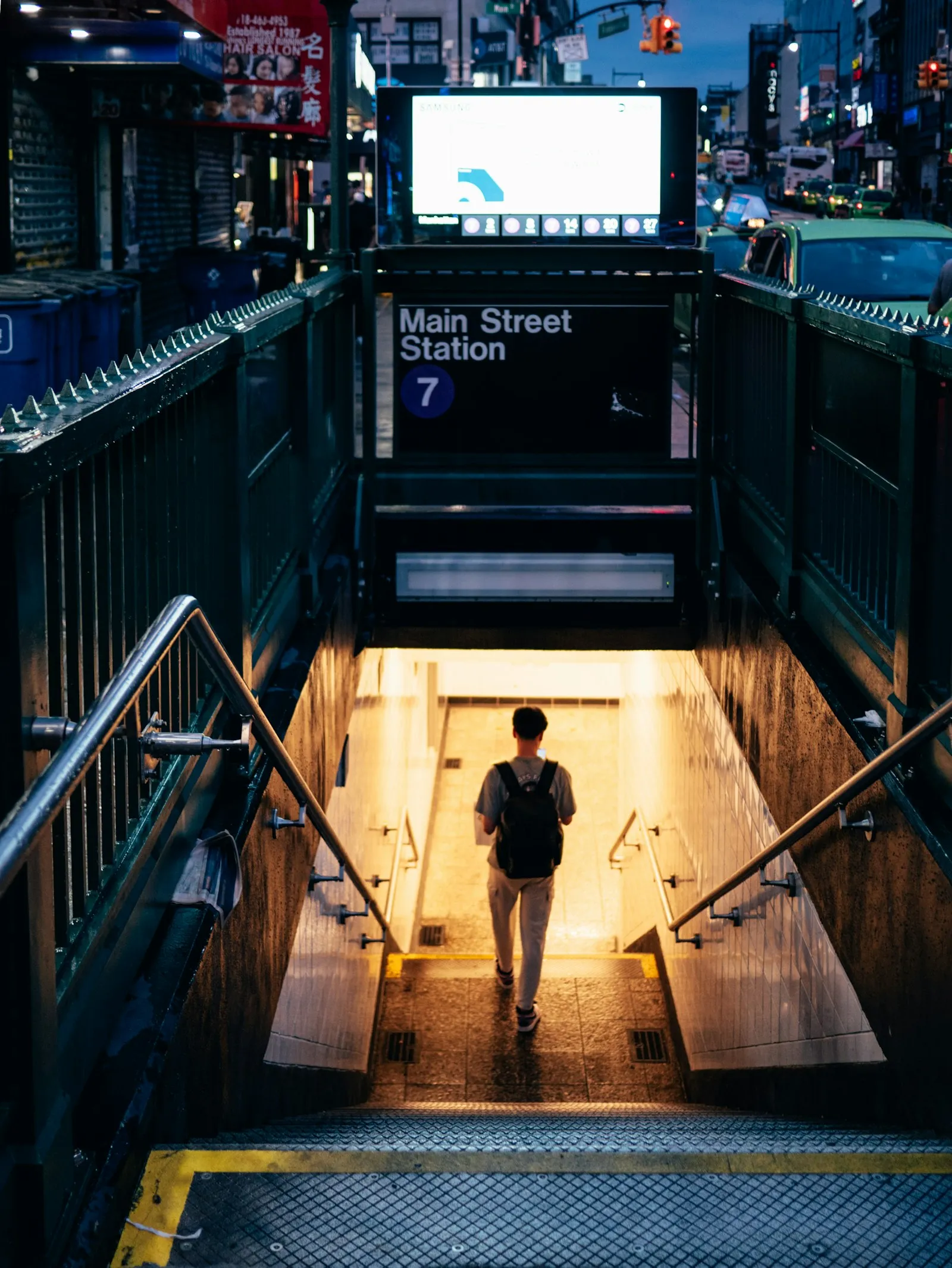
Downtown Flushing is one of the borough’s busiest commercial districts. The 7 train ends at Flushing–Main Street, the LIRR Port Washington Branch stops at its own Main Street station nearby, and bus routes converge on the same blocks. People come for restaurants, shopping, banking and errands, and many of them call a Lyft for the last leg home. What that looks like for app cars:
- Pickups: riders request cars outside the subway exits and wait at the curb on Main Street, Roosevelt Avenue and 39th Avenue, where legal stopping room is scarce.
- Drop-offs: drivers stop in travel lanes rather than circle again, which invites rear-end hits and door strikes on cyclists.
- Pin confusion: a misplaced pickup pin sends riders across the street mid-block to reach a car.
Flushing Meadows Corona Park
Across Flushing Creek to the west, the park holds the Unisphere, the USTA Billie Jean King National Tennis Center and, next door, Citi Field. On game and tournament days, Lyft demand spikes all at once. Expect drop-offs bunched near entrances, pickups stalled on the approaches, and drivers merging toward the Grand Central Parkway, the Van Wyck Expressway or the Whitestone Expressway in heavy traffic, with crowds walking between lots and venues.
Queens Botanical Garden
The garden sits on Main Street south of downtown. Visitors who arrive by Lyft are typically let out right on Main Street, where through-traffic is not braced for a car stopping short. Opening a door into a passing bike or car is a real risk here.
Other Pickup Hazards We See Around Flushing
- Northern Boulevard: wide and fast; drivers cut across lanes to reach a rider.
- Kissena Boulevard and College Point Boulevard: busy feeders into downtown with frequent sudden stops.
- Expressway ramps: airport-bound Lyft trips run through the area toward the Van Wyck, Whitestone Expressway, Long Island Expressway and Grand Central Parkway.
- Phone distraction: drivers glancing at the app to accept the next ride.
Want the pedestrian and cyclist side of this in more depth? Read our article on being hit by a Lyft car in Flushing.
Why Work With a Lyft Accident Attorney From Our Firm
- Based in Queens: our office is at 1 Cross Island Plaza in Rosedale.
- Three languages: consultations in English, Russian and Spanish.
- We come to you: home, hospital or video meetings.
- No fee unless we win.
- Phone intake 24/7; office hours Monday to Friday, 9 to 6.
- We chase the trip record, the TLC policy and any additional coverage, so you are not stuck doing it.
More background: our car accident practice, our settlements page, the Flushing accident lawyers hub, and our Lyft accident lawyer page for Auburndale next door.
Lyft Accident FAQs
Does the state rideshare rule’s $1.25 million figure, meant for trips starting outside the city, apply to my Flushing ride?
Generally no. That state rule exempts New York City. Trips that start in NYC fall under TLC minimums: $100,000 per person and $300,000 per occurrence in liability, and $100,000 per person in PIP. The state figure matters for trips starting outside the city, such as in Nassau or Westchester.
I was in the back seat. Can I be blamed?
Rarely. A passenger’s own fault is seldom an issue. The fight is usually between the drivers and their insurers over who caused the crash.
Who handles my medical bills first?
As a rider, you send the no-fault application to the insurer of the Lyft car’s commercial policy within 30 days. No-fault pays medical bills, lost earnings and other basic economic loss regardless of fault. It does not pay for pain and suffering.
When can I sue for pain and suffering?
When your injury meets one of the eight serious injury categories in Insurance Law 5102(d). You then claim against the at-fault driver and, where appropriate, the vehicle’s owner.
The Lyft driver was hurt too. Are we competing for the same money?
Not usually. Lyft drivers in NYC hurt on the job are generally covered for their own work injuries through the New York Black Car Fund, which provides workers’ compensation for black-car and app-based for-hire drivers. That is separate from your passenger claim.
My crash happened before March 1, 2026. Which PIP amount applies?
Possibly the policy that was in force on the crash date. We check the actual policy rather than assume.
What does a consultation cost?
Nothing. The case review is free, and there is no attorney’s fee unless we win. You can also browse our general FAQ page.
About Flushing: Local FAQs
What is the easiest transit route into downtown Flushing?
The 7 train to its last stop, Flushing–Main Street, or the LIRR Port Washington Branch to its Flushing–Main Street station. Many bus lines also end or pass through downtown.
Which neighborhoods surround Flushing?
College Point and Whitestone to the north, Murray Hill and Auburndale to the east, Fresh Meadows and Kew Gardens Hills to the south, and Corona across the park to the west.
What is there to see in Flushing Meadows Corona Park besides the Unisphere?
The park is also home to the Queens Museum, the New York Hall of Science, the Queens Zoo and the tennis center that hosts the US Open. The 7 train’s Mets–Willets Point station serves the park’s north end.
Where are the nearest hospitals?
NewYork-Presbyterian Queens on Main Street and Flushing Hospital Medical Center on Parsons Boulevard. In an emergency, call 911.
Which precinct takes crash reports?
The NYPD’s 109th Precinct covers Flushing.
Where would my case be heard?
Flushing is in Queens County, so many injury suits go to Queens County Supreme Court, with its civil courthouse on Sutphin Boulevard in Jamaica. See the New York State Unified Court System.
Any tips for getting picked up downtown safely?
Set your pin on the same side of the street you are standing on, wait on the sidewalk until the car stops fully, and exit on the curb side after checking for bikes.
Get a Free Flushing Lyft Accident Case Review

The 30-day no-fault clock is already running. Call 718.775.3110 any time, day or night, or send us a message for a free case review. We meet in English, Russian or Spanish, at home, in the hospital, by video, or at our office: Yakov Mushiyev & Associates, P.C., 1 Cross Island Plaza, Suite 325, Rosedale, NY 11422. No fee unless we win.
Attorney Advertising. This is general information about New York law, not legal advice. Reading this page does not create an attorney-client relationship. Every case turns on its own facts. Prior results do not guarantee a similar outcome.