
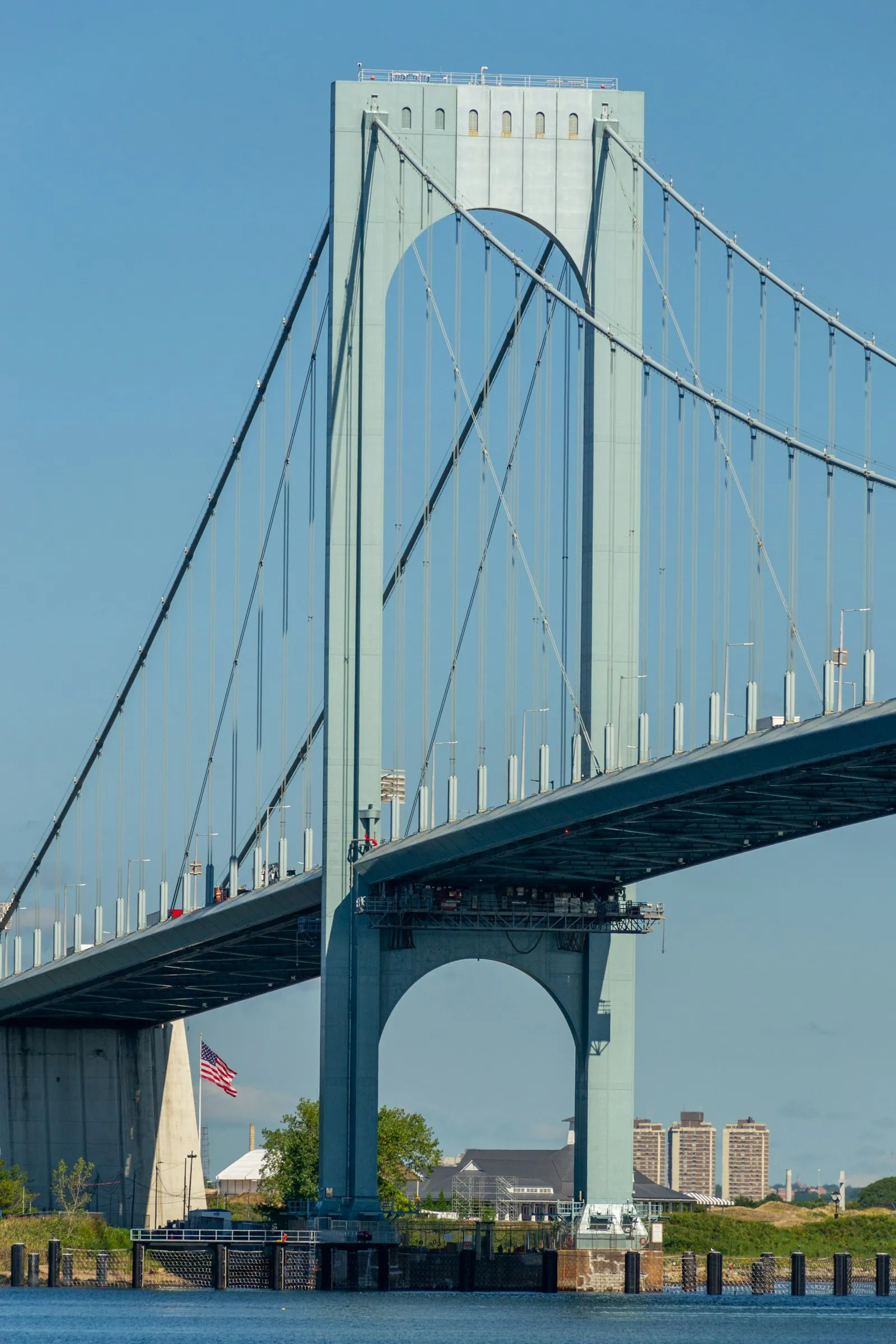
In Whitestone, most trips start on a ramp. You merge onto the Whitestone Expressway to reach LaGuardia, swing onto the Cross Island Parkway to head toward Bayside, or climb the approach to the Bronx–Whitestone Bridge on the way to the Bronx and beyond. Yellow cabs, green cabs, Uber and Lyft cars and black-car services run those same ramps all day, often fast and often while the driver is watching a phone mount for the next fare. When one of those vehicles hits you, the claim that follows is not an ordinary car case. Mushiyev Law represents passengers, drivers, pedestrians and cyclists hurt in taxi and for-hire crashes in Whitestone, Beechhurst, Malba and the rest of northeast Queens, and this page lays out how those claims actually work in 2026.
The Whitestone Commute, Seen From a Claims File
Whitestone sits in the northeast corner of Queens, ZIP code 11357, with the East River along its northern shore, College Point to the west, Bayside to the east and Flushing to the south. There is no subway stop inside the neighborhood. The nearest train is the 7 at Flushing–Main Street, and the closest Long Island Rail Road stops are on the Port Washington Branch in Flushing and Murray Hill. That gap is exactly why so many residents lean on cabs and app-based rides: to the 7 train, to the airport, to a doctor’s appointment in Flushing, or home late from Manhattan.
The neighborhood is also stitched together by some of the busiest highways in the borough. Each one creates its own kind of collision:
- Whitestone Expressway (I-678): the main artery between the bridge, LaGuardia-bound traffic and the Van Wyck. Short merge lanes and heavy airport traffic produce rear-end and sideswipe crashes, especially where the service roads feed in.
- Cross Island Parkway: runs along the waterfront toward Fort Totten and Little Neck Bay. Speed and sudden slowdowns near the bridge interchange are recurring problems.
- Clearview Expressway (I-295): the link toward the Throgs Neck Bridge on Whitestone’s eastern edge, where commuters and for-hire drivers jockey for position.
- Local streets such as Francis Lewis Boulevard, 149th Street, 150th Street and Willets Point Boulevard: pickups and drop-offs in residential blocks, double-parked cars and turning vehicles put pedestrians and cyclists at risk.
Which Insurance Pays First, and Which Pays After
New York is a no-fault state. That means the first money for your medical bills and lost wages usually comes from Personal Injury Protection (PIP), and PIP pays regardless of who caused the crash under Insurance Law § 5102. For ordinary private cars, the state minimum is $50,000 per person. Vehicles licensed by the NYC Taxi and Limousine Commission — yellow and green taxis, black cars, limousines and app-based rides like Uber and Lyft — carry a separate, higher requirement. As of March 1, 2026, the TLC requirement is $100,000 per person, after a rule change that reduced the earlier figure.
Whose PIP you claim depends on where you were:
| Where you were | Usual PIP source | What it generally covers |
|---|---|---|
| Passenger in a cab or app-based ride | The vehicle you were riding in | Medical care, lost earnings, other basic economic loss |
| Driver of your own car hit by a cab | Your own auto policy | Same basic economic loss, up to your policy’s PIP limit |
| Pedestrian on Francis Lewis Blvd or a side street | The vehicle that struck you | Same basic economic loss |
| Cyclist on a local street | The vehicle that struck you | Same basic economic loss |
PIP does not pay for pain and suffering. To recover for that, you bring a liability claim against the at-fault driver and the vehicle owner. For a medallion taxi, TLC rules require liability coverage of at least $100,000 per person and $300,000 per occurrence. If the person at fault was not the cab driver — say, a private driver who cut across two lanes on the Whitestone Expressway and pushed the cab into you — the claim may run against that driver’s insurer instead, or against both.
The serious injury threshold
A no-fault state limits who can sue for pain and suffering. You must show a “serious injury” as defined in Insurance Law § 5102(d). The 2026 state budget removed one of the old categories, and the list now has eight: death; dismemberment; significant disfigurement; a fracture; loss of a fetus; permanent loss of use of a body organ, member, function or system; permanent consequential limitation of use of a body organ or member; and significant limitation of use of a body function or system. Building the medical record that proves one of these categories is a large part of what we do.
What Changed in 2026 for Highway Crash Claims
Two changes matter most to anyone hurt on a Whitestone highway this year, because expressway crashes are often the kind where an insurer argues everybody shares some blame.
- A new fault cutoff. Under new CPLR 1411(b), in motor-vehicle injury lawsuits under the no-fault article that are commenced on or after May 26, 2026, a claimant whose share of fault is greater than the defendant’s (or the defendants’ combined share) recovers nothing. A claimant found 50% at fault or less has the recovery reduced in proportion. This applies to lawsuits filed on or after that date regardless of when the accident happened.
- Fault decided first. Under Insurance Law § 5104, the fact-finder must now decide fault before deciding whether there is a serious injury.
- A cap for certain at-fault claimants. New § 5104(d) limits non-economic damages to $100,000 for an at-fault claimant who was driving uninsured (subject to a narrow exception for a short lapse), was convicted of impaired driving, or was convicted of a felony committed while driving. It does not cap economic damages, other people’s claims or wrongful death claims.
On a merge lane, every driver has a story about who moved first. Under the 2026 rules, whose story the evidence supports can decide whether you recover anything at all.
That is why we move quickly on evidence in expressway cases: dashcam footage, ride-app trip data, the TLC driver’s records and statements from anyone who saw the lane change.
Deadlines on the Clock
- 30 days from the accident to file a no-fault application (11 NYCRR 65-1.1). Miss it and medical bills can go unpaid.
- 90 days to serve a notice of claim if a New York City or MTA vehicle was involved (General Municipal Law § 50-e).
- 3 years to file a personal injury lawsuit under CPLR 214(5).
- 2 years for a wrongful death action (EPTL 5-4.1), which in New York remains limited to pecuniary damages.
You will also generally need to report a crash involving injury to the New York DMV on form MV-104. We can help make sure that report is consistent with your medical records and the police report.
Top Destination: Francis Lewis Park Beneath the Bronx–Whitestone Bridge
Francis Lewis Park is a waterfront park on the East River at the Queens foot of the Bronx–Whitestone Bridge, run by NYC Parks. It takes its name from Francis Lewis, a signer of the Declaration of Independence who lived in Whitestone. People come for the shoreline, the open lawns and the view straight up at the bridge’s deck and towers — one of the most photographed angles of the span. On warm evenings and weekends, the park draws dog walkers, families, photographers and people from well outside the neighborhood who want to see the bridge up close.
That popularity creates a traffic pattern worth understanding. The park sits on narrow residential streets just off the bridge and expressway approaches, so visitors arrive by app-based ride or cab and are dropped at the curb on blocks that were not designed for steady pickups. Drivers coming off the Whitestone Expressway or Cross Island Parkway are still moving at highway pace when they hit those local streets. Common risks include:
- Ride-share cars stopping mid-block to let passengers out, prompting doors opened into traffic or cyclists
- U-turns and three-point turns by drivers who overshoot the park entrance
- Pedestrians crossing between parked cars after sunset, when visibility drops
- Drivers checking navigation while trying to find the ramp back onto the highway
If you were hurt as a passenger being dropped near the park, or as a pedestrian walking to it, the same no-fault and liability rules described above apply. Photos of exactly where the car stopped often turn out to be the most important evidence in the file.
How We Handle a Whitestone Taxi Case, Step by Step
- Free review. We talk through what happened, by phone, by video, at your home or at the hospital. Consultations are available in English, Russian and Spanish.
- No-fault paperwork. We get your PIP application in on time and to the right carrier, which for a TLC vehicle may not be the one you expect.
- Evidence preservation. We send preservation requests for camera footage, trip records and vehicle data before they are overwritten.
- Medical documentation. We coordinate with your treating doctors so the records reflect the serious-injury categories accurately.
- Liability claim and negotiation. We identify every responsible party and every policy, then press the insurers.
- Lawsuit if needed. Queens cases are filed in Queens County Supreme Court; we keep the filing date in mind given the May 26, 2026 rule changes.
Why Commuters in Northeast Queens Call Mushiyev Law
- No fee unless we win. You pay nothing up front.
- Queens-based. Our office at 1 Cross Island Plaza in Rosedale sits on the same parkway many Whitestone drivers use every day.
- We come to you. Home, hospital and video visits for people who cannot easily travel after a crash.
- Phone intake 24/7. Office hours are Monday to Friday, 9 to 6, but you can reach us any time.
- Taxi and for-hire focus. We understand TLC insurance layers and how they differ from a regular car accident claim.
You can read about the kinds of matters our firm has handled on our settlements page, and general answers to common questions on our FAQ page. For a deeper, practical look at what to do on the road and in the days after a crash here, see our article on taxi accidents in Whitestone, Queens. We also serve neighboring communities, including College Point and Bayside, and the rest of the borough through our Queens accident lawyer practice.
Taxi Accident FAQs
I was a passenger in an Uber on the Whitestone Expressway. Whose insurance covers my medical bills?
Passengers generally claim PIP from the vehicle they were riding in. Because Uber and Lyft cars in New York City are TLC-licensed, that PIP is subject to the TLC requirement of $100,000 per person as of March 1, 2026.
Can I sue the cab driver for pain and suffering?
Yes, if your injury meets one of the eight serious-injury categories in Insurance Law § 5102(d) and the cab driver (or another driver) was at fault. No-fault benefits cover economic loss; pain and suffering comes through the liability claim.
What if the insurer says I was partly at fault?
For motor-vehicle lawsuits filed on or after May 26, 2026, if your share of fault is greater than the defendants’ combined share, you recover nothing. If it is 50% or less, your recovery is reduced by your percentage. That makes early evidence gathering critical.
Does the old “90 days out of work” category still count as a serious injury?
No. The 2026 state budget removed that category. The remaining eight categories are listed above, and your medical records need to support one of them.
How long do I have to file for no-fault benefits?
The no-fault application is due within 30 days of the accident. The lawsuit deadline for personal injury is generally three years, but the no-fault deadline comes first and is easy to miss.
What if a city bus or MTA vehicle was involved?
Claims against New York City or MTA vehicles require a notice of claim within 90 days. That is a much shorter window than the general lawsuit deadline.
Where can I check auto insurance rules myself?
The New York State Department of Financial Services publishes consumer information on auto insurance and no-fault, and the TLC posts its insurance rules on its website.
About Whitestone: Local FAQs
How do you get to Whitestone without a car?
There is no subway station in Whitestone. Most people take a local bus to the 7 train at Flushing–Main Street, or to the LIRR Port Washington Branch in Flushing. Many residents use taxis and app-based rides for those first and last legs.
What ZIP code is Whitestone?
Whitestone, including Beechhurst and Malba, is generally served by ZIP code 11357.
Which police precinct covers Whitestone?
The NYPD’s 109th Precinct, which also covers Flushing and College Point. If police responded to your crash, the report will usually come from there.
Which hospitals are closest?
The nearest major hospitals are in Flushing: NewYork-Presbyterian Queens and Flushing Hospital Medical Center.
Where would a Whitestone injury lawsuit be filed?
Whitestone is in Queens County, so a personal injury lawsuit would typically be filed in Queens County Supreme Court in Jamaica. The New York State Unified Court System has general court information.
Any tips for avoiding trouble near the bridge approaches?
Give yourself extra space on the Whitestone Expressway merges, expect sudden slowdowns near the bridge, and when you are dropped off near Francis Lewis Park, ask the driver to pull fully to the curb before you open the door.
Get a Free Case Review From a Whitestone Taxi Accident Lawyer
If a cab, an app-based ride or a black car hit you on the expressway, on the bridge approach or on a quiet Whitestone side street, the deadlines start running right away. Call 718.775.3110 for a free case review, or send us a message online. There is no fee unless we win.

Yakov Mushiyev & Associates, P.C.
1 Cross Island Plaza, Suite 325, Rosedale, NY 11422
Phone: 718.775.3110
Monday–Friday, 9 a.m.–6 p.m. · Phone intake 24/7 · English, Russian and Spanish
Attorney Advertising. This is general information about New York law, not legal advice, and reading it does not create an attorney-client relationship. Every case depends on its own facts. Prior results do not guarantee a similar outcome.