
Most people who call us after a cab crash have already heard a rule or two from a friend, a coworker, or a search engine. Some of those rules are right. Many are half right. A few are dangerously wrong, and the wrong ones tend to involve deadlines. As a Taxi Accident Lawyer in Queens, our firm, Yakov Mushiyev & Associates, P.C., spends a good part of every new case correcting assumptions before they cost someone a claim. We represent passengers, pedestrians, cyclists, and other drivers hurt in collisions with yellow cabs, green Boro Taxis, and car-service vehicles across the borough, from our office at 1 Cross Island Plaza in Rosedale.
This page is about precision. Below, we take the rules people most often get wrong after a taxi crash in New York and explain what the law actually says, where the exceptions are, and why the exact wording matters. We stick to what the statutes provide and flag where the answer depends on facts. If you want to understand how compensation is calculated and which insurance pays what, our guide to how Queens taxi accident claims are valued and paid covers that ground in detail.
Why a Taxi Accident Lawyer in Queens Starts With the Rules
Taxi cases sit at the intersection of several legal systems at once. There is New York’s no-fault insurance law. There is the serious injury threshold, which decides whether pain and suffering is even on the table. There are the general statute of limitations and, sometimes, much shorter municipal notice periods. There are the Taxi and Limousine Commission’s licensing and insurance requirements for the vehicle. And as of 2026, there are new rules on comparative fault for motor-vehicle cases.
Each of those systems has its own deadline and its own definitions. Getting one wrong usually does not announce itself right away. It shows up months later as a denied benefit, a dismissed claim, or a defense you cannot answer. So when you contact us, our first job is not to estimate value. It is to identify every clock that is running and every requirement you must satisfy. Here is how we help:
- We identify the vehicle owner, the driver, the insurer, and whether any public entity is involved.
- We file or confirm your no-fault application within the deadline and track the benefits.
- We gather the medical proof needed to meet the serious injury definition.
- We calendar the statute of limitations and any notice-of-claim deadline in writing.
- We deal directly with insurers so your statements are accurate and complete.
You can see the full range of matters we handle on our practice areas page.

The Deadlines, Stated Precisely
Before going rule by rule, here is the timeline in one place. These are general rules; specific facts can change them, which is why we review each case individually.
| Requirement | General deadline | Source |
|---|---|---|
| No-fault application (medical bills, lost wages) | Generally within 30 days of the accident | Insurance Law Article 51 and regulations |
| MV-104 accident report by drivers (injury, death, or property damage over $1,000) | Within 10 days | NY DMV |
| Notice of Claim against NYC or many public authorities | Generally within 90 days | General Municipal Law §50-e; Public Authorities Law §1212 |
| Lawsuit against NYC or covered public authorities | Generally within 1 year and 90 days | General Municipal Law and related statutes |
| Personal injury lawsuit against private parties | 3 years | CPLR 214(5) |
| Wrongful death lawsuit | 2 years from death | EPTL 5-4.1 |
Rule One: “I Have Three Years, So There’s No Rush”
What people assume: The statute of limitations for personal injury in New York is three years, so there is plenty of time.
What the law actually says: The three-year period in CPLR 214(5) is real, but it is only the deadline to file a lawsuit against a private defendant such as a cab driver or taxi owner. It does nothing to extend the 30-day no-fault application, which governs whether your medical bills get paid in the meantime. And if any public entity is involved — say the taxi collided with a city sanitation truck, or a defective traffic signal maintained by the City contributed — a Notice of Claim is generally due within 90 days under General Municipal Law §50-e.
Why precision matters: The three-year number is the latest deadline, not the first one. Treat the earliest deadline as the real one.
Rule Two: “No-Fault Means Nobody Gets Blamed”
What people assume: New York is a no-fault state, so fault does not matter and you cannot sue anyone.
What the law actually says: No-fault is a benefits system, not a ban on lawsuits. Under Insurance Law Article 51, the no-fault carrier pays basic economic loss up to $50,000 per person regardless of who caused the crash: necessary medical expenses, 80% of lost earnings up to $2,000 per month, and up to $25 per day for other reasonable and necessary expenses. Fault still matters a great deal for everything beyond that — pain and suffering, and economic losses that exceed no-fault — which are pursued against the at-fault party.
Which policy pays no-fault: This is where the details trip people up. A passenger in a taxi generally claims no-fault through the taxi’s insurance. A pedestrian or bicyclist struck by a cab generally claims through the vehicle’s insurer as well. A driver of a private car hit by a taxi generally claims through their own auto policy. Filing with the wrong carrier wastes time you may not have.
Rule Three: “Any Injury Lets You Sue for Pain and Suffering”
What people assume: If you were hurt and the cab driver was at fault, you can recover for pain and suffering.
What the law actually says: In a motor-vehicle case, you must first show a “serious injury” as defined in Insurance Law §5102(d). The categories include death; dismemberment; significant disfigurement; a fracture; loss of a fetus; permanent loss of use of a body organ, member, function or system; permanent consequential limitation of use of a body organ or member; and significant limitation of use of a body function or system. Soft-tissue injuries can qualify, but usually only with objective medical evidence of the limitation, such as measured range-of-motion deficits tied to imaging and examination findings.
One exception people miss: The threshold applies to non-economic damages. Economic losses that exceed what no-fault pays — for example, lost earnings above the $2,000 monthly cap — can be pursued against the at-fault party regardless of whether the injury meets the serious injury definition.
2026 update: For motor-vehicle personal injury actions commenced on or after May 26, 2026, the “90/180-day” category — a non-permanent injury that prevented a person from performing substantially all of their usual daily activities for at least 90 of the 180 days after the accident — was removed from the serious injury definition. Cases built on that category alone no longer qualify. The remaining categories, particularly fracture, permanent consequential limitation, and significant limitation, now carry even more weight, and the medical proof behind them must be specific.
Rule Four: “The Taxi Company Is Automatically Responsible”
What people assume: If a cab hit you, the taxi company pays.
What the law actually says: Responsibility follows ownership, employment, and the facts of the crash, and taxi ownership in New York City can be layered. A yellow cab’s medallion and vehicle may be owned by one person or entity and leased to the driver who was behind the wheel. A green Boro Taxi or car-service vehicle may be owned by the driver personally and affiliated with a base. Under Vehicle and Traffic Law §388, the owner of a vehicle is generally liable for the negligence of anyone driving it with the owner’s permission, so the registered owner is a key defendant even when someone else was driving.
Taxis and car-service vehicles licensed by the NYC Taxi and Limousine Commission must carry commercial insurance. Identifying exactly which policy covers the vehicle, and who the named insureds are, is part of our early work. We do not assume; we verify through the police report, registration records, and the insurer’s own disclosures.
Rule Five: “If I Was Partly at Fault, I Get Nothing”
What people assume: Any share of blame wipes out a claim.
What the law actually says: The answer now depends on when the lawsuit is commenced and what kind of case it is. For motor-vehicle personal injury actions commenced on or after May 26, 2026, amended CPLR 1411 applies a modified comparative fault rule: if your share of fault is greater than the defendants’ combined fault — more than 50% — you recover nothing; at 50% or less, your recovery is reduced by your percentage. Non-motor-vehicle cases, such as a fall on a broken curb while hailing a cab, remain under pure comparative fault, where recovery is reduced by your share but not eliminated.
Why precision matters: For a passenger, fault is rarely an issue. For a pedestrian crossing mid-block on Jamaica Avenue or a cyclist who rolled a stop sign, the percentage assigned can change the outcome dramatically under the new rule. Evidence about signals, sightlines, speed, and the cab driver’s own attention becomes central.
Rule Six: “The Police Report Decides Who Was at Fault”
What people assume: Whatever the officer wrote is the final word.
What the law actually says: A police accident report is important evidence, but officers usually arrive after the crash and record what they are told. Reports can contain errors, missing witnesses, or a one-sided account. Fault in a civil case is determined from all of the evidence: video, witnesses, vehicle damage, the drivers’ statements, phone records where relevant, and the rules of the road. Separately, drivers must file a DMV MV-104 report within 10 days when someone is injured or killed or property damage exceeds $1,000. If you were driving, that obligation is yours even if police also made a report.
Rule Seven: “I Have to Give Every Insurer a Recorded Statement”
What people assume: Cooperating with every adjuster who calls is mandatory.
What the law actually says: Your own no-fault carrier — or the taxi’s carrier, if you were its passenger — can require certain cooperation as a condition of paying benefits, such as medical examinations by doctors it selects or an examination under oath. Failing to attend those can jeopardize benefits, so they should be taken seriously and prepared for. The at-fault party’s liability insurer is in a different position. Its adjuster is evaluating a claim against its own insured, and a casual recorded conversation can be used to narrow or dispute your injuries. We handle those communications.
Rule Eight: “If the Cab Drove Off, There’s No One to Claim Against”
What people assume: A hit-and-run ends the case.
What the law actually says: Leaving the scene of an injury crash is itself a violation of VTL §600, and taxis are often identifiable through witnesses, the vehicle’s markings, or video. When a vehicle truly cannot be identified, other coverage may apply: supplementary uninsured/underinsured motorist (SUM) coverage on your own policy or a household member’s, or, when no other coverage exists, the Motor Vehicle Accident Indemnification Corporation (MVAIC). MVAIC has strict notice requirements, generally including a police report and timely written notice, so report the crash and act as soon as possible.
Where the Rules Get Tested on Queens Streets
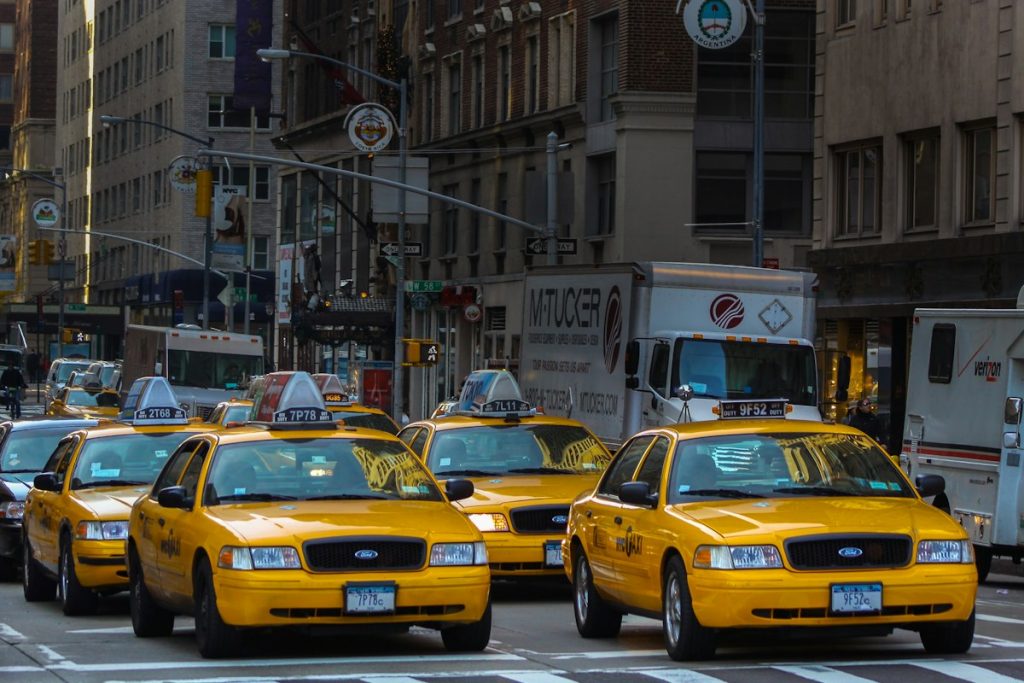
Taxi traffic in Queens concentrates around the airports, transit hubs, and commercial corridors. Yellow cabs stream along the Van Wyck Expressway and the Grand Central Parkway to and from JFK and LaGuardia. Green Boro Taxis and car-service vehicles work Jamaica Avenue, Hillside Avenue, Merrick Boulevard, Main Street in Flushing, and Roosevelt Avenue, where frequent pickups mean frequent sudden stops, lane changes, and doors opening into traffic. Each setting raises different rule questions: a rear-end on the Van Wyck turns on following distance; a pedestrian strike on Hillside Avenue turns on the driver’s duty of care under VTL §1146 and on comparative fault; a cyclist doored on Main Street raises questions about who opened the door and when. Our page on e-bike accident claims in Queens covers how those rider cases differ, and our drunk driving accident page explains the additional issues when impairment is involved.
Three Queens Landmarks and the Cab Traffic Around Them
Addisleigh Park Historic District in St. Albans
Addisleigh Park is a landmarked residential district in St. Albans, recognized by New York City for its early twentieth-century Tudor- and colonial-style houses and for the prominent jazz musicians and athletes who made their homes there. The quiet interior blocks contrast sharply with the corridors that border the area, including Linden Boulevard and Merrick Boulevard, where car-service vehicles and Boro Taxis pick up and drop off throughout the day. Crashes on those corridors often involve sudden curbside stops or turns across traffic. For anyone in St. Albans, our Rosedale office is close by, a short drive southeast.
Cunningham Park
Cunningham Park is a large wooded park in eastern Queens, spanning the Fresh Meadows and Oakland Gardens area, with tennis courts, ballfields, and trails that include a preserved stretch of the old Long Island Motor Parkway now used by cyclists and walkers. Major roads cut through and around it, including the Grand Central Parkway, the Clearview Expressway, and Francis Lewis Boulevard. Cabs heading to and from the airports frequently pass this way, and the merge points near the park can be the scene of high-speed collisions. Commercial vehicles are barred from the parkways, but taxis are not, so cab traffic on the Grand Central is constant.
The Lewis Latimer House
The Lewis Latimer House in Flushing is a museum dedicated to the nineteenth-century African American inventor and draftsman who lived in the house and contributed to early developments in electric lighting. The house is a designated New York City landmark and offers programs on science, technology, and history. It sits in a residential part of Flushing not far from the busy Northern Boulevard and Main Street corridors, where taxis, car services, and buses compete for curb space. Visitors arriving by cab should be careful when stepping out on the traffic side of the vehicle.
Directions to Our Rosedale Office from St. Albans
From the Addisleigh Park area of St. Albans, head south on Merrick Boulevard toward Laurelton. Continue to the Conduit Avenue and Belt Parkway area, then travel east toward the Cross Island Parkway interchange and follow Brookville Boulevard into Rosedale. 1 Cross Island Plaza sits just off the parkway. The map below gives turn-by-turn directions based on current traffic.

Taxi Accident Rules: Frequently Asked Questions
Does the 30-day no-fault deadline ever get extended?
The no-fault application is generally due within 30 days of the accident. Insurance regulations recognize that a late filing may be excused if there is a reasonable justification, but relying on that is risky because the insurer decides in the first instance whether your reason is acceptable. The safest course is to file within 30 days, even if you are still unsure how serious your injuries are. You can supplement information later.
If I was a pedestrian hit by a cab, whose insurance pays my medical bills?
Pedestrians struck by a vehicle generally claim no-fault benefits through that vehicle’s insurer, which means the taxi’s policy in most cases. If you or a household relative own a car, the analysis can differ, so tell us about any policies in your household. Pain and suffering, if your injury meets the serious injury threshold, is pursued separately against the driver and owner of the cab.
Does the 90-day notice rule apply to a crash with a private taxi?
Not usually. The 90-day Notice of Claim requirement generally applies to claims against the City of New York, its agencies, and many public authorities. A claim against a privately owned taxi and its driver generally follows the three-year statute of limitations. However, if a public entity shares responsibility — for example, a city vehicle was also involved — the 90-day rule applies to that part of the claim.
What counts as a “fracture” under the serious injury law?
Fracture is one of the listed categories in Insurance Law §5102(d), and it generally means a break in a bone confirmed by medical imaging. Even small or hairline fractures can qualify. Because it is objective, a fracture is often one of the more straightforward ways to meet the threshold, but the defense may still dispute whether the crash caused it, so prompt imaging and clear records matter.
Does the 2026 comparative fault change apply to my crash from last year?
The modified comparative fault rule in amended CPLR 1411 applies to motor-vehicle personal injury actions commenced on or after May 26, 2026. The key date is when the lawsuit is filed, not necessarily when the crash happened. That means timing decisions can matter, and we discuss them with clients whose cases may involve shared-fault arguments.
I was in a car-service vehicle, not a yellow cab. Are the rules different?
The core rules are the same: no-fault through the vehicle’s insurer for passengers, the serious injury threshold for pain and suffering, and the same statutes of limitations. Car-service vehicles and Boro Taxis licensed by the TLC must carry commercial insurance. What differs is how the vehicle is owned and dispatched, which affects who the defendants are and which policy responds.
Can a minor’s taxi accident claim wait until they turn 18?
New York law generally tolls, or pauses, certain limitation periods for minors, but the rules have important exceptions, and notice-of-claim deadlines against public entities are handled differently. The no-fault application deadline also still applies. Parents should not assume they can wait. We review the specific deadlines for any child’s claim as soon as possible.
What if the cab driver says I opened my door into traffic?
Disputes about dooring and exiting are common in taxi cases. New York’s rules of the road address opening vehicle doors, and the facts — where the cab stopped, whether the driver directed you out on the traffic side, and what the approaching driver could see — determine how fault is allocated. Witnesses and video are especially valuable in these situations.
Do I need to report the crash to the TLC?
Reporting to police and, if you were a driver, filing an MV-104 with the DMV are the key reporting steps. The TLC regulates licensed drivers and vehicles, and information about the vehicle’s license can help identify the owner and insurer. What matters most for your claim is getting the vehicle number, driver information, and police report details at the scene if you can.
What if my injury seems minor now?
Some injuries, especially to the neck, back, and joints, worsen over days or weeks. File your no-fault application within 30 days regardless and get evaluated promptly. If symptoms persist, follow-up testing may reveal a condition that meets the serious injury definition. An early, consistent medical record protects you either way.
Get Precise Answers From a Taxi Accident Lawyer in Queens
The rules after a cab crash are not intuitive, and the earliest deadlines are the least forgiving. A Taxi Accident Lawyer in Queens can tell you exactly which clocks are running in your situation, which insurer owes what, and what proof your claim will need. If your crash happened closer to the Nassau border, our Bellerose taxi accident page covers that area, and our frequently asked questions page answers broader questions about injury claims.
Call Yakov Mushiyev & Associates, P.C. at 718.775.3110 or reach our Rosedale office online. We will review what happened and walk you through every deadline that applies.
Related reading: Taxi Accident Lawyer in Queens: how claims are paid and valued.
General information, not legal advice. Attorney Advertising. Prior results do not guarantee a similar outcome.