
A Lyft ride through Forest Hills usually feels unremarkable in the best sense: you tap a button outside the 71st Avenue station or on a quiet block south of Austin Street, a car arrives within minutes, and you settle in expecting to be home before the next train. When that ride ends in a collision, the ease of the app gives way to questions few people have had reason to ask, beginning with whose insurance is responsible and what the injured rider must do first.
Yakov Mushiyev & Associates, P.C. is a Queens personal injury firm, and this page is written for anyone looking for a Lyft accident lawyer in Forest Hills who wants accurate answers before deciding what to do. We explain how New York City treats Lyft vehicles differently from the rest of the state, how your role in the crash shapes the claim, what evidence lives inside the app, and how the 2026 changes to New York injury law affect a case filed today. To speak with someone directly, call 718.775.3110; consultations are free and available in English, Russian and Spanish.
A Lyft Car in Queens Is a Licensed For-Hire Vehicle
Outside the five boroughs, people tend to picture Lyft as a private driver in a personal car. Inside New York City that picture is wrong. Every Lyft car operating here is licensed by the NYC Taxi and Limousine Commission as a for-hire vehicle: the driver must hold a TLC driver license, the car carries TLC plates, and the vehicle must be covered by commercial for-hire insurance. That status decides which insurance rules govern your case, and treating a Queens Boulevard Lyft crash like an ordinary collision between two private cars can send an injured rider to the wrong insurer just as the deadlines begin to run.
Who Pays When a Forest Hills Lyft Ride Goes Wrong
New York is a no-fault state: your first layer of benefits, Personal Injury Protection or PIP, pays medical treatment, lost earnings and other basic economic loss regardless of who caused the crash, under Insurance Law § 5102. The state minimum for a private car is $50,000 per person. TLC-licensed vehicles, including Lyft cars, carry a higher requirement, which was reduced this year under a TLC rule implementing Local Law 90 of 2025. Where the trip begins matters as much as where it ends:
| Coverage question | Lyft trip starting in New York City | Lyft trip starting outside the city (for example, in Nassau) |
|---|---|---|
| Which rules apply | TLC insurance minimums for for-hire vehicles | New York State rideshare (transportation network company) rules |
| Liability minimum | $100,000 per person / $300,000 per occurrence (vehicles with fewer than 8 seats) | $1.25 million while a passenger is aboard, under the state rule that applies outside NYC |
| No-fault (PIP) | $100,000 per person since March 1, 2026 | Set under the state framework |
| Extra coverage | Lyft may carry coverage above the minimums on some trips; whether it applies, and how much, must be confirmed from the insurer and the trip record | Confirmed from the policy and trip record |
The larger state figure quoted in national rideshare articles does not govern a ride that begins in Forest Hills, because the state rideshare law exempts cities of one million or more people and leaves New York City to the TLC. Crashes before March 1, 2026 may still fall under the PIP coverage then in force. And when another driver caused the crash and carries little insurance, your own supplementary uninsured/underinsured motorist (SUM) coverage, or a household relative’s, can become important; the Department of Financial Services explains these coverages.
Where You Were Sitting, Standing or Driving Changes the Claim
Riding as a Lyft passenger
A passenger generally claims no-fault benefits from the vehicle he or she occupied, so the application goes to the Lyft car’s commercial insurer. A rider’s own fault is rarely an issue; the usual disputes concern which policy applies and whether the injury is serious enough to sue.
Walking or cycling when a Lyft car hit you
Pedestrians and cyclists generally claim PIP from the vehicle that struck them. These are also the claims where the 2026 fault rule bites hardest, because insurers often argue that someone on foot or on a bike moved into traffic.
Driving the other car, or driving for Lyft
A motorist struck by a Lyft driver usually receives no-fault benefits through his or her own policy and may sue the Lyft driver and owner, with any shared fault examined closely. Lyft drivers hurt on the job are generally covered for their own work injuries through the New York Black Car Fund, which is separate from any passenger’s claim.
The Lyft Evidence Worth Preserving Tonight
- The ride receipt and trip ID. Screenshot the in-app receipt with start and end times and the route.
- The driver’s name and plate as shown in the app. Compare them with the TLC plate on the car.
- The driver’s status. Whether the app was off, waiting for a request, en route to a pickup or carrying a passenger can affect which coverage applies.
- An in-app safety report. Report the crash in the Lyft app as well as to police.
- The app itself. Do not delete it; the trip history may be needed later.
- Scene photos and witnesses. Capture vehicle positions, signals, storefronts and anyone who stopped to help.
What 2026 Changed for Every Lyft Accident Attorney in New York
No-fault pays economic loss, but not pain and suffering. To recover those damages you must show a “serious injury,” and the 2026 state budget (Chapter 58, Part EE) removed the former time-based category, leaving eight in Insurance Law § 5102(d): death; dismemberment; significant disfigurement; fracture; loss of a fetus; permanent loss of use of a body organ, member, function or system; permanent consequential limitation of use of a body organ or member; and significant limitation of use of a body function or system.
Insurance Law § 5104 now requires the fact-finder to decide fault before serious injury. For motor-vehicle injury lawsuits commenced on or after May 26, 2026, new CPLR 1411(b) bars recovery for a claimant whose fault is greater than the defendant’s (or defendants’ combined), and reduces the award proportionally for a claimant 50% or less at fault. The rule turns on the filing date, not the crash date (DFS Circular Letter 2026-01).
For a Lyft passenger, fault is rarely the battleground. For the pedestrian, the cyclist and the other driver, the 2026 fault cutoff can decide whether there is any recovery at all.
A new § 5104(d) also caps non-economic damages at $100,000 for an at-fault claimant who was driving uninsured (with a narrow exception for a short lapse that was not the claimant’s responsibility), was convicted of impaired driving, or was convicted of a felony committed while driving. It does not limit economic damages, other people’s claims or wrongful death claims.
Deadlines That Run From the Day of the Crash
- 30 days to file the no-fault application with the Lyft car’s insurer (11 NYCRR 65-1.1).
- 90 days to serve a notice of claim if a City or MTA vehicle was involved (General Municipal Law § 50-e).
- 2 years for a wrongful death action (EPTL 5-4.1), still limited to pecuniary damages.
- 3 years for a personal injury lawsuit under CPLR 214(5).
Where Lyft Pickups Turn Hazardous in Forest Hills
Forest Hills places a major arterial, a busy subway hub, a commuter rail station and narrow residential streets within a few blocks of one another, and Lyft drivers move constantly between all four.
- Queens Boulevard service roads. Drivers pull over for riders near the Forest Hills–71st Avenue station (E, F, M, R) while other cars cut across from the main lanes to turn right.
- Austin Street and 71st Avenue. Double-parked deliveries and shoppers stepping between cars make sudden stops and door strikes a real risk.
- Station Square and the LIRR. When trains arrive, waves of riders look for their cars at once on streets never designed for curbside traffic.
- Woodhaven and Yellowstone Boulevards. Wide, fast roads where a driver hunting for a pickup pin may turn abruptly.
- Grand Central and Jackie Robinson Parkways. Higher-speed routes at the edges, used on trips toward the airports and Brooklyn.
Forest Hills Gardens and Forest Hills Stadium: Arrivals, Departures and the Curb
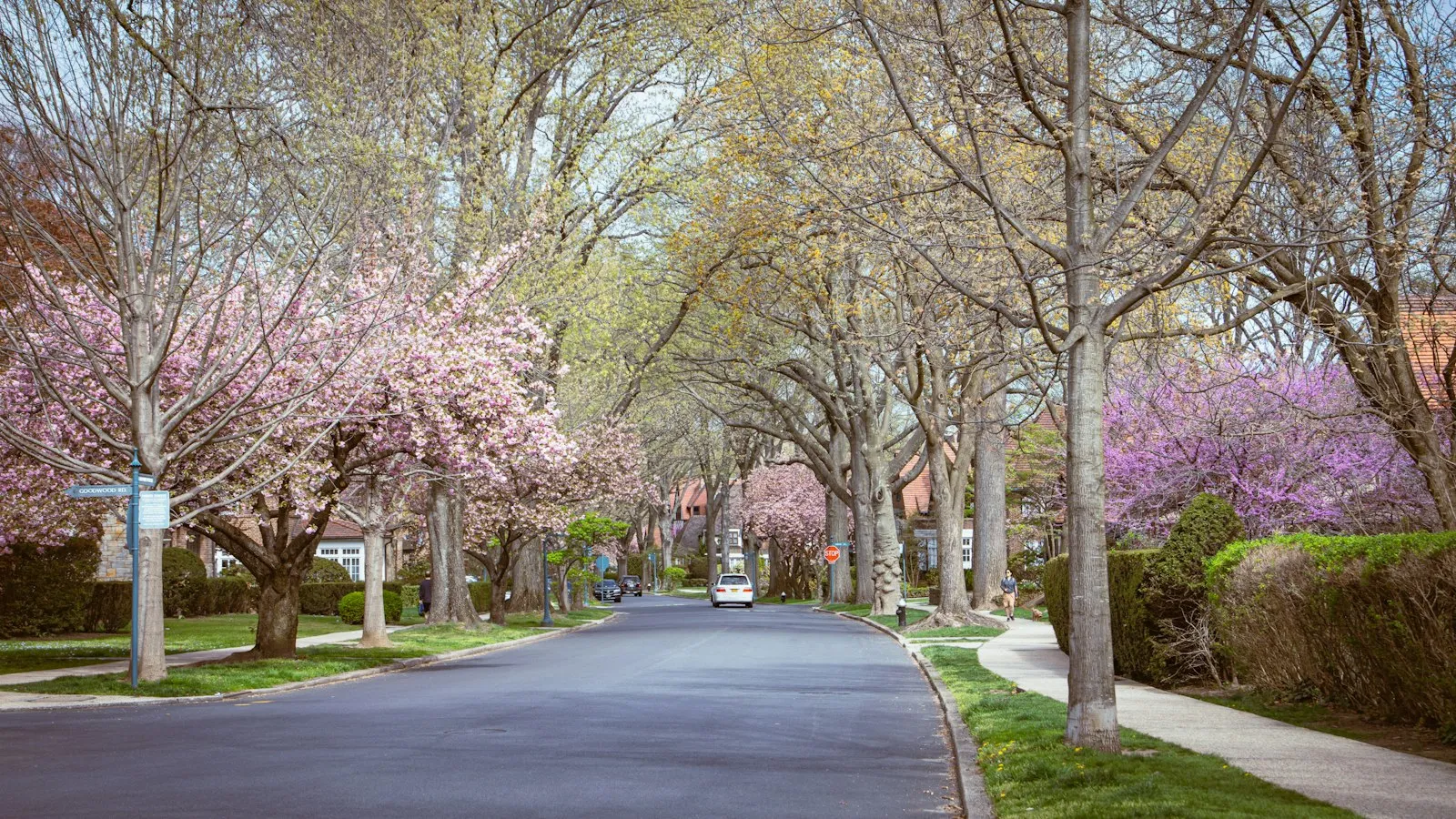
Forest Hills Gardens is the planned community south of the Long Island Rail Road tracks, known for its Tudor-style homes, curving privately maintained streets and Station Square, its front door. Visitors come to walk the streets, admire the architecture and dine around Station Square and Austin Street. Within the Gardens stands Forest Hills Stadium, the historic tennis venue of the West Side Tennis Club, once home to the U.S. national championships and now a major outdoor concert venue.
Together they create a distinctive Lyft rhythm. Before a show, drop-offs concentrate along Queens Boulevard, Austin Street and the approaches to Station Square, because the Gardens’ narrow streets leave little room to stop. Afterward the pattern reverses at once: crowds leave together, many opening the app at the same moment, while drivers circle, stop short for a waving passenger and attempt U-turns. If you were hurt in that setting, note where your driver stopped, whether staff or police were directing traffic, and whether you were already in the car or still walking toward it, since that detail can decide whose coverage applies.
Our companion guide explains what to screenshot and save after a Lyft accident in Forest Hills. Hurt in a yellow or green cab instead? See our Forest Hills taxi accident page.
Why Forest Hills Riders Choose Mushiyev Law
A Lyft case is rarely difficult because the law is obscure; it is difficult because the facts are scattered across an app, a TLC file, several insurers and a medical record still being written. As a Lyft accident lawyer in Queens, we gather those pieces methodically: we meet clients at home, in the hospital or by video in English, Russian or Spanish; file the no-fault application on time; request trip records, police reports and nearby video before they are lost; and identify every available policy, including your own SUM coverage. There is no fee unless we win.
Learn more on our car accident practice page, our FAQ page and the Forest Hills accident lawyer hub. We also handle Lyft crashes in neighboring Rego Park and Kew Gardens.

Lyft Accident FAQs
How much no-fault coverage does a Lyft car carry?
TLC-licensed vehicles, including Lyft cars, must carry PIP of $100,000 per person since March 1, 2026. Earlier crashes may fall under the policy then in force.
Can I sue Lyft directly?
Claims typically run against the at-fault driver and the vehicle’s owner and their insurers. Whether additional Lyft coverage applies to your trip must be confirmed from the insurer and trip record.
Another driver hit my Lyft. Whose insurance handles my claim?
As a passenger, you file for no-fault with the Lyft car’s insurer. A lawsuit may run against the other driver, the Lyft driver or both, depending on fault.
My driver was between rides. Does that change anything?
It can. The driver’s app status is one of the facts we confirm from the records, because it may affect which coverage responds.
What if I share some of the blame?
For lawsuits filed on or after May 26, 2026, a claimant more at fault than the defendants recovers nothing; at 50% or less, the award is reduced by that share. No-fault benefits are not reduced by fault.
About Forest Hills: Local FAQs
How do most people reach Forest Hills without driving?
The E, F, M and R trains stop at Forest Hills–71st Avenue, the E and F also stop at 75th Avenue, and the LIRR serves Forest Hills station at Station Square.
Where is the closest emergency care?
Long Island Jewish Forest Hills, part of Northwell Health, is in the neighborhood. In an emergency, call 911 and go where paramedics take you.
Where would a Forest Hills Lyft lawsuit be heard?
Forest Hills is in Queens County, so a case would typically be filed in Queens County Supreme Court in Jamaica; see the New York State courts website.
What areas surround Forest Hills?
Rego Park lies to the north, Kew Gardens to the east, Middle Village and Glendale to the west, and Forest Park to the south. Most of the neighborhood uses ZIP code 11375.
Where should I ask a Lyft driver to stop near Austin Street?
Choose a legal curb on a side street rather than a travel lane, exit on the curb side, and buckle up even for a few blocks. On concert nights, walk a short distance from the densest crowd before requesting.
Speak With a Forest Hills Lyft Accident Lawyer Today
Whether you were a passenger on Queens Boulevard, a pedestrian near Station Square or a driver struck by a Lyft car on Yellowstone Boulevard, we will listen, explain your options and tell you candidly what we think. Call 718.775.3110 (phone intake 24/7) or reach us through our contact page. Our office is at 1 Cross Island Plaza, Suite 325, Rosedale, NY 11422, open Monday through Friday, 9 to 6, with home, hospital and video visits throughout Queens. The case review is free.
Attorney Advertising. This is general information about New York law, not legal advice, and reading it does not create an attorney-client relationship. Every case depends on its own facts. Prior results do not guarantee a similar outcome.