
“Car accident” describes one kind of crash. “Motor vehicle accident” describes dozens: a bus that sideswipes a sedan on Woodhaven Boulevard, a tractor-trailer that drifts across lanes on the Van Wyck, a motorcycle struck by a left-turning SUV, a yellow cab rear-ended on Northern Boulevard, a moped hit at a Jamaica intersection. As a motor vehicle accident lawyer in Queens, Yakov Mushiyev & Associates, P.C. handles all of them, and the most useful thing we can tell you is how your kind of crash differs from the ordinary two-car collision most people picture. Different vehicles bring different insurance, different deadlines and different evidence.
Who We Are: A Motor Vehicle Accident Lawyer in Queens for Every Kind of Vehicle
Our firm is based at 1 Cross Island Plaza in Rosedale, at the southeastern corner of the borough, and we represent people injured in collisions involving cars, buses, commercial trucks, motorcycles, taxis, rideshare vehicles, mopeds and e-bikes. What ties those cases together is a set of New York rules that apply to motor vehicles generally. What separates them is everything layered on top: federal trucking regulations, municipal notice requirements, gaps in no-fault coverage, and commercial insurance arrangements.
When a new client calls, the first question we ask is not “how did it happen?” but “what was involved?” The answer tells us which deadlines are already running and which records we need to request immediately. From there we build the claim: identifying insurers, preserving evidence, coordinating medical documentation, and handling negotiations or litigation. You can learn more about our approach on our firm overview page, and our general personal injury FAQ answers common questions about working with a lawyer.
This page is built as a comparison. We start with the baseline, an ordinary car-versus-car crash, and then walk through each vehicle type and explain what changes.
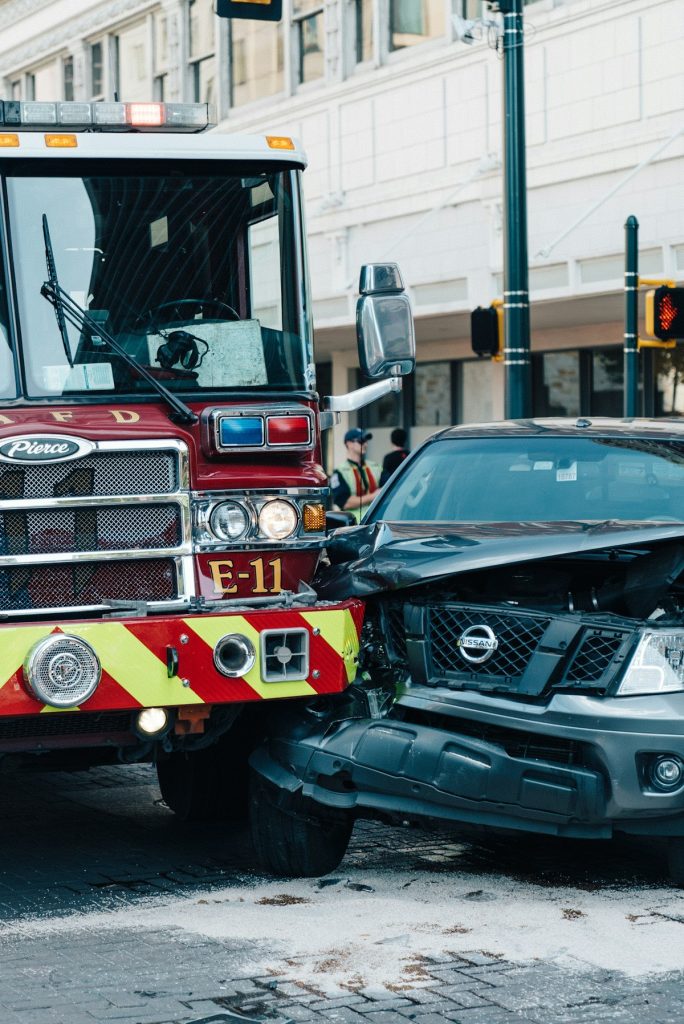
The Baseline: How an Ordinary Two-Car Crash Works
To compare anything, you need a reference point. In a typical collision between two privately insured passenger cars in Queens, the claim follows a familiar path:
- No-fault first. Each injured occupant applies, generally within 30 days, for no-fault benefits through the policy on the car they were in. Those benefits cover basic economic loss up to $50,000 per person: medical expenses, 80% of lost earnings up to $2,000 a month, and up to $25 a day in other reasonable expenses.
- Threshold for pain and suffering. To sue the at-fault driver for non-economic damages, the injured person must show a “serious injury” under Insurance Law §5102(d), such as a fracture or a significant or permanent consequential limitation.
- Fault by percentage. Responsibility is divided by comparative fault, with the 2026 changes discussed below.
- Owner responsibility. Under Vehicle and Traffic Law §388, the owner of the at-fault car is generally liable for a permissive driver’s negligence.
- Three-year deadline. The lawsuit must generally be filed within three years under CPLR 214(5).
- Paperwork. Drivers file DMV form MV-104 within 10 days if anyone was injured or killed or property damage exceeds $1,000.
Hold that baseline in mind. Every section below describes a departure from it.
At a Glance: How Each Vehicle Type Changes the Case
| Vehicle involved | What changes compared with a car-vs-car crash |
|---|---|
| MTA bus or city vehicle | Notice of Claim generally within 90 days; lawsuit generally within 1 year and 90 days; possible 50-h hearing. |
| Commercial truck | Federal safety rules, corporate defendants, higher insurance minimums for interstate carriers, and electronic records that must be preserved quickly. |
| Motorcycle | Motorcycle operators and passengers are not covered by New York no-fault, so medical bills follow a different path. |
| Taxi or rideshare | TLC-licensed vehicles must carry commercial insurance; passengers usually start with no-fault from the vehicle’s policy. |
| Hit-and-run or uninsured | MVAIC and your own SUM coverage may replace the missing insurer, with strict notice rules. |
| E-bike, e-scooter or moped | Separate legal categories and speed rules; coverage depends on the vehicles and policies involved. |
Buses and City Vehicles Compared With Ordinary Crashes
The difference: the clock is much shorter. In an ordinary crash, three years feels like plenty of time. When the other vehicle belongs to New York City or one of its agencies, or to many public authorities, you generally must serve a formal Notice of Claim within 90 days under General Municipal Law §50-e. For NYC Transit buses, Public Authorities Law §1212 sets similar notice requirements. The lawsuit itself is generally due within 1 year and 90 days.
City vehicles include more than police cars. A DSNY sanitation truck backing out of a side street in Queens Village, or a city agency van on Merrick Boulevard, can bring these rules into play. MTA buses fall under transit authority rules, and the 90-day notice is the key warning.
The other difference: the pre-suit hearing. After receiving your notice, the city or authority may demand a 50-h hearing, a sworn examination about the accident and your injuries. In an ordinary car case, the first time you testify is usually a deposition well into the lawsuit. Here, it can come within months.
What stays the same: If you were in a car hit by a bus, your no-fault benefits generally still come from the policy on your own car. The serious injury threshold still applies to pain and suffering claims.
Commercial Trucks Compared With Passenger Cars
The difference: a second rulebook. Private drivers answer to the Vehicle and Traffic Law. Interstate commercial truck drivers also answer to the Federal Motor Carrier Safety Administration. Its hours-of-service rules for property-carrying drivers limit driving to 11 hours after 10 consecutive hours off duty, confine driving to a 14-hour on-duty window, and require a 30-minute break after 8 hours of driving. Compliance is tracked with electronic logging devices (ELDs). A violation can be powerful evidence of fatigue.
The difference: more defendants and more insurance. In an ordinary crash, there is usually one driver and one owner. In a truck case, the driver, the motor carrier, the owner of the tractor, the owner of the trailer, the shipper or loader, and a maintenance company may all play a role. Federal rules require interstate general freight carriers to carry at least $750,000 in liability coverage, with higher minimums for hazardous materials.
The difference: evidence that lives in computers. Engine control modules, ELD data, dashcam video, maintenance and inspection records, and driver qualification files can be decisive. Because some of that data can be overwritten or discarded in the ordinary course of business, we send preservation (spoliation) letters as early as possible.
A Queens-specific wrinkle: commercial vehicles are banned from New York parkways, including the Grand Central, the Cross Island, the Belt and the Jackie Robinson. A truck on a parkway is already breaking the rules, and low overpasses on those roads have caused bridge strikes. Trucks belong on routes like the Van Wyck, the Long Island Expressway, the BQE and designated truck routes. Our page for a commercial truck accident lawyer in Queens goes deeper into these cases.
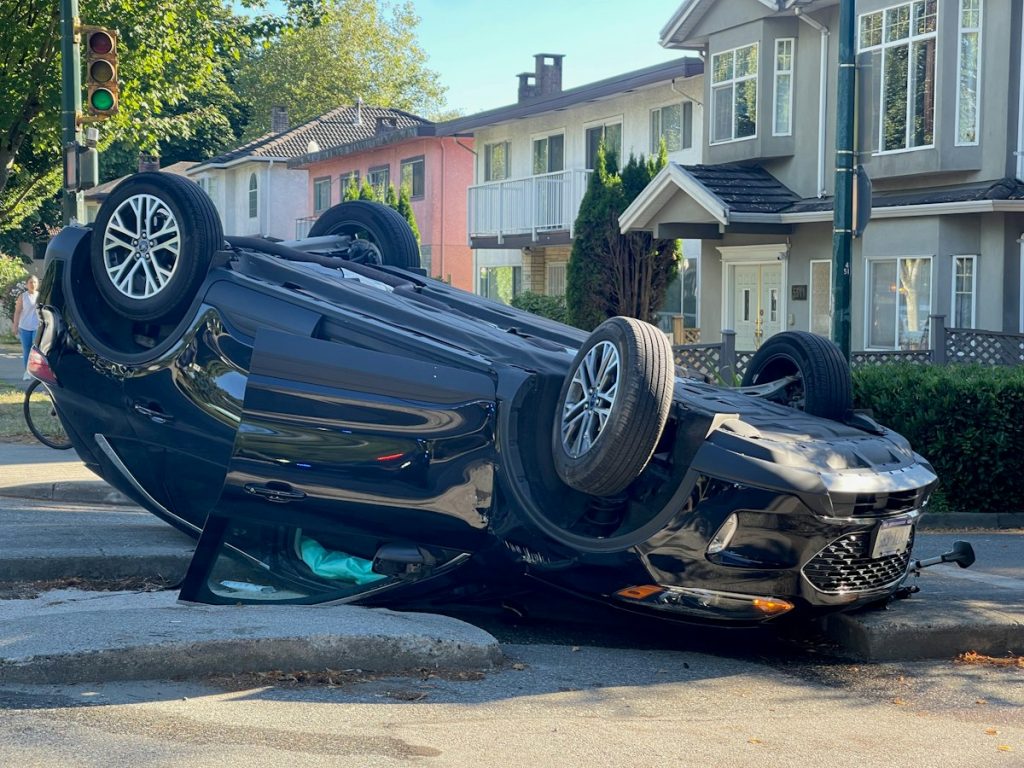
Motorcycles Compared With Cars: The No-Fault Gap
The difference: no no-fault safety net. This is the single biggest distinction on this page. New York’s no-fault system does not cover motorcycle operators or passengers. In an ordinary car crash, your medical bills are paid quickly by no-fault regardless of fault. After a motorcycle crash, those bills generally have to be paid through health insurance, any optional coverage on your own policy, and ultimately a claim against the at-fault driver.
That gap makes the fault-based claim more urgent and more important. It also makes evidence more important, because riders often face an unfair assumption that they were speeding or weaving. Crash reconstruction, video and witness statements can counter that bias. Left-turning cars that fail to see an oncoming rider are a well-known danger for motorcyclists.
What stays the same: the three-year statute of limitations, comparative fault, and the owner liability rules for the vehicle that hit you. Because the way the serious injury rules interact with a motorcycle claim can be technical, it is worth having a lawyer review the specific facts.
Taxis and Rideshare Vehicles Compared With Private Cars
The difference: commercial licensing and insurance. Yellow cabs, green cabs and Uber and Lyft drivers in New York City are licensed by the NYC Taxi and Limousine Commission and must carry commercial insurance. A private car may carry only basic personal coverage; a TLC vehicle is held to a different standard.
What stays similar: if you were a passenger, your medical bills usually start with no-fault benefits from the vehicle’s policy, just as they would if you were riding with a friend. Pain and suffering claims still require meeting the serious injury threshold, and fault still drives the claim against whichever driver caused the crash, which may be the TLC driver, another motorist, or both. Our page for an Uber passenger accident lawyer in Queens walks through those layers in detail.
Hit-and-Run and Uninsured Drivers Compared With an Insured Crash
The difference: there is no other insurer to call. In the baseline crash, the at-fault driver’s bodily injury coverage is the target of the pain and suffering claim. When the driver fled or had no insurance, that target disappears. Leaving the scene is itself a violation of Vehicle and Traffic Law §600, but that does not pay your bills.
Two substitutes may fill the gap. Your own SUM coverage (supplementary uninsured/underinsured motorist coverage) may apply. And when no other coverage is available, the Motor Vehicle Accident Indemnification Corporation (MVAIC) may provide benefits. Both come with strict notice requirements, including a police report and timely written notice. The practical lesson: report a hit-and-run to police immediately, and act on insurance notices as soon as possible.
E-Bikes, E-Scooters and Mopeds Compared With Cars
The difference: separate legal categories. Class 1 through 3 e-bikes and e-scooters are legal in New York under Vehicle and Traffic Law Articles 34-C and 34-D, subject to their own rules. New York City set a 15 mph speed limit for e-bikes and e-scooters taking effect in late 2025; the city’s e-bike guidance explains the categories. Mopeds, also called limited-use motorcycles, must be registered and insured.
The difference: coverage is case-specific. In an ordinary car crash, the coverage map is predictable. In a crash involving an e-bike, scooter or moped, which policies apply, and whether no-fault is available, depends on the vehicles involved and the policies in place. If a car struck the rider, the car’s insurance is usually the first place to look, but the answer depends on the facts.
What Stays Constant Across Every Motor Vehicle Case
For all the differences above, several rules apply to virtually every motor vehicle crash in Queens. Knowing them gives you a stable foundation, whatever vehicle hit you.
The serious injury threshold
Whether the other vehicle was a sedan, a bus or a box truck, a claim for pain and suffering arising from a motor vehicle accident generally runs through the serious injury definition in Insurance Law §5102(d). Economic losses above no-fault can be pursued regardless.
Comparative fault and the 2026 change
2026 update: For motor-vehicle personal injury actions commenced on or after May 26, 2026, CPLR 1411 applies modified comparative fault: a claimant whose fault exceeds the defendants’ combined fault (more than 50%) recovers nothing, and a claimant at 50% or less has recovery reduced by their share. The same legislation removed the “90/180-day” category from the serious injury definition. Because these changes are tied to motor-vehicle actions, they apply across cars, buses, trucks and other motor vehicles alike; non-motor-vehicle cases remain under pure comparative fault.
Owner responsibility
Vehicle and Traffic Law §388 generally makes owners liable for the negligence of permissive drivers. In commercial cases, employer liability may add another layer.
Prompt medical care and documentation
In every type of case, consistent medical treatment builds the evidence that insurers and courts rely on. A gap in care is one of the most common arguments used to reduce a claim, regardless of the vehicle involved.
For a step-by-step version of these rules, organized as a checklist from the scene to the courthouse, see our blog guide on what to do after a motor vehicle accident in Queens. If you were hurt by a driver who fled, our Queens hit-and-run accident page covers MVAIC in more depth.
Three Queens Landmarks, Three Different Traffic Pictures
Keeping with the comparative theme, here are three well-known Queens destinations whose surroundings show how different the borough’s traffic environments can be.
The Queens Zoo
The Queens Zoo sits inside Flushing Meadows Corona Park in Corona, not far from the Unisphere and the New York Hall of Science. It is a compact zoo focused largely on animals of the Americas, popular with families and school groups. Its surroundings illustrate the mixed-vehicle environment of central Queens: the park is ringed by the Grand Central Parkway, the Long Island Expressway and the Van Wyck, while local streets nearby carry buses, delivery trucks and heavy pedestrian traffic. Because commercial vehicles are barred from the parkway, trucks funnel onto the expressways and local arterials around the park, where families on foot cross to the entrances.
Jacob Riis Park
Jacob Riis Park, on the Rockaway Peninsula, is part of the Gateway National Recreation Area and is known for its broad beach and historic Art Deco bathhouse. On summer weekends, traffic to the park builds on Flatbush Avenue and across the Marine Parkway–Gil Hodges Memorial Bridge, and on Cross Bay Boulevard from central Queens. That traffic mixes beachgoers’ cars with buses, motorcycles enjoying the shore roads and cyclists. Crash conditions on the way to the beach range from slow-speed rear-end collisions in congestion to higher-speed crashes on open stretches, and a single trip can involve almost every vehicle type on this page.
Kissena Park
Kissena Park in Flushing features a lake, walking paths, a historic tree grove and the Kissena Velodrome, a cycling track built in the 1960s that still hosts races. The park sits among residential streets near Kissena Boulevard and Rose Avenue, a short distance from the busy commercial heart of downtown Flushing. Here the traffic picture is smaller-scale: cyclists heading to the velodrome, e-bike delivery riders, school traffic and local buses. It is a reminder that the vehicle types with the least protection, bicycles, e-bikes and pedestrians, are often the ones most seriously hurt in neighborhood crashes.
Directions to Our Rosedale Office from the Queens Zoo
From the Queens Zoo in Flushing Meadows Corona Park, get on the Van Wyck Expressway southbound, which runs along the eastern side of the park. Follow it south toward JFK Airport, then take the Belt Parkway east toward Long Island. Our office at 1 Cross Island Plaza, Suite 325, is in Rosedale near the junction of the Belt and Cross Island Parkways; take the Rosedale exits and use the map below for the last few turns. Allow about 20 to 30 minutes outside peak hours.
Comparing Your Situation: Frequently Asked Questions
Do the same deadlines apply no matter which vehicle hit me?
No, and this is where the differences matter most. The general three-year statute of limitations covers most crashes between private vehicles. But if a city-owned vehicle, an MTA bus or another public authority’s vehicle was involved, a Notice of Claim is generally due within 90 days and the lawsuit within 1 year and 90 days. No-fault applications are generally due within 30 days, and MVAIC and SUM claims carry their own prompt notice requirements. Identify the vehicle owner early so you know which clock applies.
An MTA bus hit my car. Whose insurance pays my medical bills?
As an occupant of a private car, you generally start with no-fault benefits through the policy on your own vehicle, the same as in a car-versus-car crash. The difference is on the fault side: a claim for pain and suffering or excess economic loss against the transit authority requires a timely Notice of Claim, generally within 90 days. Do not let the familiar no-fault process lull you into missing that much shorter deadline for the bus claim.
Does the serious injury threshold apply if I was hit by a truck instead of a car?
Generally, yes. The threshold in Insurance Law §5102(d) applies to personal injury claims arising from motor vehicle accidents, and commercial trucks are motor vehicles. What changes in a truck case is usually the severity of injuries, the number of potential defendants and the amount of insurance available, not the threshold itself. Economic losses above no-fault, such as substantial lost earnings, can be pursued regardless of whether the threshold is met.
Are trucks allowed on the Belt Parkway or the Cross Island Parkway?
No. Commercial vehicles are banned from New York parkways, including the Belt, the Cross Island, the Grand Central and the Jackie Robinson. Trucks are supposed to use expressways like the Van Wyck and the Long Island Expressway and designated truck routes. If a commercial truck was on a parkway when it caused your crash, that fact can support a negligence claim against the driver and potentially the carrier, and it should be documented in photos and the police report.
I was riding my motorcycle. Who pays for my hospital bills?
Because New York no-fault does not cover motorcycle operators or passengers, your health insurance is often the first source of payment, along with any optional medical coverage on your own motorcycle policy. Ultimately, those costs can be part of your claim against the at-fault driver. Keep every bill and explanation of benefits. Health plans that pay crash-related bills may later seek repayment from any recovery, so it helps to track payments from the start.
Are e-bikes and mopeds treated the same way under the law?
No. Class 1 through 3 e-bikes and e-scooters are legal in New York under their own rules, and New York City set a 15 mph speed limit for them in late 2025. Mopeds, also known as limited-use motorcycles, must be registered and insured. These distinctions affect which rules a rider was required to follow and which insurance may be available after a crash. Coverage depends on the specific vehicles involved and the policies in place, so each case needs individual review.
Is a taxi crash handled differently from a crash with a private car?
Partly. Yellow cabs and other TLC-licensed vehicles must carry commercial insurance, and the driver’s licensing and trip records may become evidence. For passengers, the starting point is similar: no-fault benefits usually come from the vehicle’s policy. Claims for pain and suffering still depend on the serious injury threshold and on who was at fault, which could be the cab driver, another motorist, or both. Note the medallion or vehicle number and take a photo of the driver’s TLC license if you can.
In a multi-vehicle pileup, can more than one driver be responsible?
Yes. Chain-reaction crashes on the Van Wyck or the Long Island Expressway often involve several drivers, each of whom may bear a share of fault. Rear-end presumptions apply to each impact in the chain, but the details, such as whether a car was pushed forward or struck the car ahead on its own, matter a great deal. Comparative fault divides responsibility by percentage, and each at-fault driver’s insurance may contribute to the recovery.
Does the 2026 comparative fault change apply to bus and truck crashes?
The 2026 changes apply to motor-vehicle personal injury actions commenced on or after May 26, 2026. Buses and trucks are motor vehicles, so those cases fall within the change: a claimant more than 50% at fault recovers nothing, and a claimant at 50% or less has recovery reduced by their share. If your crash happened earlier but the lawsuit had not yet been filed by that date, timing can matter, so ask a lawyer how the rule affects your case.
What if the vehicle that hit me was registered outside New York?
Out-of-state vehicles are common in Queens, especially on routes to the airports and bridges. A crash in New York is generally governed by New York’s traffic rules, but which policy responds, and how, can depend on where the vehicle is insured, so the coverage questions deserve a careful look. Your no-fault benefits still typically come through the policy on the vehicle you occupied. Collect the other driver’s full insurance information, plate and state at the scene.
Talk to a Motor Vehicle Accident Lawyer in Queens About Your Crash
Whatever was involved, a bus, a truck, a motorcycle, a cab or an e-bike, the differences can change your deadlines and your recovery. A motor vehicle accident lawyer in Queens can sort out which rules apply to your case and act on them quickly. Call Yakov Mushiyev & Associates, P.C. at 718.775.3110 or reach our Rosedale office through the contact page. Residents near the city line may also find our page for a motor vehicle accident lawyer in Bellerose helpful.
Related reading: Motor Vehicle Accident Lawyer in Queens: a ten-step checklist from the scene to the courthouse.
General information, not legal advice. Attorney Advertising. Prior results do not guarantee a similar outcome.